

Walk into any well-stocked wine shop in America this spring and you will notice something different about the familiar stretch of French and Italian reds. The bottles are still there, the labels unchanged, but the prices have moved. A reliable $18 Côtes du Rhône now sits closer to $27. That dependable $30 Chianti Classico has crept past $40. The cause is no mystery: a 15 percent tariff on European wines has landed, and the three-tier distribution system amplifies every percentage point by the time a bottle reaches the shelf. For the curious drinker scanning the aisle for something that still tastes like good value, the answer may already be one section over, where Portuguese red wines have been quietly earning the respect of sommeliers for the better part of two decades.
Portugal has long occupied a peculiar position in the American wine imagination. Port, the fortified dessert wine, is familiar enough. Vinho Verde, the light, slightly fizzy white, has carved out a summer niche. But Portuguese red wines, produced from a gene pool of more than 250 indigenous grape varieties across strikingly diverse terrain, remain one of the most underappreciated categories on the market. That is changing, and the tariff environment has accelerated what was already an inevitable correction.
The Douro: Where Port Meets Dry Red
The numbers suggest a country on the cusp. Portugal’s Instituto da Vinha e do Vinho has set a target of one billion euros in wine exports for 2026, a milestone that would cap a generation-long modernization effort that began when the country joined the European Union in 1986. In February, 18 Portuguese wines were selected for the World’s Best Sommeliers’ Selection 2026; all eight of the reds came from a single region, the Douro. And on American wine lists, Portuguese red wines are appearing with increasing frequency, not as curiosities but as by-the-glass pours and sommelier recommendations positioned squarely against Bordeaux and the Rhône.
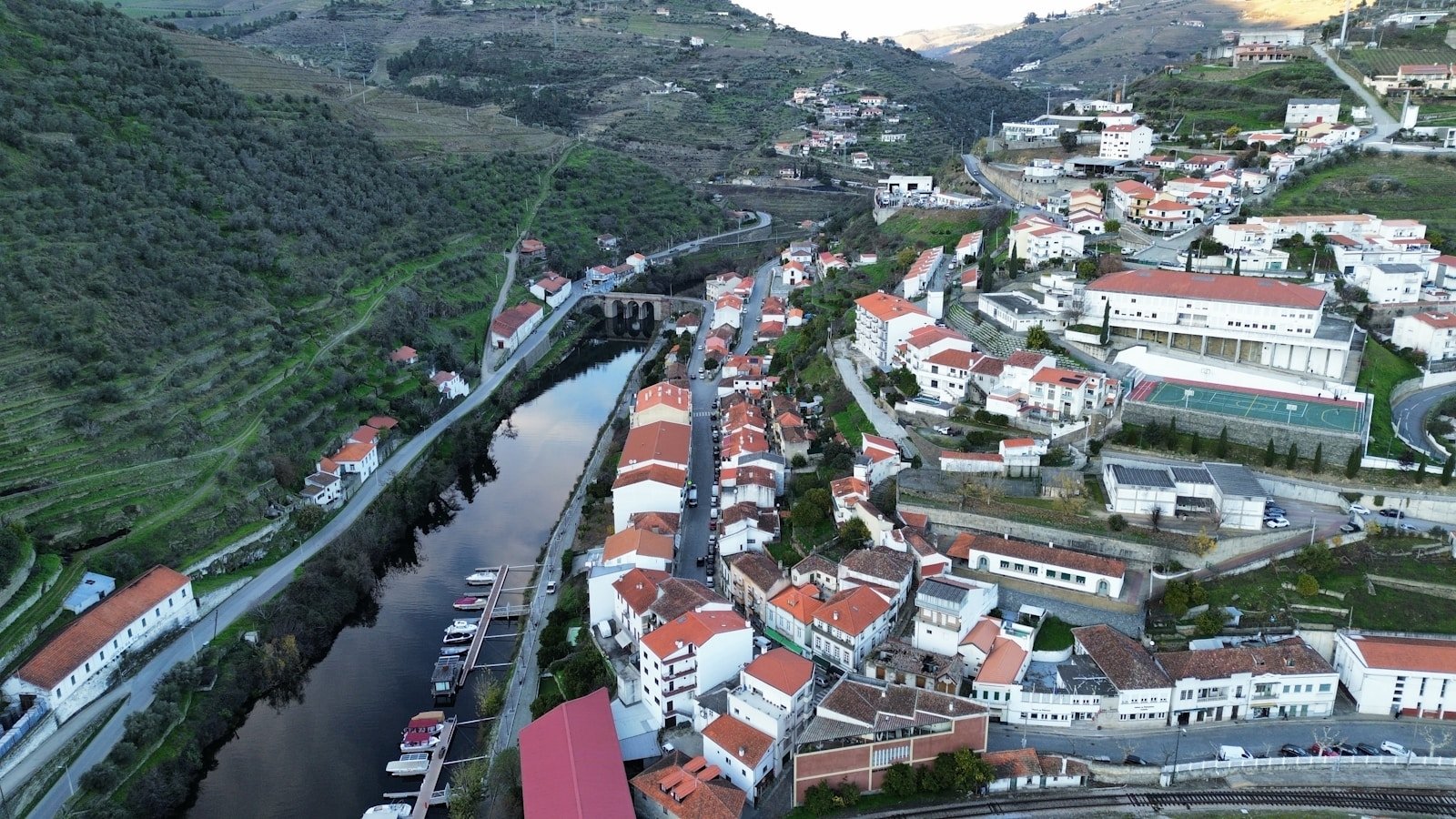
The Douro Valley is where the conversation begins. The same terraced schist slopes that produced the exceptional 2024 vintage yield dry red wines of remarkable depth and complexity. Touriga Nacional, the country’s most celebrated variety, delivers palate-coating layers of blueberry, plum, and bittersweet cocoa laced with floral notes of violet and a subtle, stimulating hint of mint. Touriga Franca adds aromatic intensity. Tinta Roriz, known elsewhere as Tempranillo, contributes structure and spice. Blended together across the Douro’s dramatic landscape of steep hillsides and ancient terraces, these grapes produce wines that can hold their own against bottles costing three or four times as much. An everyday Douro red runs $10 to $15. A serious, age-worthy bottling from a top estate sits around $50, a price point that in Bordeaux buys you a competent Cru Bourgeois at best.
The Dão and Beyond
South of the Douro, the Dão offers something different entirely. Where the Douro trades in power and density, the Dão speaks in a quieter register. Surrounded by granite mountains that shield vineyards from Atlantic storms and continental heat alike, the region produces reds with a Burgundian sense of restraint: structured, floral, and built for the long term. Touriga Nacional takes on a different character here, more perfumed and less overtly muscular, with a fine-grained tannic architecture that rewards patience. Wine experts increasingly cite the Dão as Portugal’s most exciting region for collectors, a place where terroir is not a marketing term but a geological fact written in granite and altitude.
Beyond these two flagships, Portugal’s viticultural map unfolds with startling variety. Lisboa’s coastal vineyards, cooled by Atlantic breezes, produce reds with bright acidity and saline minerality. The sun-drenched plains of the Alentejo deliver fruit-forward blends built on Trincadeira and Aragonez that offer immediate pleasure at gentle prices. And in Bairrada, the indigenous Baga grape, with its fierce acidity and assertive tannins, draws comparisons to Nebbiolo: a challenging variety in the wrong hands, a revelatory one in the right ones.
The Value Equation
What unites these regions is not a single style but a shared inheritance: grapes that exist nowhere else on earth, shaped by millennia of adaptation to specific soils and microclimates. This is not a country producing Cabernet Sauvignon and Merlot in Portuguese packaging. It is a country whose viticultural identity is genuinely, irreducibly its own. For a wine market saturated with familiar international varieties, that distinctiveness is itself a form of value.
The arithmetic, meanwhile, is not subtle. A Dão Touriga Nacional with the elegance and complexity of a good village Burgundy can be found for $18 to $25. A Douro blend that drinks like a $40 northern Rhône sits on the shelf at $12 to $15. Even as tariffs compress the margins on French and Italian imports, Portugal’s lower baseline prices and strong domestic production capacity leave its wines better positioned to absorb the pressure without punishing the consumer.
Portugal does not need trade policy to make its case. The wines have been waiting, built on ancient soils and indigenous vines, for the kind of attention that France and Italy have long taken for granted. The tariffs simply removed the last excuse not to look. For the drinker willing to reach past the familiar, the reward is not a compromise. It is a country that has been quietly producing some of the most compelling Portuguese red wines on the market, and a glass that leaves you wondering why it took you so long to find it.
The next one arrives Thursday.
Vintage intelligence, producer profiles, and curated cellar picks — before the critics weigh in. Weekly dispatch.