

The Atlas > Asia > China
China
A nation discovering its own wine traditions at continental scale, with Ningxia emerging as Asia’s finest fine-wine frontier
3
·
785K ha
·
2nd
·
1980s
VARIETIES
Cabernet Sauvignon · Merlot · Marselan
When the imperial envoy Zhang Qian returned from the Western Regions in 138 BC, the goods he carried became legend: silk, horses, and according to Han Dynasty chronicles, the vine itself. Yet the story of viticulture in China diverges sharply from what those cuttings would become in Mesopotamia or Rome. Grapes arrived at an imperial court where grain-based spirits already commanded the ritual ground, where wine would never achieve the fusion of ceremony and commerce as it did elsewhere. For two millennia, vitis vinifera in China remained a curiosity, an agricultural oddity, never the civilizing force it became in Europe. History, it seemed, had chosen a different path for the Chinese vine.
That path stayed unresolved until 1980, when the French spirits house Rémy Martin established the first Sino-foreign joint venture approved by the Chinese government: Dynasty Wine in Tianjin. It was a transaction characteristic of the early reform era—foreign expertise in exchange for market access. For three decades, the arrangement held: international companies trained Chinese hands, bulk wine accumulated, and the market absorbed what it produced. The moment that changed was small and specific. In 2011, a Cabernet blend called Jia Bei Lan Grand Reserve from a small Ningxia estate called Helan Qingxue won the Decanter World Wine Awards International Trophy, defeating entries from classified Bordeaux estates themselves. The award was not loud, but its consequence was permanent. Within a single vintage, a regional winery had entered the international conversation at its highest level. For Chinese wine, the timeline shifted.
Between Imitation and Invention
China’s 785,000 hectares of vineyards represent the world’s second-largest area by land, a statistic that obscures the industry’s true structure. Approximately 90 percent of those vines produce table grapes, not wine. The wine fraction is small, younger, and almost entirely trained in European models. A generation of Chinese winemakers studied in Bordeaux, Burgundy, and Napa before returning home to apply those lessons: Cabernet Sauvignon, Merlot, Bordeaux blends, the inherited canon. Yet the winemakers now building China’s reputation understand something their teachers did not: the continental terroirs of Ningxia, the extreme aridity of Xinjiang, the high-altitude elegance of Yunnan operate under conditions that European viticulture was not designed to solve. The tension is not pedagogical but geographic. Helan Qingxue’s 2011 victory was achieved precisely because the winery had learned to calibrate Bordeaux-style ambition to continental terroir. The question now facing the entire industry is whether that calibration leads to mastery of Bordeaux methods, or to something else entirely.
In 2013, Ningxia’s regional government announced a classification system modeled explicitly on Bordeaux’s 1855 structure: five tiers, with evaluation criteria including production quality, distribution reach, and estate-bottling standards. Wineries designated as “First Growth” face reassessment every decade, a deliberate signal of permanence and aspiration. Simultaneously, international investors moved in. LVMH acquired and developed Ao Yun, a Yunnan estate at 2,200-2,600 meters elevation. It released its 2013 vintage in 2016 and became, in 2022, the first Chinese wine distributed through Bordeaux’s official négociant system. Pernod Ricard established a wholly-owned Ningxia operation, Pernod Ricard Winemakers Co., investing in Helan Mountain branded wines and signaling long-term commitment to the region. These moves revealed a paradox. China has the vineyard area to rival Spain or France, the capital to hire the best winemakers, and Marselan, a grape covering approximately 4,000 hectares across the country and expressing distinct terroir characteristics by region. What it does not yet have, in volume, is the market to absorb fine wine at premium prices. The industry’s expansion is constrained not by ambition or land, but by the cultural shift required to convert baijiu drinkers (a spirit accounting for over 70 percent of China’s spirit consumption) into wine collectors.
What the Land Already Knows
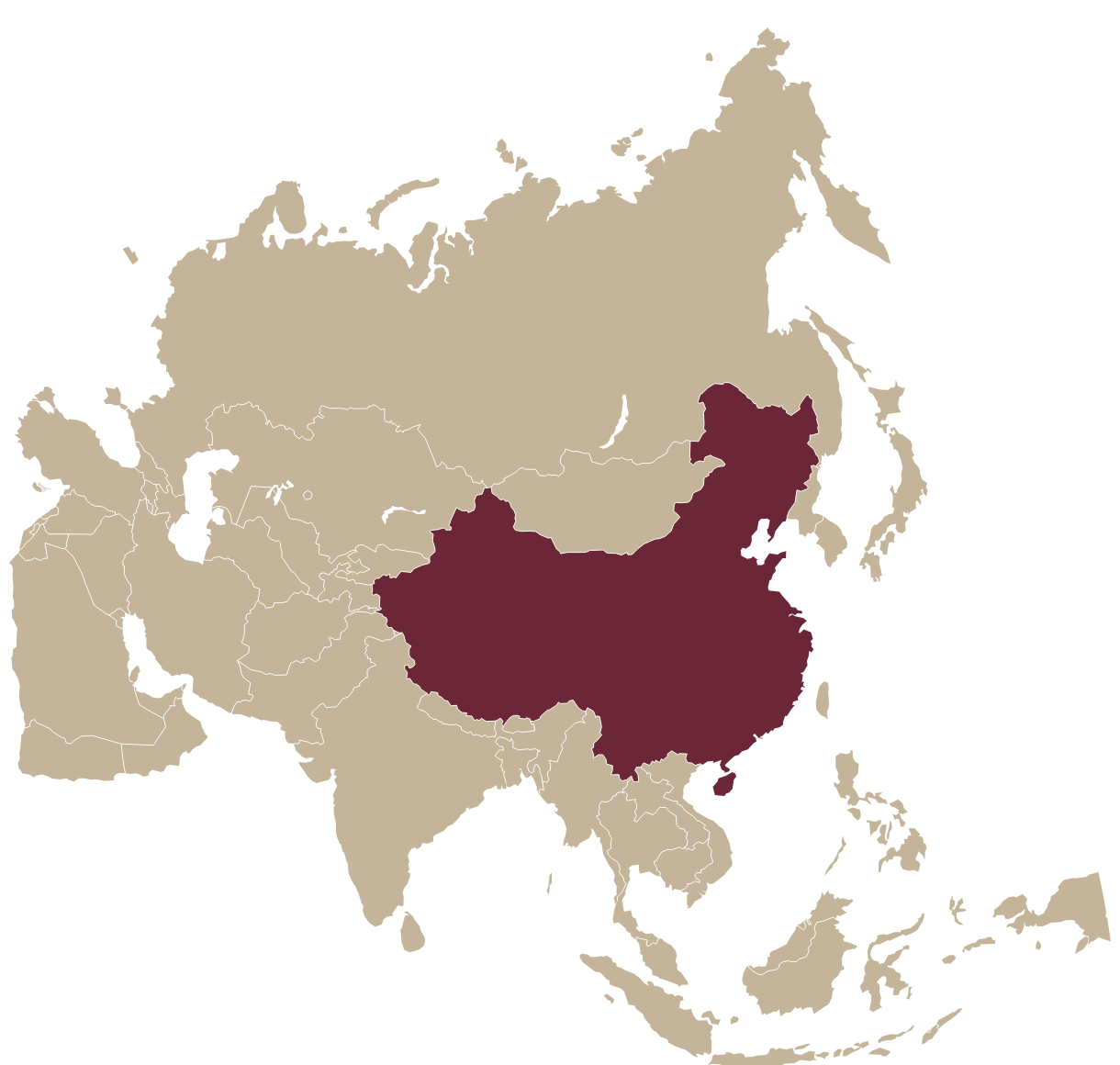
Ningxia sits at the foot of the Helan Mountains, in the northwest, with calcareous soils, a continental climate, and summers hot enough to ripen Cabernet Sauvignon and Marselan with mineral precision and controlled alcohol. Xinjiang occupies the high-desert Silk Road corridor at the far west, where 2,700 hours of annual sunshine, sandy and gravel-rich soils, and dramatic diurnal temperature swings produce wines of density and dark fruit; however, winter temperatures drop to -20°C and require vine burial to survive. Yunnan sits at the edge of the Tibetan Plateau in the subtropical southwest, where volcanic soils and altitudes above 2,200 meters create the opposite condition: cool nights, extended growing seasons, low disease pressure, and wines of aromatic subtlety and freshness. These three regions share nothing except a Chinese passport. The winemakers who have chosen them (Lin Gao and Emma Gao at Silver Heights in Ningxia, trained in Bordeaux; CK Chan at Grace Vineyard in Shanxi, advised by Bordeaux enologist Denis Boubals; the international team assembled at Ao Yun) have each come to the same recognition: the land is not asking to be imitated. It is asking to be read.
The winemakers now defining China’s fine wine ambition belong to a generation with no precedent. They are building a wine culture where one never coalesced, in a society where baijiu commands ritual authority and where a fast-growing affluent consumer class is engaging with wine with the hunger it brings to every luxury category. They are working at a scale and speed European winemakers would recognize as reckless: international trophy within a decade, government classification within two, multinational investment and Bordeaux distribution within fifteen years. Yet Ningxia’s rise from obscurity to destination for serious collectors suggests the timeline is not reckless—it may simply be accurate. China’s wine regions do not require another century of apprenticeship. Ningxia, Xinjiang, and Yunnan are ready now. The question is whether collectors outside China recognize the magnitude of what is being built before the wines themselves make the argument inevitable.
“There is no need to simply make a Bordeaux when one can buy Bordeaux elsewhere. China must make something new.”
— Li Demei, Decanter China
The Regions
Three regions define China’s emerging fine-wine landscape—each testing the proposition that continental Asian terroir can produce wines of international consequence, and each writing chapters in a wine narrative that remains largely unknown to global collectors.
Premier
Ningxia →
Every autumn, workers bury Ningxia’s vines to survive −25°C winters. Every spring, they dig them out. This is winemaking as endurance, Cabernet Sauvignon as metaphor for Chinese ambition.
Cabernet Sauvignon · Merlot · Cabernet Franc · Marselan
Emerging
Xinjiang →
China’s high-desert frontier where permafrost refrigerates and ambition rewrites terroir. Xinjiang is continental extremism as winemaking philosophy.
Cabernet Sauvignon · Merlot · Riesling · Marselan
Emerging
Yunnan →
High-altitude monsoon tropics where native Vitis Davidii meets Cabernet ambition. Yunnan is wine’s final frontier—lush, experimental, wholly undiscovered.
Cabernet Sauvignon · Merlot · Vitis Davidii · Riesling
Last updated: April 2026
Related Stories
TERROIR’s coverage of Chinese wine.
The next one arrives Thursday.
Vintage intelligence, producer profiles, and curated cellar picks — before the critics weigh in. Weekly dispatch.