

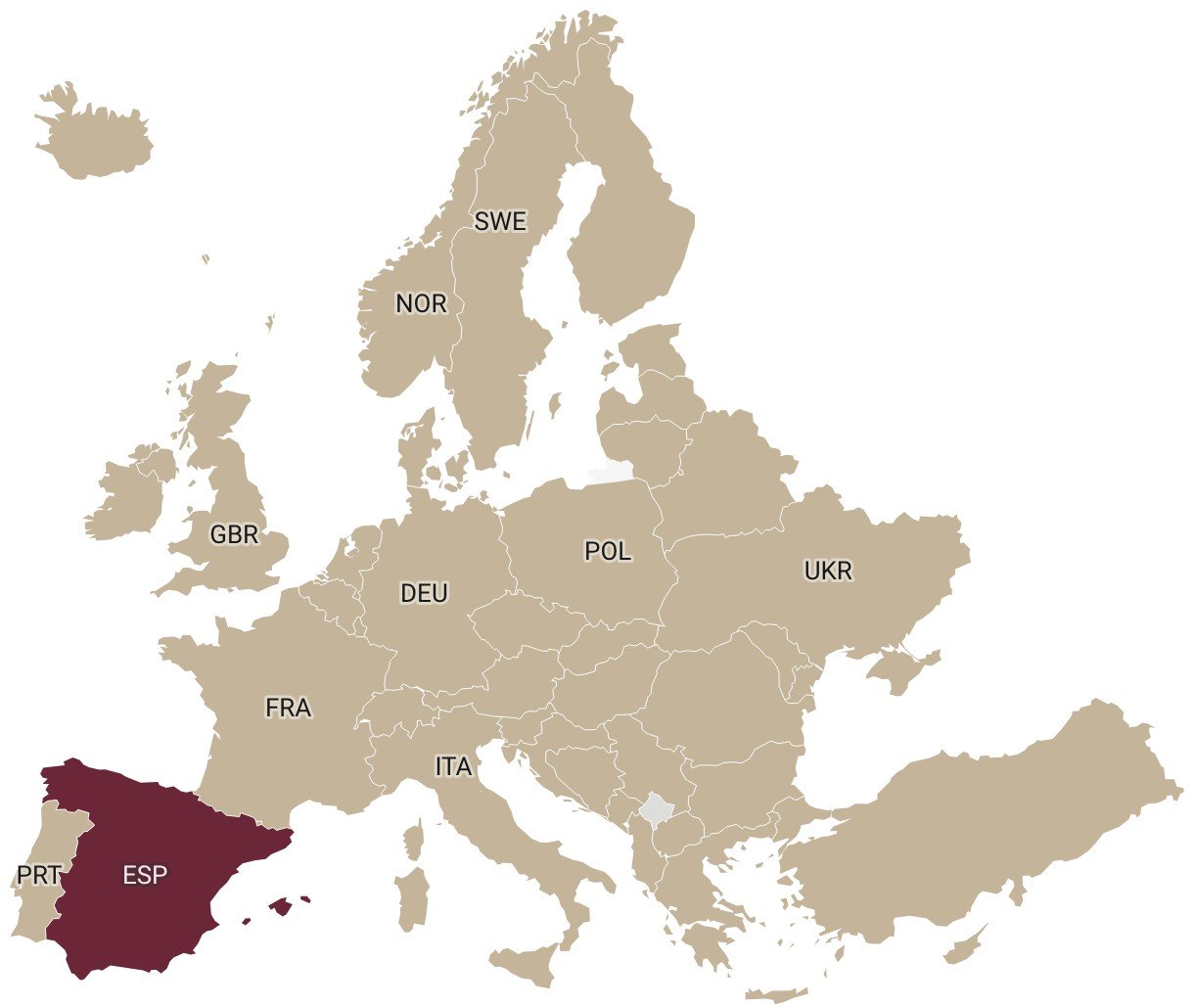
Spain
A vast land of dramatic landscapes and distinctive wines, from austere high plateaus to sun-baked sherry country.
70+
·
3rd
·
961K ha
·
500+
VARIETIES
Tempranillo · Garnacha · Albariño · Verdejo · Palomino
Spain holds the largest vineyard area on Earth — nearly a million hectares of vine stretching across a landmass so varied it contains almost every climate Europe can offer. Yet for most of the twentieth century, that staggering acreage produced bulk wine sold by the tanker, not the bottle. The transformation began in the 1980s, when a generation of winemakers returned from studies in Bordeaux and Burgundy determined to prove that Tempranillo could rival Cabernet Sauvignon, that Garnacha deserved the same reverence as Grenache in the Rhône, and that the ancient Palomino vineyards of Jerez held a sherry tradition unmatched anywhere on the planet. Within two decades Spain had reinvented itself from Europe’s wine lake into one of its most exciting fine-wine frontiers.
What defines Spanish wine today is altitude and aridity. The Meseta Central — the vast interior plateau — sits at 600 to 700 metres, giving vines punishing temperature swings that concentrate flavour in ways lowland vineyards cannot replicate. Spain’s Denominación de Origen system now recognises more than 70 appellations, with two elevated to the top-tier DOCa status: Rioja in 1991 and Priorat in 2009. Production is dominated by red varieties — Tempranillo alone accounts for roughly a fifth of all plantings — but the surge in quality white and sparkling wine from regions like Rías Baixas, Rueda, and Penedès has redrawn the map of what Spain means to the global wine drinker.
The productive tension in Spanish wine is between its established icons and its restless diversity. Rioja and Ribera del Duero command global recognition and premium prices, yet some of the country’s most thrilling bottles now emerge from forgotten corners — old-vine Garnacha in Gredos, volcanic Listán Negro in the Canary Islands, mineral Godello in Valdeorras. Meanwhile, Jerez guards a sherry tradition that predates every other European fortified wine, and Galicia’s Albariño has become the white-wine discovery of a generation. Spain’s internal contradiction — ancient terroir, revolutionary ambition — is precisely what makes it the most dynamic wine country in Europe today.
“Spain is an anarchic jumble of districts and regions, just as its landscape is an anarchic jumble of staggeringly raw scenery, and has to be treated as such by the wine enthusiast. There is real treasure to be found by those prepared to dig.”
— Jancis Robinson, The Oxford Companion to Wine
The Regions
From the Atlantic coast of Galicia to the sun-baked plains of La Mancha, Spain’s wine regions span every imaginable terroir. Explore the appellations shaping Spanish wine today.
Rioja →
Spain’s most celebrated wine region, where Tempranillo reaches its most elegant expression. A classification overhaul in 2017 introduced single-vineyard bottlings that finally reward terroir over blending.
Tempranillo · Garnacha · Graciano · Viura
Ribera del Duero →
The Duero plateau at 800 metres produces Tempranillo of fierce concentration and tannic structure. Vega Sicilia set the standard; a new generation of garage producers now challenges it.
Tempranillo · Cabernet Sauvignon · Merlot · Malbec
Priorat →
Llicorella slate soils and old-vine Garnacha on terraced hillsides created Spain’s fastest ascent to DOCa status. Tiny yields, volcanic intensity, and prices to match Burgundy’s ambitions.
Garnacha · Cariñena · Cabernet Sauvignon · Syrah
Rías Baixas →
Galicia’s Atlantic coast delivers Spain’s most distinctive white wine. Albariño grown on granite pergola-trained vines produces a salinity and tension that red-dominated Spain never saw coming.
Albariño · Treixadura · Loureiro · Caiño Blanco
Jerez (Sherry) →
The oldest continuously produced wine style in Europe, guarded by the solera system and the albariza chalk that makes Palomino transcendent. Overlooked for a generation, now undergoing a critical renaissance.
Palomino · Pedro Ximénez · Moscatel
Last updated: April 2026
Related Stories
The latest from TERROIR on Spanish wine, producers, and regions.
The next one arrives Thursday.
Vintage intelligence, producer profiles, and curated cellar picks — before the critics weigh in. Weekly dispatch.