

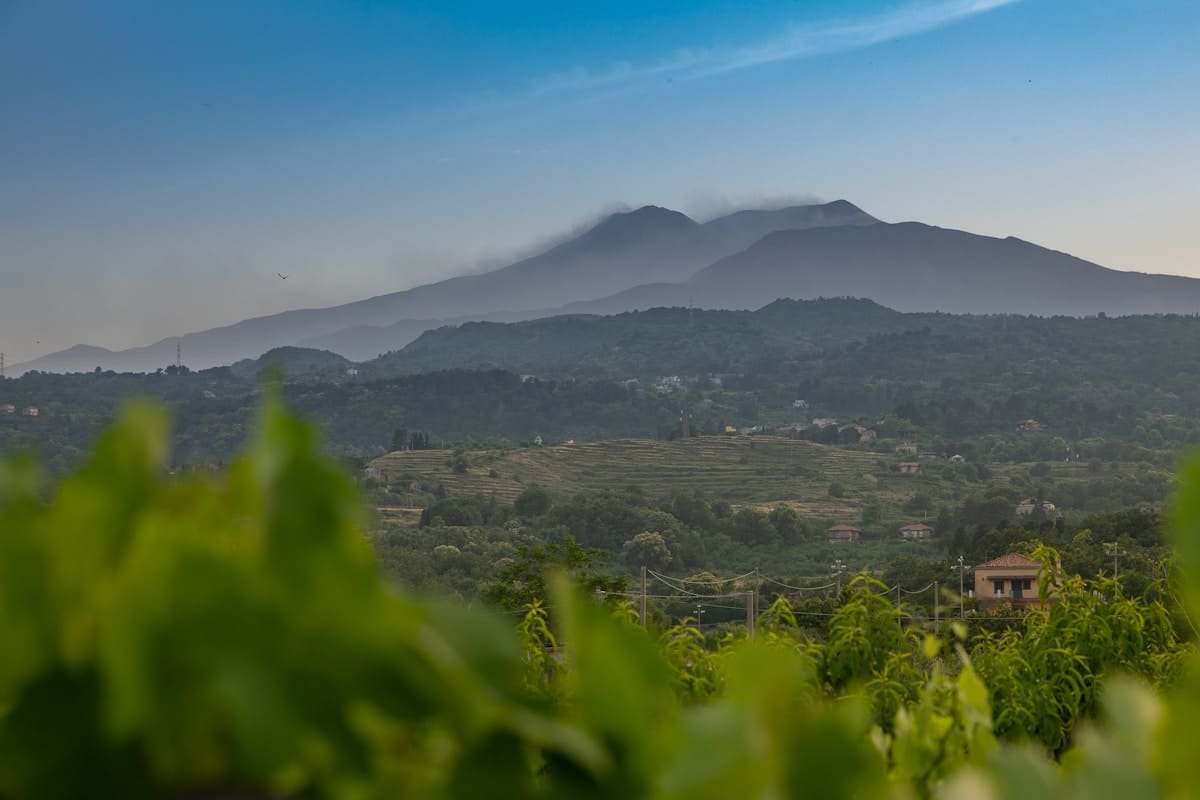
The soil is black. Not the dark loam of river valleys, but the powdered remains of a volcano that has been remaking itself for more than half a million years. Stand on the north slope of Mount Etna at seven hundred meters — where Nerello Mascalese vines twist low against the wind — and you can feel it underfoot: ground that was liquid rock within living memory, now crumbling into something that feeds one of the most compelling wine revolutions in the Mediterranean, built around an Etna contrada system with no precedent in the south of Italy.
A generation ago, this was bulk wine territory. Etna’s DOC, established in 1968, was a formality printed on labels few outside Sicily bothered to read. Today, the volcano’s wines draw comparisons to Burgundy — not for their flavor, which belongs entirely to this place, but for the precision with which a new generation maps terroir to individual vineyard sites. The instrument of that precision is the Etna contrada system — 133 districts first codified in 2011, with nine more mapped in 2022 to bring the total to 142 — each tied to a distinct lava flow, each producing wines that differ dramatically from a neighbor a few hundred meters away. It is, by any measure, among the most ambitious vineyard classifications in Italian wine.
A Volcano in Three Acts
The modern story unfolds in three movements. From the DOC’s founding through the late 1990s, Etna was a footnote — ancient vines and crumbling palmento structures, the traditional lava stone buildings where farmers had made wine for centuries. The volcano’s sandy soils proved inhospitable to phylloxera, the pest that devastated European vineyards in the nineteenth century, so many old vines remain ungrafted — their roots drawing directly from volcanic earth, a living thread to a viticultural past most of Europe lost over a century ago.
The second act began when outsiders arrived. Andrea Franchetti came from Tuscany in 2000 and founded Passopisciaro, among the first estates to bottle wines from individual contrade. Marc de Grazia, an American-Italian wine merchant, established Tenuta delle Terre Nere in 2001 and became the most insistent voice arguing that each Etna contrada deserved the same attention as Burgundy’s individual climat. Alberto Graci followed in 2004; Planeta, Sicily’s most prominent wine family, entered in 2008. Where near-zero quality-focused producers had existed, more than 150 wineries now operate on the volcano’s slopes.
The third act belongs to a younger generation — winemakers like Federico Graziani and Girolamo Russo — whose philosophy rejects both global trends and local stereotypes. Where the second wave proved Etna could produce serious wine, the third wave defines what serious Etna wine should taste like: restrained rather than extracted, transparent rather than powerful, shaped by the specific contrada rather than by the winemaker’s hand.
Reading the Volcano
Mount Etna is Europe’s tallest and most active volcano, a UNESCO World Heritage Site since 2013. Each eruption sends lava down a different path, and each flow, as it cools and weathers, creates distinct soil — varying concentrations of basalt, pumice, and volcanic ash that mineralize at different rates. The result is not one terroir but hundreds, layered like geological strata in a library of eruptions.
Altitude compounds the variation. Vineyards range from roughly three hundred to over a thousand meters above sea level, with a sweet spot between six hundred and nine hundred meters, where extreme diurnal temperature swings — scorching days yielding to cold mountain nights — produce wines with bright acidity and striking aromatic intensity. The volcano’s four slopes add another axis of difference: the north face, centered around Randazzo and Castiglione di Sicilia, is the most celebrated for reds; the east slope, anchored by the town of Milo, is the spiritual home of Carricante, Etna’s great white grape; the southeast and southwest offer warmer, earlier-ripening conditions that shape a different style altogether.
Two Grapes, One Volcano
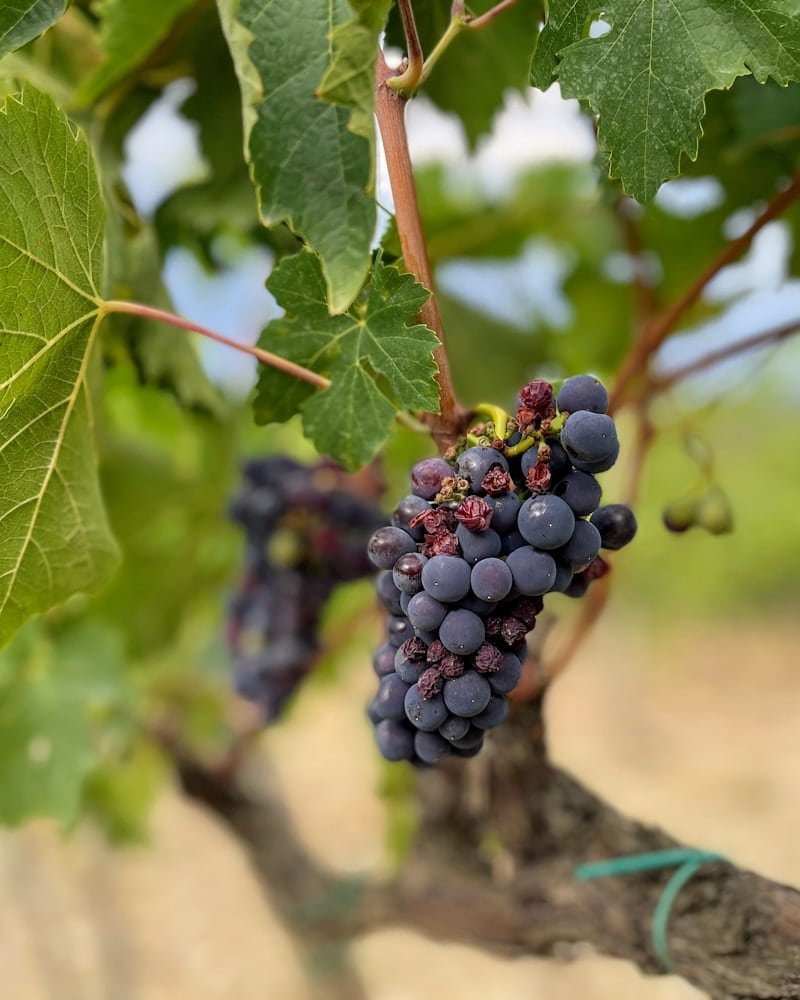
Two indigenous varieties define Etna. Nerello Mascalese is the soul of Etna Rosso, required at a minimum of eighty percent in the blend, with Nerello Cappuccio — a softer, darker variety — permitted up to twenty percent. Critics reach for comparisons to Pinot Noir and Nebbiolo: the pale garnet color, the aromatic complexity, the almost unsettling transparency that lets you taste the specific patch of earth where the grapes grew. But Nerello Mascalese is neither of those grapes — it is a native speaker of volcanic terroir, so responsive to site-specific differences that blending across districts would blur precisely what makes Etna compelling.
Carricante is its white counterpart — the primary grape of Etna Bianco, high in acidity, mineral-driven, capable of gaining complexity over years in bottle. From Milo, it has become the benchmark for what volcanic white wine can be.
What the Volcano Writes Next
Etna stands at the edge of its most significant classification change since the DOC was established. The Consorzio has applied for DOCG status — Italy’s highest wine designation — and if approved, the new classification could debut with the 2026 harvest. The proposed rules would formalize minimum aging requirements, vine age thresholds for contrada-designated bottlings, and yield limits for specific contrade.
For the drinker, the practical news: Etna remains accessible. Entry-level Rosso and Bianco start around fifteen to twenty-five dollars. Contrada-specific bottlings occupy the twenty-five to fifty dollar range, where terroir differences become vivid. And at the top, single-contrada wines command fifty to one hundred dollars or more — serious prices for wines that increasingly justify them.
The volcano is still erupting. The vines grow in its shadow regardless — ungrafted, rooted in ground that was molten rock within memory, producing wines that exist nowhere else on earth. The next time an Etna contrada name appears on a label, it is worth knowing that it means something specific: that someone mapped this patch of lava and decided that this place — not the winemaker, not the vintage — is the story worth telling.
The next one arrives Thursday.
Vintage intelligence, producer profiles, and curated cellar picks — before the critics weigh in. Weekly dispatch.