

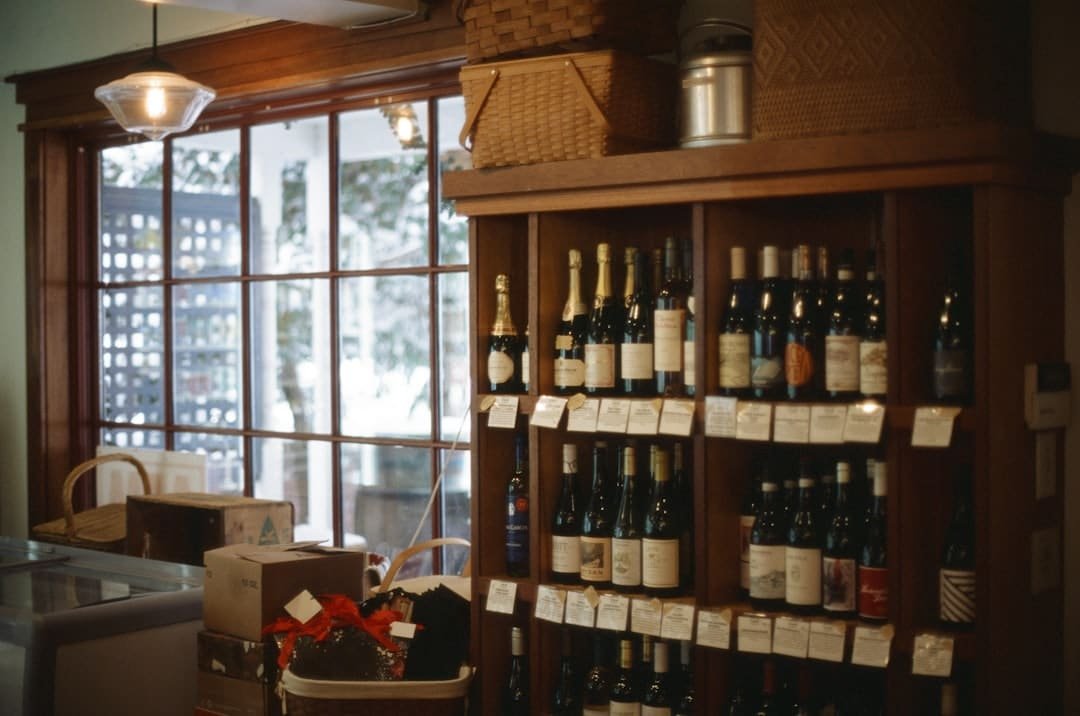
The bottle of Chianti Classico used to cost eighteen dollars. It was the kind of wine you reached for without thinking — a Tuesday night pasta wine, reliable as the corkscrew in the drawer. Now the sticker reads twenty-seven dollars, and the retailer across the counter is doing the math for you before you ask. It’s the tariffs, he says. You glance at a California Sangiovese on the next shelf — twelve dollars, decent reviews — and something stops you. It is not stubbornness, exactly. It is the memory of how the Chianti tasted last October, with the tomato sauce and the cold night coming in through the window, and the knowledge that wine tariffs have rewritten the math on something you love. You buy the Chianti anyway. Or you walk out empty-handed.
This is the story that trade policy tells at the retail level — not in spreadsheets and tariff schedules, but in the small decisions of people standing in wine shops, recalculating what they are willing to pay for something they love. The wine tariffs now imposed on European wines entering the United States — currently 15% on most imports, with the threat of far worse — are more than a line item in customs filings. They are reshaping what Americans drink, how the wine industry operates, and in ways that few consumers will ever see on a label, what goes into the bottle itself.
A Euro at the Border, Three Dollars on the Shelf
The most important number in the tariff conversation is not the tariff rate. It is the multiplier.
When a 15% tariff is levied on a bottle of wine at the US border, that cost does not simply add 15% to the retail price. It enters America’s three-tier distribution system — the importer-distributor-retailer chain established after Prohibition to regulate alcohol sales — and each tier takes its standard margin on the now-higher base cost. The tariff compounds at every stage. A recent National Bureau of Economic Research study found that for every $1.19 in tariff revenue collected by the government, consumers paid $1.59 in higher prices. The cost to the consumer exceeds the revenue to the treasury.
The mechanics are not complicated, but they are relentless. An importer pays the tariff and marks up the landed cost to maintain their margin. The distributor takes their percentage on top of that. The retailer does the same. Industry analysts have estimated that at higher tariff levels, the compounding effect can push retail prices significantly beyond the tariff rate itself. A village-level Burgundy that cost thirty dollars at the start of 2025 could approach forty-five dollars by summer 2026 — an increase far exceeding the tariff percentage. The Italian wine trade group Unione Italiana Vini reported that the aggregate markup from winery gate to American shelf has jumped from 123% to 186% under the new tariff regime.
This is the architecture of amplification. The three-tier system was never designed to absorb trade policy shocks — it was designed to prevent speakeasies. Now it functions as a tariff multiplier, and the consumers bearing the cost have no visibility into why their bottle of Côtes du Rhône costs twelve dollars more than it did last year.
Barolo Drinkers Don’t Switch
The protectionist argument for wine tariffs rests on a simple premise: make European wine more expensive, and Americans will buy American. The premise sounds logical. The data says otherwise.
One year into the current wine tariff regime, American wineries have not seen a significant sales boost. Wine Industry Insight reported modest gains between late 2025 and early 2026, but overall domestic growth has been limited — nowhere near enough to offset the broader contraction in the domestic market. The anticipated pivot to domestic bottles has not materialized at scale.
The reason is something economists call preference stickiness, but wine drinkers know by a simpler name: taste. A consumer who has spent years developing an affinity for Barolo — who has learned to appreciate the tannic grip and tar-and-roses character of Nebbiolo grown in the Langhe hills — is not going to substitute a Napa Valley Cabernet Sauvignon because it is twenty dollars cheaper. These are not interchangeable products. They are different wines from different places, shaped by different soils and different traditions, and the drinker who chose one did not arrive there by accident.
Wine Enthusiast’s reporting confirms this pattern. As pre-tariff inventory depleted through late 2025, consumer impact began hitting shelves in earnest — but the response was not a mass migration to domestic alternatives. The response was a combination of paying more and drinking less. Neither outcome helps American producers.
Twenty-Five Thousand Jobs and Counting
The tariff’s most counterintuitive consequence is that it harms the very industry it was ostensibly designed to protect.
The American wine supply chain does not operate in parallel tracks — one for imports, one for domestic. The same importers who bring in Sancerre and Barossa Valley Shiraz often distribute California Pinot Noir and Oregon Chardonnay through the same networks, using the same sales representatives and the same logistics infrastructure. When tariffs compress their margins on imported wines, these businesses cut staff. SevenFifty Daily reported that importers who also distribute domestic wines have reduced their sales teams — which means fewer people selling American wine to restaurants and retailers. The Toasts not Tariffs coalition — a group of 57 US alcohol industry associations — has projected that more than 25,000 American jobs are at risk, with an estimated two billion dollars in lost sales across the sector.
The structural damage extends beyond headcount. Wine Enthusiast has documented a transformation that goes deeper than a price adjustment — importers sharing cost burdens with producers, cutting their own margins to maintain relationships, freezing hiring indefinitely. This is not a temporary disruption that resolves when tariff rates adjust. The NBER study found that retail price increases persisted for nearly a year after earlier tariffs were removed. The damage outlasts the policy.
The uncomfortable truth is that this is a tax with no clear beneficiary. Consumers pay more. Importers lose margin and staff. Domestic producers lose distribution. The government collected an estimated $492 million in wine tariff revenue in 2025, according to industry analysis — a sum that, set against the broader economic costs, begins to look less like revenue and more like a rounding error on a much larger loss.
Two Hundred Percent
If the current wine tariffs represent a policy problem, the threatened escalation represents a structural crisis.
In early 2026, President Trump threatened a 200% tariff on French wines and Champagnes — a figure so extreme that industry analysts described it as a mechanism that could freeze commerce entirely. The threat was linked to European diplomatic tensions, reportedly triggered by French President Macron’s reluctance to accept a seat on the so-called Board of Peace. Wine, in other words, had become a geopolitical bargaining chip.
The 200% tariff may never materialize. But the threat alone is doing damage. The Drinks Business reported that the prospect of such extreme duties could accelerate US job losses and halt investment decisions across the import chain. Importers will not commit to container shipments when the tariff landscape could shift overnight. Retailers will not commit to shelf space for wines that may double in cost before they arrive. European producers — Italian winemakers watching from the other side of the Atlantic, as Gambero Rosso International has documented — are recalculating whether the American market is worth the risk.
Uncertainty, it turns out, is its own form of tariff. It does not generate revenue, but it destroys planning horizons and freezes capital. Even unrealized threats have real economic consequences.
Fourteen Point One Percent
Perhaps the most striking consequence of tariff policy is one that few consumers will ever notice: the tariffs are changing the wine itself.
The NBER study uncovered a detail that cuts deeper than pricing. During a previous round of tariffs that set a threshold at 14% alcohol by volume, French winemakers adjusted their production to avoid higher duty categories. The share of French wines shifting from at or below 14% ABV to above 14% jumped by approximately ten percentage points. Producers were not making these changes for stylistic reasons — they were optimizing for duty rates.
Consider what this means. A winemaker in Châteauneuf-du-Pape, a region already at the warm end of the spectrum, nudging a blend past 14% to land in a lower tariff bracket is not refining their wine. They are responding to a customs form. The policy is reaching past the price tag, past the supply chain, into the cellar itself — reshaping the liquid in the bottle in ways that no label will ever disclose.
Stand in a wine shop in March 2026, and the forces converging on that shelf are extraordinary. A system designed in 1933 to prevent bootlegging is amplifying a twenty-first-century trade war. A geopolitical dispute over diplomatic seating is threatening to double the price of Champagne. Winemakers an ocean away are adjusting their blends to satisfy a tariff threshold they did not choose.
The bottle in your hand — whatever it costs, wherever it comes from — carries the weight of all of it. The price tag tells you the number. It does not tell you the story. And the story, as it tends to with wine, is more complicated than it looks.
The next one arrives Thursday.
Vintage intelligence, producer profiles, and curated cellar picks — before the critics weigh in. Weekly dispatch.