

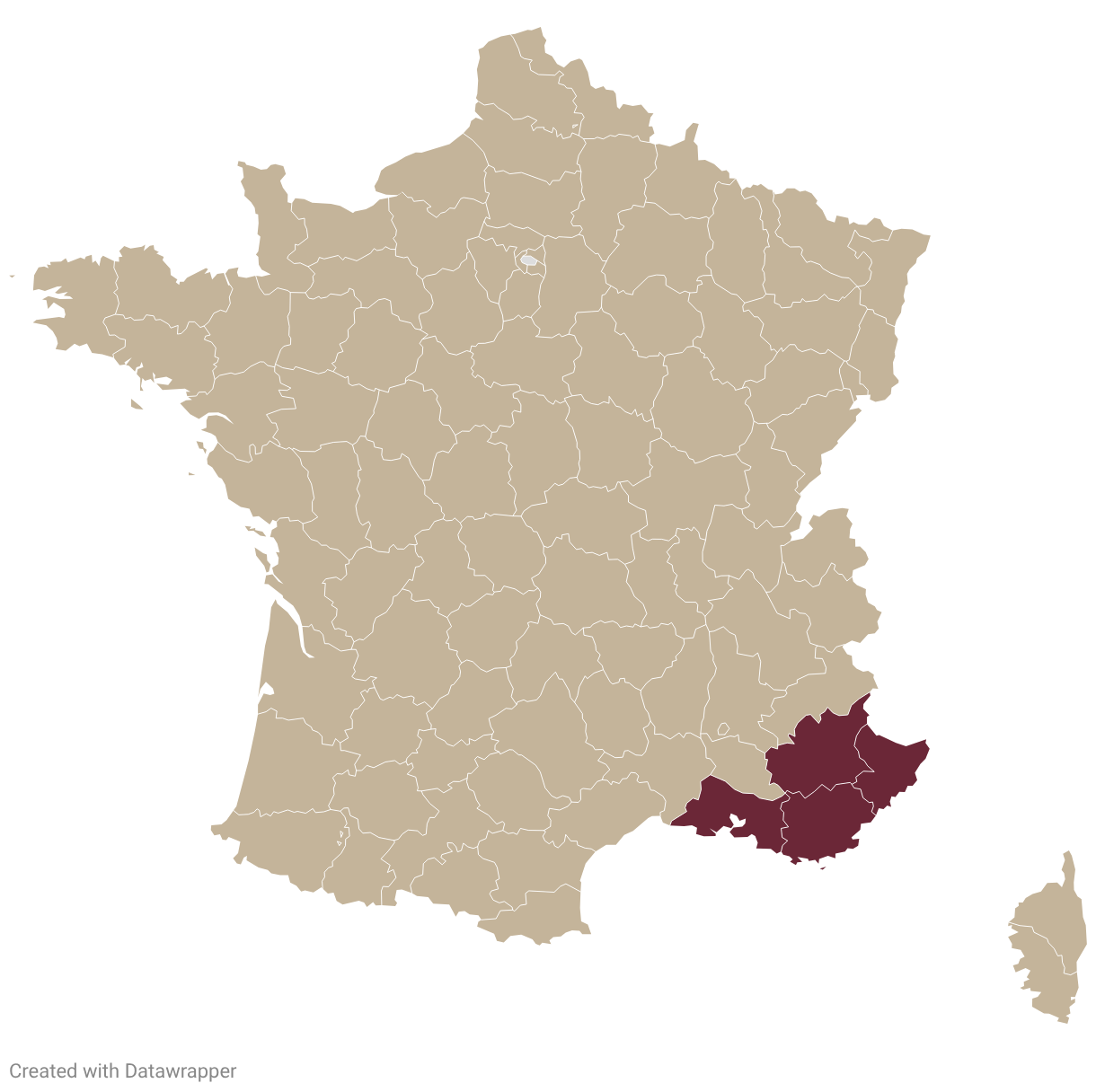
Provence
The world’s definitive rosé, a serious red from Bandol’s Mourvèdre, and 2,600 years of Mediterranean winemaking behind every bottle.
3
·
26,000 ha
·
40%
·
600 BC
VARIETIES
Grenache · Cinsault · Mourvèdre · Syrah · Vermentino
The Greeks planted vines at Massalia (modern Marseille) around 600 BC, making Provence France’s oldest wine region by nearly a thousand years. What those colonists established on Mediterranean limestone persisted through Roman occupation, medieval fragmentation, and the long centuries of local winemaking that followed. That continuity matters less for historical reasons than for what it suggests about Provence’s soil: something in this corner of the Mediterranean retained the ability to produce wine worth drinking, century after century, without the infrastructure that later regions required to achieve quality. The Greeks understood something the region still expresses today.
But Provence today is not the wine region those ancients would recognize. It is, instead, the pale, dry, mineral rosé that has become not just the region’s signature but an entire global wine category — one that accounts for roughly 40 percent of all French rosé production. The best examples, from Bandol and the hillside estates of the Var, from limestone-rich soils far inland from the coast, achieve a restraint and salinity that no other rosé-producing region has matched at scale. Yet this commercial dominance masks a deeper tension: between Provence as lifestyle brand (summer, beaches, prestige estate acquisitions) and Provence as a serious wine region where terroir remains legible in the glass. That tension will define the region’s next two decades.
The Paradox of Success
Provence’s transformation from rustic local wine to global phenomenon happened in four decades. For most of the twentieth century, Provence wine was unremarkable outside the Côte d’Azur. The shift began in the 1980s and accelerated through the 2000s, driven by investment in temperature-controlled fermentation, earlier harvests for freshness, and a global appetite for lighter, drier pink wine. Provence’s winemakers did not invent rosé; they perfected its modern idiom and scaled it to an industrial magnitude that rivals European production regions ten times its historical size. Yet that same volume — 26,000 hectares producing millions of bottles annually — creates a reputational trap. When 40 percent of your region’s output is rosé, and 90 percent of that rosé is undistinguished, the question becomes whether quality gains at the top can ever outweigh the commodity perception at the base.
The arrival of celebrity estate acquisitions — high-profile investors drawn by Provence’s lifestyle brand rather than its terroir — compounds this dynamic. The region attracts capital, which can fund vineyard improvement and modernization. It also attracts skepticism: the belief that Provence exists primarily as a plaything for wealthy outsiders rather than a region where winemakers own their land and define its future. This perception, fair or not, persists because it contains a grain of truth. A growing number of Provençal estates are fighting back — investing in organic conversion, single-vineyard bottlings, and red wines that challenge Bandol’s monopoly on seriousness — but the battle for legitimacy will require a generation, not a vintage.
Where the Mistral Writes
The mistral wind is the central climatic fact of Provence. This cold, dry northwesterly descends from the Alps and sweeps across the region at velocities that strip humidity from the air, reduce disease pressure in the vineyard, and concentrate flavors in the grape skin. With roughly 3,000 hours of sunshine per year, Provence should be too hot for fine wine by Mediterranean logic — but the mistral provides the temperature correction that allows Grenache, Cinsault, and Mourvèdre to ripen slowly rather than bake. The best rosés and reds taste of this wind: savoury, herbal, dried-flower aromatic, with an acidity that seems improbable given the latitude. Beneath the sunshine, the soils tell a more complex story. Côtes de Provence stretches across limestone hillsides, clay basins, and sandstone outcrops. Bandol’s amphitheatre of terraces faces the sea on calcareous clay over hard limestone — the exact combination that allows Mourvèdre, a late-ripening variety that struggles in cooler climates, to reach full phenolic maturity and structure. Coteaux d’Aix-en-Provence, the coolest appellation, sits on alluvial and stony soils where Cabernet Sauvignon and Syrah join the classic blend, producing lighter-framed rosés and approachable reds.
Bandol stands apart within Provence with a claim to seriousness that extends well beyond rosé. The appellation’s reds — built on a minimum of 50 percent Mourvèdre — are structured, dark, and garrigue-scented wines that require 18 months’ aging before release. The finest Bandol reds from estates like Domaine Tempier and Château Pradeaux can age for 20 to 30 years, developing a mineral depth and savoury complexity that earns comparison with the great age-worthy reds of the Rhône. This is where Provence’s future lies — not in defending rosé’s dominance but in proving that the region’s terroir, properly expressed, can produce wines worthy of serious collectors’ attention. The question is whether enough of the region’s winemakers will invest in that direction, or whether the economics of volume will continue to pull them toward the profitable middle ground.
Beneath the sunshine, the soils tell a more complex story. Côtes de Provence stretches across limestone hillsides, clay basins, and sandstone outcrops between the coast and the inland garrigue. Bandol’s amphitheatre of terraces faces the sea on calcareous clay over hard limestone, providing the thermal regulation that Mourvèdre — a late-ripening variety that struggles in cooler climates — requires to reach full phenolic maturity. Coteaux d’Aix-en-Provence, the coolest of the three major appellations, sits on alluvial and stony soils where Cabernet Sauvignon and Syrah join the Provençal blend, producing lighter-framed rosés and approachable reds.
Bandol stands apart within Provence with a claim to seriousness that goes well beyond rosé. The appellation’s reds — built on a minimum of 50 percent Mourvèdre, a grape that elsewhere in the world rarely reaches its potential — are structured, dark, and garrigue-scented wines that require a minimum of 18 months’ aging before release. The finest Bandol reds from estates like Domaine Tempier and Château Pradeaux can age for 20 to 30 years, according to importers who have tracked multiple vintages, developing a mineral depth and savoury complexity that earns comparison with the great age-worthy reds of the Rhône.
The tension in Provence is between volume and ambition. The same climate and soil that produce exceptional estate rosé also feed a colossal industrial machine — Provence’s output dwarfs that of any other premium rosé region. Whether the next generation of winemakers can maintain the quality gains of the past two decades while meeting global demand is the question that will define the region’s trajectory. The answer, so far, is encouraging: a growing number of estates are investing in organic conversion, single-vineyard bottlings, and red wines that challenge Bandol’s monopoly on Provençal seriousness.
“In Bandol, the Mourvèdre does what it does nowhere else on earth: it remembers the sea.”
— Rosemary George MW, The Wines of the South of France
The Sub-Appellations
From the vast hillside rosés of Côtes de Provence to the age-worthy Mourvèdre reds of Bandol — three appellations, three distinct faces of the same Mediterranean sun.
Regional
Côtes de Provence
The appellation that defined the category: pale, dry rosés from limestone hillsides between the Var coast and inland garrigue. Quality ranges from generic supermarket to single-estate benchmark — knowing the producer is everything.
Grenache · Cinsault · Mourvèdre · Syrah · Vermentino
Prestige
Bandol
Mourvèdre’s foremost expression: a minimum 18 months of aging and years in bottle reveal structured, garrigue-scented reds of dark fruit, iron mineral, and cellar-worthy depth. The rosés, from the same Mourvèdre base, rank among the most serious in Provence.
Mourvèdre · Grenache · Cinsault · Clairette
Major
Coteaux d’Aix-en-Provence
The cooler, more northerly appellation around Aix, where Cabernet Sauvignon and Syrah join the classic Provençal varieties. Lighter-framed rosés and approachable reds at genuine value — the most food-friendly expression of the region.
Grenache · Syrah · Cabernet Sauvignon · Cinsault · Vermentino
Last updated: April 2026
Related Stories
TERROIR’s coverage of Provence — appellations, producers, and vintages worth knowing.
The next one arrives Thursday.
Vintage intelligence, producer profiles, and curated cellar picks — before the critics weigh in. Weekly dispatch.