

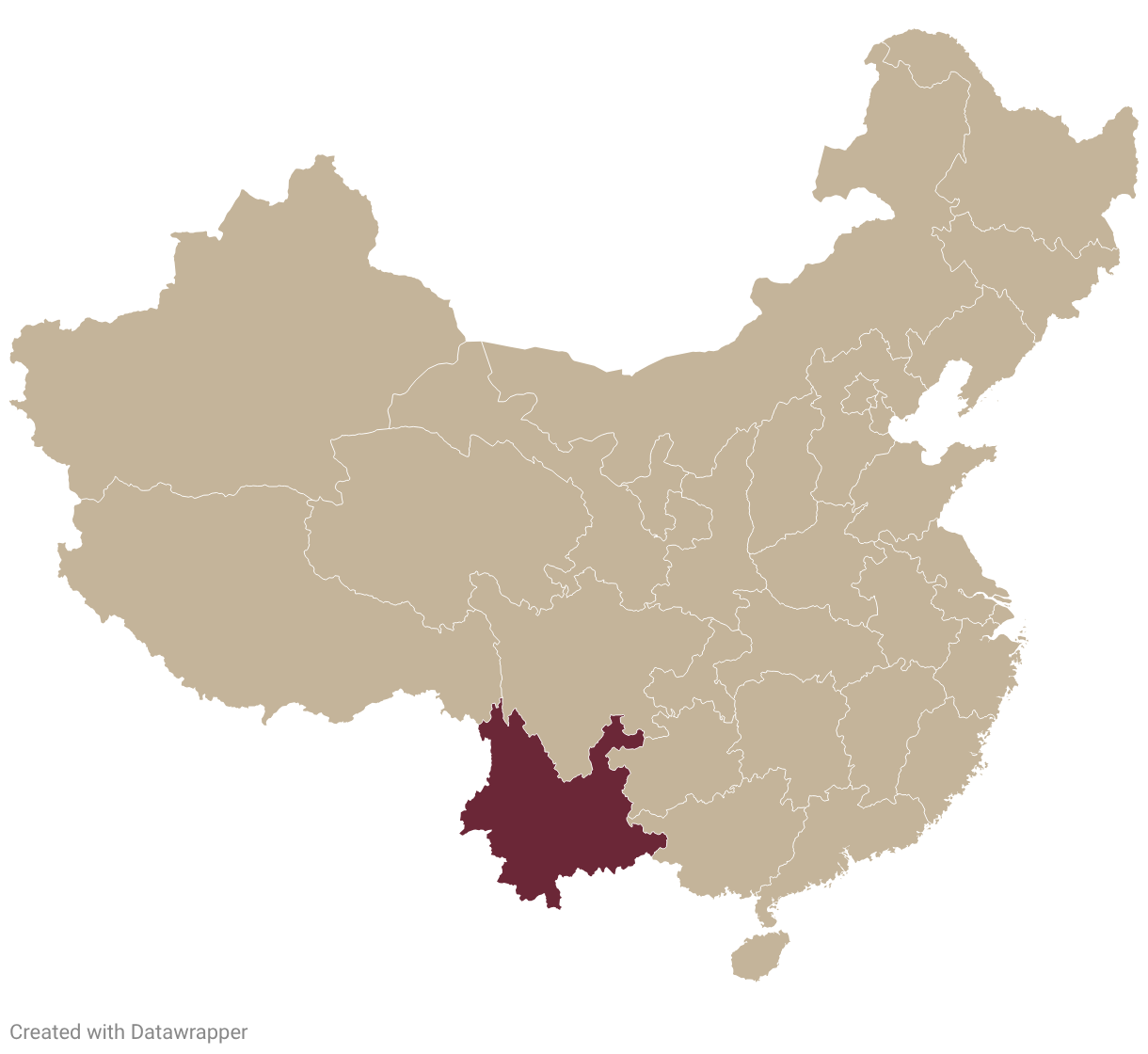
Yunnan
China’s high-altitude frontier, where subtropical monsoon meets Tibetan elevation to create wines of improbable finesse and genuine distinctiveness
3,000+
·
3
·
1,500–2,800m
·
2013
VARIETIES
Cabernet Sauvignon · Merlot · Rose Honey · Vitis Davidii
In 1867, French missionaries from the Society of Foreign Missions of Paris completed a small stone church in Cizhong, a Tibetan village on the upper Mekong River more than 2,200 metres above sea level. They had come to Yunnan’s remote borderlands, where the province touches Myanmar, Laos, and Vietnam, with an unusual intention: to produce sacramental wine. The vines they planted, including a delicate red called Rose Honey (玫瑰蜜), would anchor the Catholic liturgy for generations. This was not grand commerce, but subsistence faith made tangible. Those first vineyards remained small, intimate, and utterly improbable: European Vitis vinifera adapting to subtropical monsoon conditions at an elevation where the air itself is thin and the growing season arrives late.
Three centuries later, that same geography, those same cool nights and high-altitude soils, caught the attention of Moët Hennessy. In the late 1990s and early 2000s, scouts from LVMH began surveying the Shangri-La corridor with the precision of colonists staking claims. What the missionaries had planted for God, the luxury industry would develop for connoisseurs. In February 2012, Moët Hennessy signed a controlling stake in Shangri-Li Winery Company, committing to permanent viticultural ambition. Maxence Dulou, an estate manager trained in Burgundy, Bordeaux, and South Africa, arrived to manage not one vineyard but four, scattered across four villages along the upper Mekong. The first vintage, a Cabernet Sauvignon and Cabernet Franc blend named Ao Yun, released in 2016 at approximately $300 per bottle. The monastery had become the domain.
The Monsoon’s Discipline
Every summer, the monsoon comes. From June through September, Yunnan receives 1,000 to 1,200 millimetres of rainfall—a deluge that neither Bordeaux nor Napa had trained their winemakers to manage at 2,700 metres elevation. European viticulture assumes a long, dry growing season punctuated by strategic water stress. Yunnan offers the opposite: a subtropical regime of humidity, mist, and fungal pressure that demands constant vigilance. Powdery mildew, downy mildew, and rot lurk in the monsoon shadows. This is not a challenge to be solved by importing Burgundian techniques wholesale; it is a challenge that demands a new grammar of the vineyard. Canopy management becomes not a refinement but a discipline. Dulou’s team divides Ao Yun’s vineyards into 900 sub-plots, each mapped for microclimate and soil, spending 3,500 hours per hectare annually. Most of those hours fall between June and September, pruning, leafing, thinning, creating passages for air. The monsoon does not ask permission; the vineyard must speak its language.
Yet the same altitude that creates disease pressure also creates advantage. At 2,700 metres, ultraviolet radiation increases by approximately 10 per cent for every thousand metres gained above sea level, a photon-driven acceleration of phenolic synthesis that Yunnan’s cool nights would normally slow. This is the paradox: viticulture at the edge of the Himalayas receives the UV intensity of Mediterranean latitudes without the heat that usually accompanies it. Cabernet Sauvignon and Cabernet Franc, both planted widely here, develop thick skins and concentrated tannins in conditions that feel improbably cool in the glass—wines of deep garnet colour and structured flavour that belie their high-altitude, low-temperature origin. The ultraviolet accelerates ripening while the nights preserve acidity. A different equilibrium entirely.
The Grapes That Arrived by Mule
Rose Honey (玫瑰蜜) remains the region’s most poignant emblem. This Vitis vinifera subtype arrived with the missionaries in the nineteenth century and has now been grown nowhere else on earth for more than a century—a grape that survived phylloxera not by remaining in Burgundy, but by leaving it entirely. Today, the largest plantings cluster in Mile County at approximately 1,800 metres elevation, where the soil is well-drained and the monsoon pressure, though present, is slightly less extreme than in the highest zones. The wine it produces carries the name it acquired: delicate, floral, reminiscent of rose and honey. It is a rare example of a wine whose identity is genuinely singular, not by marketing narrative but by terroir isolation and botanical longevity.
Ao Yun dominates international attention, and for good reason. It represents the first serious Bordeaux-style ambition at extreme altitude, made at a scale and price that signals permanent commitment. But the more genuinely distinctive chapter lies with native and heritage varieties. Vitis davidii, a wild Chinese grape first documented in 1872, grows in the remoter corners of Yunnan’s highest slopes. Its grapes are thick-skinned, intensely coloured, and rich in anthocyanins—the same phenolic compounds that appeal to natural winemakers in France and Japan, now being explored by importers in New York and Tokyo. These are not wines made with European playbooks. They are wines emerging from botanical isolation and experimental rigour, drawing attention precisely because they feel uncompromising and place-specific.
Yunnan will never rival Ningxia’s scale or institutional investment, nor should it. Its remoteness (two hours’ drive from the nearest international airport, at the edge of three nations) remains its truest asset. This geography that made it difficult for investment to arrive has now made it impossible for mediocrity to survive. The winemakers who stay learn monsoon discipline. The grapes that persist: Rose Honey, Vitis davidii, Cabernet Franc grown at 2,700 metres, teach what altitude, latitude, and isolation can produce together. This is China’s most unconventional wine country: too demanding for casual tourism, too distinctive for easy imitation.
“At this altitude, the vines are not growing in spite of the conditions — they are growing because of them. Yunnan produces wines that could not exist anywhere else on earth.”
— Jean-Guillaume Prats, President, LVMH Wines & Spirits
The Sub-Appellations
Three distinct elevation zones define Yunnan’s wine landscape — each shaped by altitude, monsoon exposure, and proximity to the Tibetan Plateau. Together they represent the most geographically dramatic fine-wine country in Asia.
Premier
Shangri-La
Home of Ao Yun and Yunnan’s highest vineyards, Shangri-La occupies four villages along the upper Mekong at 2,200–2,600 metres. These vineyards, where LVMH committed in the late 1990s after identifying the region’s rare potential, produce the Cabernet-dominant blends that placed Yunnan on the international fine-wine map.
Cabernet Sauvignon · Cabernet Franc · Vitis Davidii
Established
Mile
Central Yunnan’s most productive zone at 1,600–2,000 metres, where the monsoon moderates and growing conditions stabilise. Mile is the heartland of Rose Honey cultivation and produces the province’s most consistent table wines — the accessible face of Yunnan’s fine-wine ambition.
Rose Honey · Cabernet Sauvignon · Chardonnay · Merlot
Frontier
Deqin
Northern Yunnan’s most extreme terrain pushes viticulture to its practical limits on the edge of the Tibetan Plateau. Deqin’s remote, high-altitude vineyards produce wines of striking mineral intensity — raw, characterful, and wholly unlike anything grown at lower elevations. The most demanding and the most distinctive sub-zone in the province.
Vitis Davidii · Rose Honey · Pinot Noir · Riesling
Last updated: April 2026
Related Stories
TERROIR’s coverage of Yunnan, China’s high-altitude wine frontier.
The next one arrives Thursday.
Vintage intelligence, producer profiles, and curated cellar picks — before the critics weigh in. Weekly dispatch.