

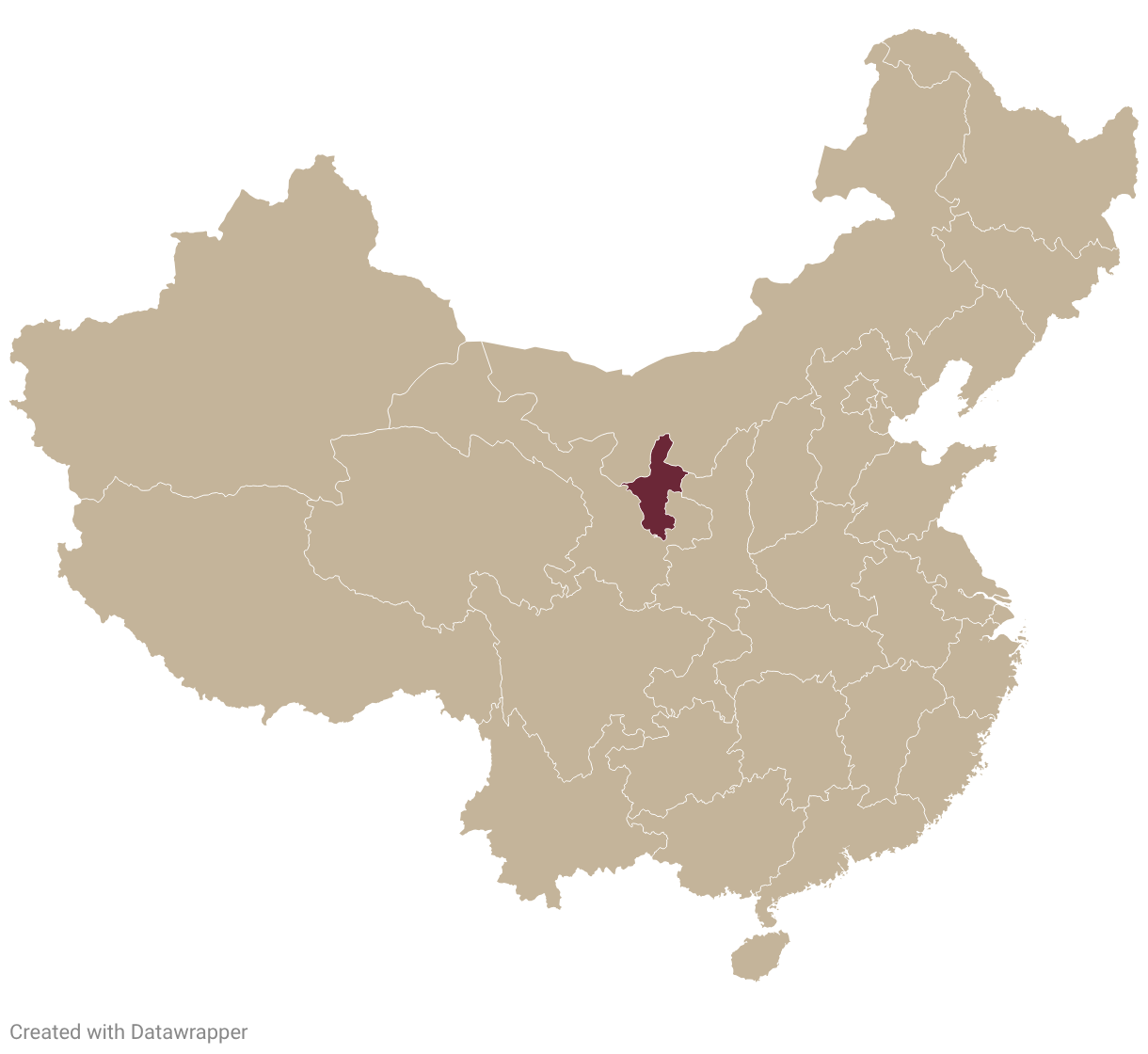
Ningxia
Where the Helan Mountains shelter vines that must be buried each winter to survive — and emerge each spring to produce some of Asia’s most ambitious fine wine.
3
·
Semi-arid, Continental
·
Cabernet Sauvignon · Merlot · Marselan
·
Gravel · Alluvial · Loess
VARIETIES
Cabernet Sauvignon · Merlot · Marselan · Cabernet Franc
Ningxia’s emergence as China’s most internationally recognised wine region can be dated with unusual precision. In 2011, a small family estate at the foot of the Helan Mountains submitted its 2009 Jia Bei Lan Cabernet blend to the Decanter World Wine Awards. Helan Qingxue, founded six years earlier by local entrepreneur Wang Fengyu and his partners, had to request that the organisers add Ningxia as a region to their entry form (it did not exist on the system). The wine won the International Trophy, defeating entries from Bordeaux in a competition where the judges did not know its origin until the category results were announced. The victory was simultaneously obscure and permanent in its consequence. Government investment accelerated within months. Winery counts grew from fewer than a hundred to more than 200. A region that had produced its first significant commercial vintages fewer than two decades earlier found itself under serious scrutiny from the international wine trade.
The defining physical fact of Ningxia viticulture has no parallel in any other major wine region. Every autumn, after harvest, workers hand-bury the vines beneath mounded earth to protect them from winters that regularly descend to −25°C, well below the −18°C threshold at which Vitis vinifera dies. Every spring, the vines are hand-unearthed. The process is entirely manual, requires roughly four times the human working hours of comparable European estates, and cannot be mechanised. The Helan Mountain piedmont, rising between 1,100 and 1,500 metres above sea level, offers compensations that justify this extraordinary labour: over 3,000 sunshine hours during the growing season, diurnal temperature swings averaging 15°C through ripening, and sandy loam overlaid with alluvial gravel that concentrates flavour into small-berried, phenolically precise fruit. The soil is not generous. It demands that vines work for their survival.
The Template and the Divergence
When Ningxia’s government launched its five-tier château classification in 2013 (modelled directly on Bordeaux’s 1855 system), the decision announced more than administrative ambition. It revealed the template against which the region measured itself. Cabernet Sauvignon dominates the plantings, producing wines of dark fruit, cedar, and a distinctive dusty mineral register that the loess-and-gravel piedmont soils impart. Chinese state television would later call Ningxia “the Oriental Bordeaux.” French-trained winemakers arrived. Temperature-controlled cellars rose from the desert floor. The infrastructure of prestige (gravity-fed facilities, barrel rooms, estate architecture designed for tourism and authority) followed the same blueprint that had worked in the Médoc. For a region learning how to make fine wine at international scale, the Bordeaux template was rational, even inevitable.
But a competing identity was already forming in the vineyard. Marselan (a Cabernet Sauvignon × Grenache cross created in 1961 at France’s INRA institute by Paul Truel, named after the town of Marseillan) had found in Ningxia something it never found in France. In the warm, dry continental climate of the Helan piedmont, Marselan produces deeper colour than Cabernet, with softer tannins and a spiced aromatic middle palate that reads as both more approachable young and genuinely regional. The finest Marselan bottlings from Ningxia have no precise international equivalent. They taste of this place: violet, red plum, and black cherry edged with that flinty minerality the soil imparts. When winemakers and investors began to acknowledge that Marselan might be Ningxia’s future rather than Bordeaux’s footnote, the region faced a choice it had not yet articulated. The infrastructure was Bordeaux. The terroir was asking for something else.
What the Gravel Remembers
The benchmark estates reveal this tension in their own trajectories. Helan Qingxue, the winery that triggered international attention in 2011, remains small and quality-focused under its founders’ continued stewardship, the reference point against which other Chinese regions still measure their own Cabernet programs. Silver Heights, established by patriarch Gao Lin in 1999 and now led by his daughter Gao Yuan (who obtained her Master’s degree in Oenology at Bordeaux and interned at Château Calon-Ségur), produces some of the region’s most delicate Cabernets, with the Summit cuvée setting a standard for elegance in a region that trends toward power. Grace Vineyard, founded in Shanxi and expanded to Ningxia’s eastern foothills in 2012, produces a Tasya’s Reserve Cabernet Franc that reads closer to a fine Loire Valley expression than anything from Bordeaux—finer-boned, more aromatic, more surprising. Pernod Ricard’s Helan Mountain estate, established in 2005, brought industrial-scale technical resources. The cumulative signal from these estates is clear: international investment has taken Ningxia’s ambitions seriously.
For collectors, Ningxia presents an unusual combination: wine of genuine quality available at prices that do not yet reflect its international profile. The region’s finest bottles remain underpriced relative to their ambition and relative to comparable-quality expressions from Bordeaux or Napa. That gap will narrow. The infrastructure investment of the past decade (temperature-controlled cellars, French-trained winemakers, gravity-fed facilities) has already produced wines capable of ageing a decade and standing comparison with mid-level classified Bordeaux. The more interesting question for the next ten years is whether Ningxia can build an identity distinct from the Bordeaux template it learned from. The progress with Marselan suggests it will. When a wine region discovers that its greatest strength lies not in copying what came before but in expressing what its gravel, loess, and extremity of climate can uniquely produce, the wines have earned a place not as curiosity but as category.
“In Ningxia, we are not trying to make a Chinese version of Bordeaux. We are trying to understand what this place is.”
— Emma Gao, Helan Qingxue, Ningxia
The Sub-Appellations
Three distinct terroir zones along the Helan Mountain piedmont define Ningxia’s internal geography — each delivering a different expression of the same exceptional growing conditions that have made this region Asia’s most consequential fine-wine address.
Premier
Helan Mountain East
The piedmont foothills of the Helan Mountains produce Ningxia’s most concentrated and structured wines. Gravel and loess soils at 1,100–1,400 metres channel intense sunshine into small-berried Cabernet Sauvignon of exceptional depth and mineral precision.
Cabernet Sauvignon · Merlot · Petit Verdot · Cabernet Franc
Premier
Helan Mountain West
Higher-elevation sites on the Helan range’s western approach benefit from greater diurnal temperature variation and more complex mineral soils. The result is Ningxia’s most elegant and age-worthy expressions — finer-boned, with greater aromatic lift and the structure to develop over a decade.
Cabernet Sauvignon · Marselan · Cabernet Franc · Chardonnay
Regional
Yellow River Corridor
Alluvial plains along the Yellow River’s eastern bank produce fruit-forward, more immediately accessible wines. Lower elevation and deep alluvial soils favour Merlot and Marselan, delivering wines of plush texture and broad appeal.
Merlot · Marselan · Cabernet Sauvignon · Chardonnay
Last updated: April 2026
Related Stories
TERROIR’s coverage of Ningxia and Chinese wine.
The next one arrives Thursday.
Vintage intelligence, producer profiles, and curated cellar picks — before the critics weigh in. Weekly dispatch.