

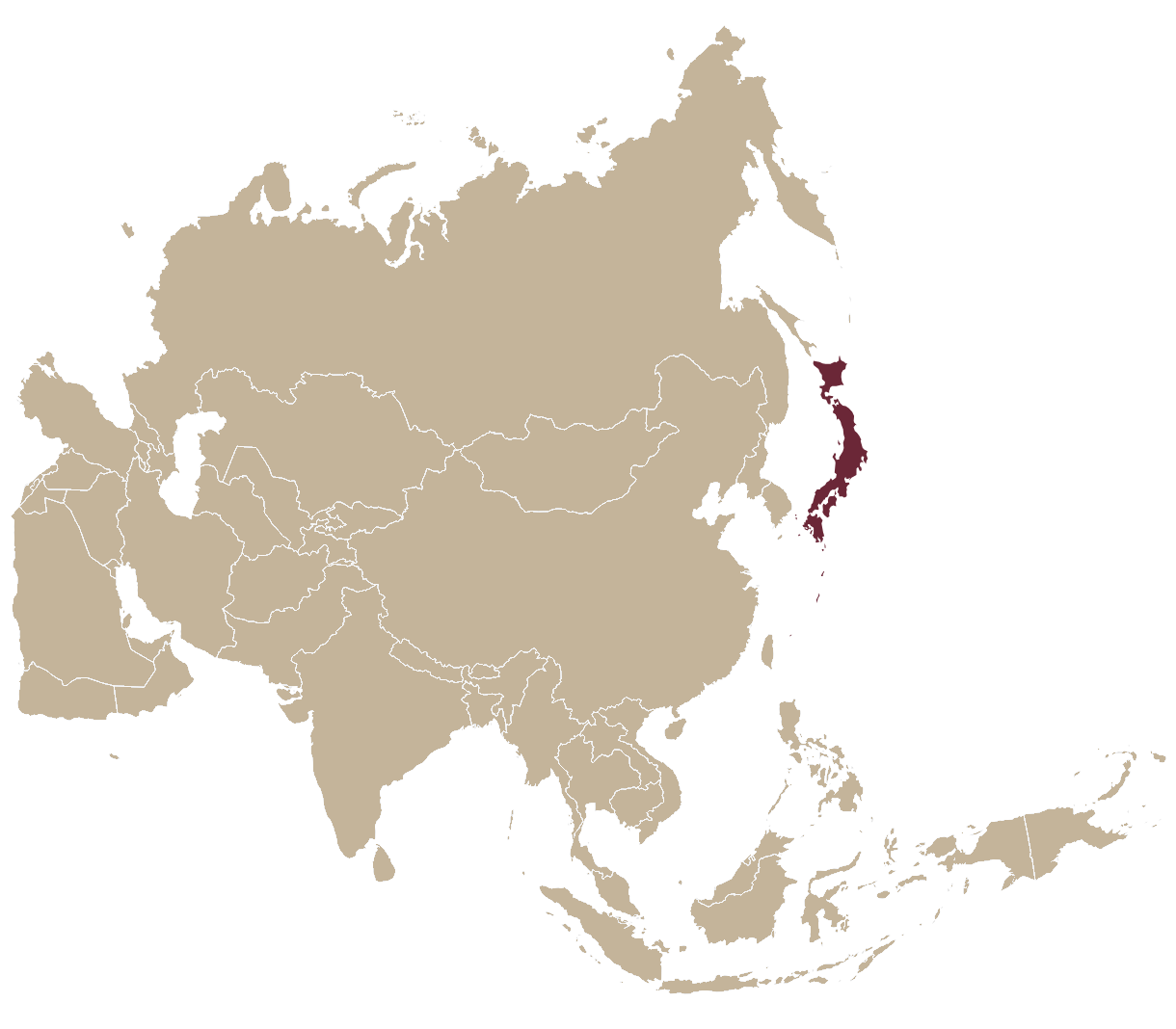
Japan
Where a millennium-old grape arrived via the Silk Road and a new generation of vignerons is proving that precision, patience, and terroir speak Japanese too
~500
·
46 of 47
·
1874
·
2018
VARIETIES
Koshu · Muscat Bailey A · Merlot · Chardonnay · Pinot Noir
Japan’s wine story begins not with a European missionary or a colonial plantation, but with a pink-skinned grape that traveled the Silk Road over a thousand years ago and settled quietly into the volcanic soils of Yamanashi. Koshu—now confirmed through DNA analysis as a true vinifera variety with Caucasian ancestry—grew for centuries as a table grape beneath the gaze of Mt. Fuji before anyone thought to ferment it. That transformation required intervention. In 1874, the Meiji government dispatched two young men from Katsunuma, Takano Masanari and Tsuchiya Ryūken, to Bordeaux with a directive that was equal parts ambition and desperation: learn to make wine, then bring the knowledge home. They returned with French techniques and rootstock, establishing the framework for a wine industry that would have to defeat geography itself to survive. Monsoon rains arrive precisely at harvest. Summer humidity invites rot. Typhoons arrive without warning. For Japan to make wine would require not imitation of Bordeaux, but invention.
The challenge remained unsolved for more than a century. Through the twentieth century, Yamanashi’s producers specialized in the slightly sweet, sake-influenced styles suited to Japanese cuisine but largely invisible to the international wine world. That silence persisted even as Japan’s manufacturing prowess reached every corner of global commerce. Wine, it seemed, would remain foreign. But in the 1990s and 2000s, a small number of estates began working against nature itself—reducing yields, managing humidity through meticulous canopy work, experimenting with stainless steel fermentation and temperature control. Grace Winery’s Koshu appeared in international wine publications. Château Mercian’s structured reds drew quiet attention. When the Japanese government established its first geographical indication in 2013—assigned to Yamanashi—it was not bestowing an honor but recognizing a fact that had taken four decades of quiet labor to establish: that Japanese wine made from Japanese grapes in a fixed place, under defined rules, was no longer an experiment.
The Silk Road, Interrupted
Today roughly 500 wineries operate across 46 of Japan’s 47 prefectures, though the serious work concentrates in three regions. Yamanashi remains the historic heartland, its 90 producers clustered in the Koshu Valley and collectively responsible for approximately one-third of Japan’s domestic wine production. Nagano, where high-altitude vineyards reaching 950 meters rest on well-drained volcanic soils, has emerged as the country’s most compelling source of internationally styled Merlot and Chardonnay, with over 80 percent of farmland situated above 500 meters elevation. Hokkaido, Japan’s northernmost main island, transformed from a rural desperation experiment in 1963 (when the town of Ikeda planted cold-hardy vines as a recovery strategy) into a region attracting investment from Burgundy itself. In 2018, Domaine de Montille announced plans to plant 25 hectares overlooking the sea at Hakodate. The volumes remain modest; Japanese wine made from domestic grapes represents barely four percent of the country’s consumption. But the 2018 labeling law that finally distinguished “Japanese wine” from bulk imports blended and bottled domestically was a turning point—not in volume, but in meaning. It rewarded the growers who had long chosen quality over quantity and gave the market a vocabulary to recognize the difference.
A Nation in Search of Its Own Voice
The central tension shaping Japanese wine today is not technical but philosophical. Should producers chase the international scorecard—Merlot and Chardonnay that stand alongside their California or Chilean counterparts—or lean into what makes Japan irreplaceable: Koshu’s crystalline restraint, Muscat Bailey A’s bright-fruited charm, and terroirs shaped by altitude, volcanic ash, and monsoon? The most interesting producers refuse this binary entirely. Grace Winery’s Koshu now appears on London wine lists alongside Chablis entries. Hokkaido Pinot Noir, produced by a generation trained at Dujac and other Burgundy estates, has drawn quiet comparisons to serious cool-climate examples from Central Otago. Château Mercian’s Kikyogahara Merlot, cultivated since the 1980s on a high plateau near Ueda at 700 meters, has become Japan’s reference point for structured red wines built to age. These producers share a philosophy that, as it happens, the culture has practiced in every other craft for centuries: precision, patience, and the unhurried expression of place. The future of Japanese wine will not be written in Bordeaux or Napa. It will be written in Yamanashi, Nagano, and Hokkaido, where vignerons trained abroad are returning home convinced that Japan’s viticultural identity lies not in imitation but in the languages that only these specific mountains, these particular soils, and this relentless monsoon can teach.
“It is in its early stages, it is dynamic, and it is growing. And it is being driven by people who care about wine and want to make something interesting.”
— Jamie Goode, wineanorak.com
The Regions
Three prefectures define Japan’s wine geography — from the historic Koshu heartland in the shadow of Mt. Fuji to the cool-climate frontier of Hokkaido.
Premier
Yamanashi →
The cradle of Japanese wine, where 90 wineries cluster in the shadow of Mt. Fuji and the pink-skinned Koshu grape has been cultivated for over a thousand years.
Koshu · Muscat Bailey A · Merlot · Cabernet Sauvignon
Major
Nagano →
High-altitude vineyards at up to 950 meters deliver the diurnal temperature swings that make Nagano Japan’s most exciting source of internationally styled Merlot and Chardonnay.
Merlot · Chardonnay · Cabernet Sauvignon · Pinot Noir
Emerging
Hokkaido →
Japan’s northern frontier, where dry summers, low humidity, and a climate recalling Alsace have drawn a new wave of artisan vignerons — including Burgundy’s Domaine de Montille.
Pinot Noir · Chardonnay · Kerner · Zweigeltrebe
Last updated: April 2026
Related Stories
The latest from our coverage of Japanese wine
The next one arrives Thursday.
Vintage intelligence, producer profiles, and curated cellar picks — before the critics weigh in. Weekly dispatch.