

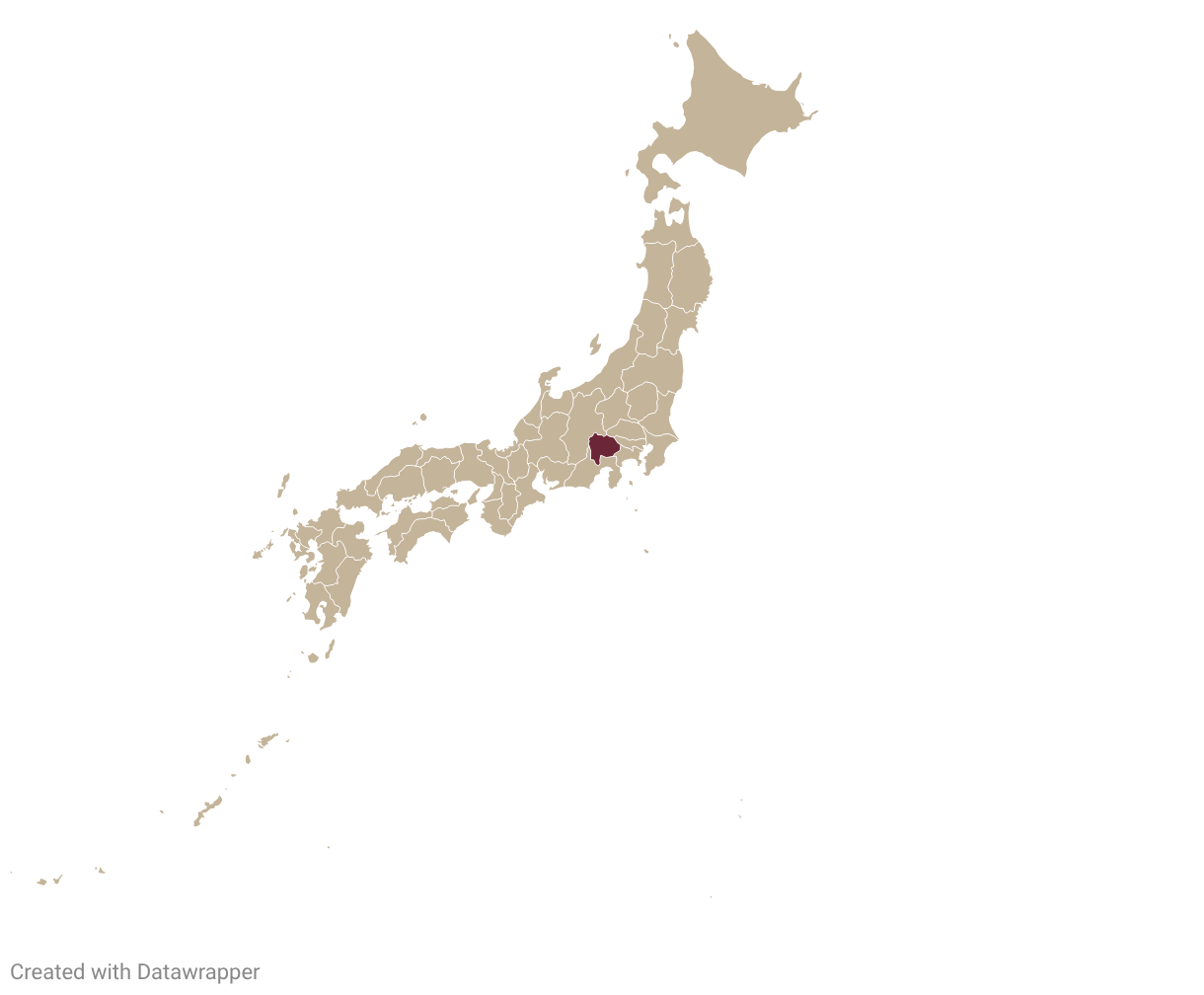
Yamanashi
Japan’s cradle of wine — where the ancient Koshū grape has grown in the shadow of Mt. Fuji for over a thousand years, and a new generation of precision-minded vignerons is proving that patience defines this land
~90
·
2013
·
1,000+ Years
·
400–500m
VARIETIES
Koshū · Muscat Bailey A · Merlot · Chardonnay · Cabernet Sauvignon
The Kōshū Valley sits in the embrace of four mountain ranges—the Southern Alps, the Kantō Mountains, the Misaka Hills, and Mt. Fuji itself—a natural amphitheater that has shaped vine cultivation since the Heian period. The Koshū grape arrived here over a thousand years ago, traveling the Silk Road from Central Asia before finding a home in the volcanic and alluvial soils that wash down from these surrounding peaks. For most of that millennium it was grown as a table grape, trained overhead in the traditional pergola system called tanazukuri, a canopy design that lifted clusters above the monsoon-drenched ground and protected the low-acid fruit from the humidity that blankets the valley each summer. This was not incidental engineering but terroir expression disguised as agriculture: the system shaped the grape’s character as much as the soil beneath did. The transformation to winemaking came abruptly in 1874, when the Meiji government dispatched two Katsunuma farmers—Takano Masanari and Tsuchiya Ryūken—to Bordeaux with orders to learn French technique. They returned with rootstock, methods, and ambition, establishing what became Japan’s first commercial winery in the village that had grown Koshu for centuries. The question they faced was fundamental: could a grape shaped by a thousand years of table-wine cultivation be persuaded into something fermented?
For much of the twentieth century, the answer was no—or at least, not in any way that resembled what the international wine world wanted to hear. Yamanashi’s producers specialized in the slightly sweet, sake-influenced styles suited to Japanese cuisine but largely invisible to the international market. The breakthrough came not from accepting this position but from rejecting it entirely. A small cohort of estates began working against Koshu’s natural tendencies in the 1990s and 2000s, reducing yields below tradition, managing humidity through aggressive canopy work, experimenting with stainless steel and temperature control in the cellar. Grace Winery’s Koshu earned coverage in international wine publications. Château Mercian’s Koshu of Katsunuma drew broader attention. When GI Yamanashi was established in 2013—Japan’s first geographical indication for wine—the region gained an official framework and the credibility that framework carried. The rules were strict: only domestically grown grapes, defined production methods, a fixed production zone. What had been a regional curiosity began to read, internationally, as something deliberate. The appellation was not declaring victory. It was declaring intent.
The Weight of a Thousand Years
Today Yamanashi accounts for roughly one-third of Japan’s domestic wine production, but the conversation has moved well beyond volume metrics. The most compelling work is happening at the intersection of tradition and precision. Grace Winery’s Akeno vineyard, at 700 meters above Nirasaki on the volcanic slopes facing Mt. Fuji, produces a structured red blend that invites careful comparison with serious Bordeaux. The terroir here operates at the precision of a wine from the Médoc: minerality from volcanic ash, freshness from altitude, complexity from the soil’s age and drainage. Sparkling Koshu from several Katsunuma estates demonstrates that the grape’s natural acidity, long constrained by sweetness in table-wine tradition, can serve as the foundation for something elegant and expressive. These are not European wines made in Japan. They are Japanese wines made by producers who studied European methods and returned home convinced that what Yamanashi needed was not imitation but translation.
When the Pergola Becomes Philosophy
A generation of winemakers returning from Burgundy, the Barossa Valley, and Stellenbosch are finding in Yamanashi’s volcanic soils and mountain air a precision that requires no apology. They work in the oldest vineyards, where the pergola system still stands not as a concession to nostalgia but because, in this monsoon-shaped landscape, the logic that built it was right from the beginning. The tanazukuri system that protected Koshu for a thousand years still protects it today, but now in service of dry wines rather than sweet ones. The distinction matters: it suggests that the region has not abandoned its past but has instead found a new language for expressing it. Domaine Takahiko and Atsushi Suzuki represent this new generation—winemakers trained in Burgundy or Australia, working with the same varieties their ancestors cultivated, but with knowledge of temperature control, phenolic ripeness, and the precise calibration of acidity that only modern viticulture brings. The pergola remains. The monsoon remains. The volcanic soils remain. Only the intention has changed. Yamanashi is proving that a region need not choose between its history and its future. It can weave them together, one vintage at a time.
“It is still early days, but in Yamanashi the foundations are deeper than anywhere else in Japan — and the best producers know exactly what they are building on.”
— Jancis Robinson MW, Financial Times
The Sub-Regions
Four distinct growing areas within the Kōshū Valley, each shaped by elevation, soil, and proximity to the mountain slopes that define Yamanashi’s winemaking landscape.
Premier
Katsunuma
Japan’s wine capital — the historic Kōshū Valley town where commercial winemaking began in 1874. The country’s highest concentration of producers clusters here, including Grace Winery and Château Mercian’s Katsunuma Estate, set among the longest sunshine hours in the region.
Koshū · Muscat Bailey A
Regional
Nirasaki & Akeno
The mountain frontier of Yamanashi, where Grace Winery’s Akeno vineyard reaches 700 metres above sea level. Volcanic soils and dramatic diurnal temperature swings produce some of Japan’s most internationally competitive structured reds and complex white wines.
Merlot · Chardonnay · Cabernet Sauvignon
Regional
Ichinomiya & Misaka
On the lower slopes facing Mt. Fuji, where ancient Koshū vines trained on traditional pergolas capture cool mountain air and morning light. The volcanic ash soils preserve acidity and intensify the delicate mineral character that defines the finest Koshū.
Koshū · Pinot Noir
Regional
Kōfu Basin
The broad valley floor surrounding Yamanashi’s prefectural capital, where established cooperatives and producers maintain the traditions of overhead-trained Koshū. Long sunshine hours concentrate flavour while the surrounding mountains preserve the grape’s characteristic mineral restraint.
Koshū · Muscat Bailey A · Merlot
Last updated: April 2026
Related Stories
The latest from our coverage of Yamanashi and Japanese wine.
The next one arrives Thursday.
Vintage intelligence, producer profiles, and curated cellar picks — before the critics weigh in. Weekly dispatch.