

Nagano
Where Japan’s highest vineyards deliver the diurnal temperature swings that make Merlot and Chardonnay speak a language the world recognises
~950m
·
20°C+
·
~50
·
2018
VARIETIES
Merlot · Chardonnay · Cabernet Sauvignon · Pinot Noir
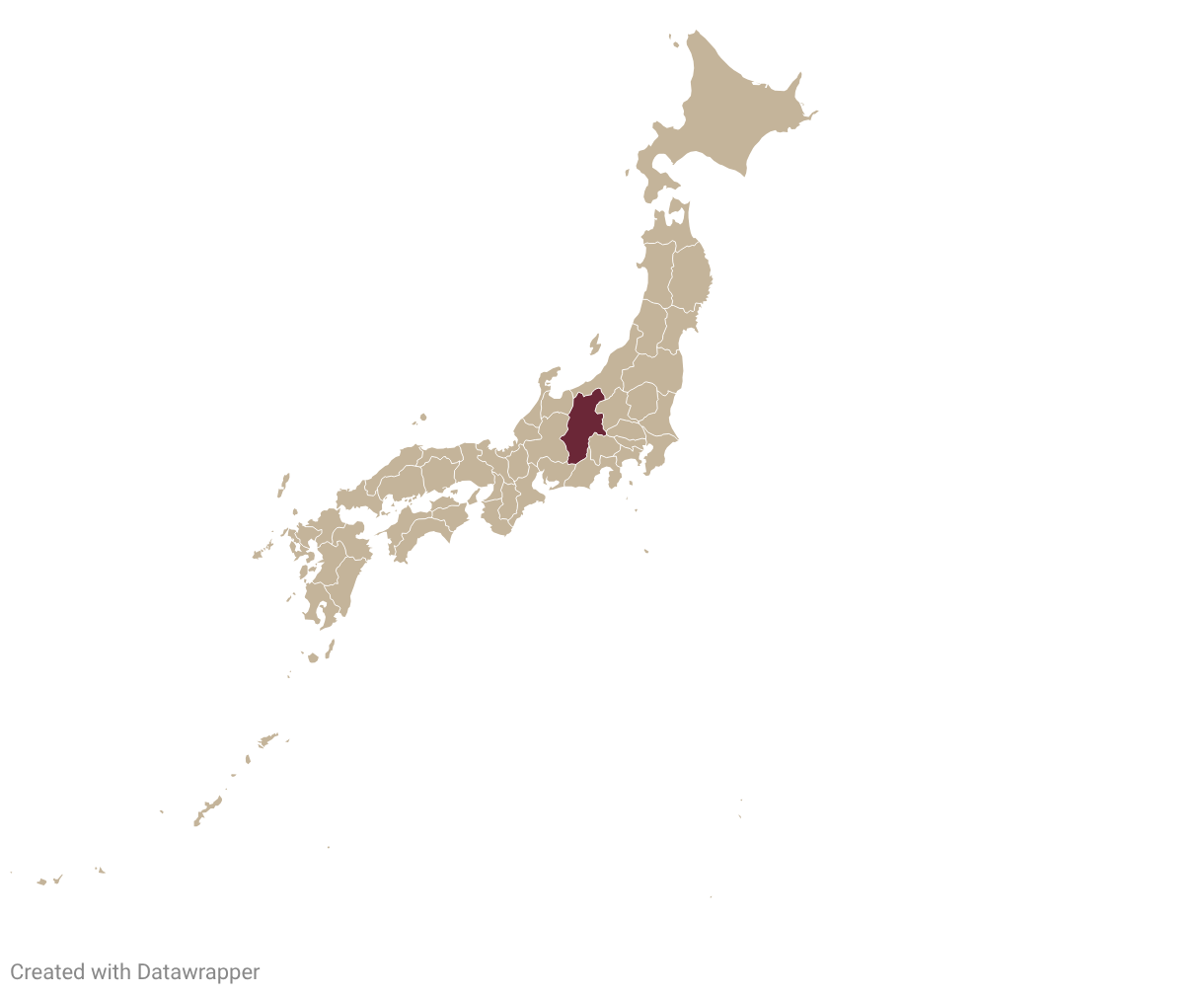
Nagano is a landlocked prefecture at the heart of Japan’s mountainous spine, where elevations rise to nearly 3,000 meters and vineyards perch on well-drained volcanic terraces between 350 and 950 meters above sea level. That altitude is the defining fact of Nagano wine. The Japanese mainland shares its latitude with the Mediterranean, but monsoon summers and persistent humidity have historically defeated serious viticulture at lower elevations across the country. Nagano’s mountain geography provides a natural escape: the same alpine walls that exclude monsoon rainfall also generate the diurnal temperature swings—sometimes exceeding 20 degrees Celsius between day and night—that allow grapes to accumulate phenolic complexity while retaining the acidity that gives fine wine its structure. At 700 meters, a difference of 100 meters in elevation can mean a five-degree shift in growing season temperature. When Japan revised its geographic indication laws in 2018 and created the Nagano GI, it was in effect recognizing what local producers had understood for decades: that altitude here is not merely altitude, but a form of terroir.
The region’s signature site is Kikyogahara, a high plateau near Ueda at roughly 700 meters, where Château Mercian—the wine arm of the Kirin beverage group—has cultivated Merlot since 1976. The Kikyogahara Merlot has become Japan’s most closely watched red wine, drawing comparisons to Pomerol for its structural weight and textured mid-palate. In 2024, Château Mercian became the only Japanese winery selected for a fifth consecutive year by World’s Best Vineyards and ranked 59th among the world’s top wineries. But Nagano’s story extends well beyond a single estate. The Chikuma River valley, running the length of the prefecture, hosts a concentration of small-scale producers working with Merlot, Chardonnay, Cabernet Sauvignon, and Pinot Noir. Nagano is the largest producer of both Merlot and Chardonnay grapes in Japan, figures that reflect both the region’s suitability and its ambition. The southern Ina Valley—where vineyards climb toward 900 meters—is producing Chardonnay of notable precision, with wines that carry the characteristic mineral tension of high-altitude sites. The common thread across all these efforts is restraint: wines that carry the altitude’s imprint in their freshness and tension rather than volume and extraction.
Altitude as Vocabulary
Nagano sits at the intersection of two directions in Japanese wine. The international school—Château Mercian foremost among them, with consulting ties to Bordeaux—has demonstrated that the prefecture can produce internationally competitive varietals at a level that draws serious attention from the global wine establishment. But a quieter, more experimental cohort of smaller producers is exploring what happens when European varieties are pushed toward the local expression. This manifests in concrete ways: longer skin contact on Chardonnay to develop texture; old-vine Merlot from sites that have had forty-plus years to develop rootstock complexity; Pinot Noir harvested for fragrance and transparency rather than extraction. These are not rejections of the international standard but interrogations of it. They ask: what does Merlot want to be at 800 meters in a volcanic region where the night temperature drops 20 degrees?
The Conversation Continues
The conversation Japan is having with itself about wine identity—imitation versus expression, volume versus vision—is most visible in Nagano. The prefecture accounts for roughly 50 wineries producing serious wine, with about 15-20 of those commanding critical attention. This is not a large number by Californian or French standards, but in Japan it represents a concentration of intention. The altitude is high enough, and the ambition deep enough, that both paths—the international and the local—remain genuinely open. Nagano is not forced to choose between being Japanese and being serious about wine. The altitude allows it to be both. In a landscape where 80 percent of farmland sits above 500 meters elevation, where the diurnal swings reach 20 degrees between day and night, and where volcanic soils provide mineral precision, Nagano has found the terroir language it needed. The future of this region will not be written in international competition scores, though those will likely improve. It will be written in the quality of its next generation of producers, the depth of their commitment to their specific sites, and their willingness to let altitude teach them what their wines should become.
“The altitude here certainly helps moderate climate, and the result is wines with a natural freshness.”
— Jamie Goode, wineanorak.com
The Wine Districts
Four principal wine districts shaped by elevation, river systems, and volcanic soil — from the famous Kikyogahara plateau to the high-altitude reaches of the southern Ina Valley.
Prestige
Kikyogahara
Japan’s most celebrated Merlot plateau at 700 metres near Ueda. Château Mercian’s estate has defined the site — structured, textured, and built for the cellar.
Merlot · Chardonnay · Cabernet Sauvignon
Premier
Chikumagawa
The Chikuma River valley forms Nagano’s viticultural spine, hosting the greatest concentration of producers in the GI. Volcanic soils from 350 to 600 metres support expressive Merlot and fresh Chardonnay.
Merlot · Chardonnay · Pinot Noir
Premier
Ina Valley
The southern arm of Nagano’s wine country reaches toward 900 metres, generating the prefecture’s most pronounced diurnal swings. Chardonnay here carries a mineral precision that has drawn comparisons to cooler European benchmarks.
Chardonnay · Merlot · Cabernet Sauvignon
Emerging
Hokushin
Northern Nagano’s gentler terrain around Nagano City, where younger producers are establishing vineyards at 400 to 500 metres. A work in progress — and one of the more interesting ones in Japanese wine.
Chardonnay · Pinot Noir · Merlot
Last updated: April 2026
Related Stories
The latest from our coverage of Nagano wines and producers.
The next one arrives Thursday.
Vintage intelligence, producer profiles, and curated cellar picks — before the critics weigh in. Weekly dispatch.