

The Atlas › The Americas › Chile › Itata & Maule
Itata & Maule
Where Chile’s oldest vines remember the past, and a new generation refuses to forget.
3
·
Mediterranean
·
100+ Years
·
Granite
VARIETIES
País · Cinsault · Carignan · Muscat
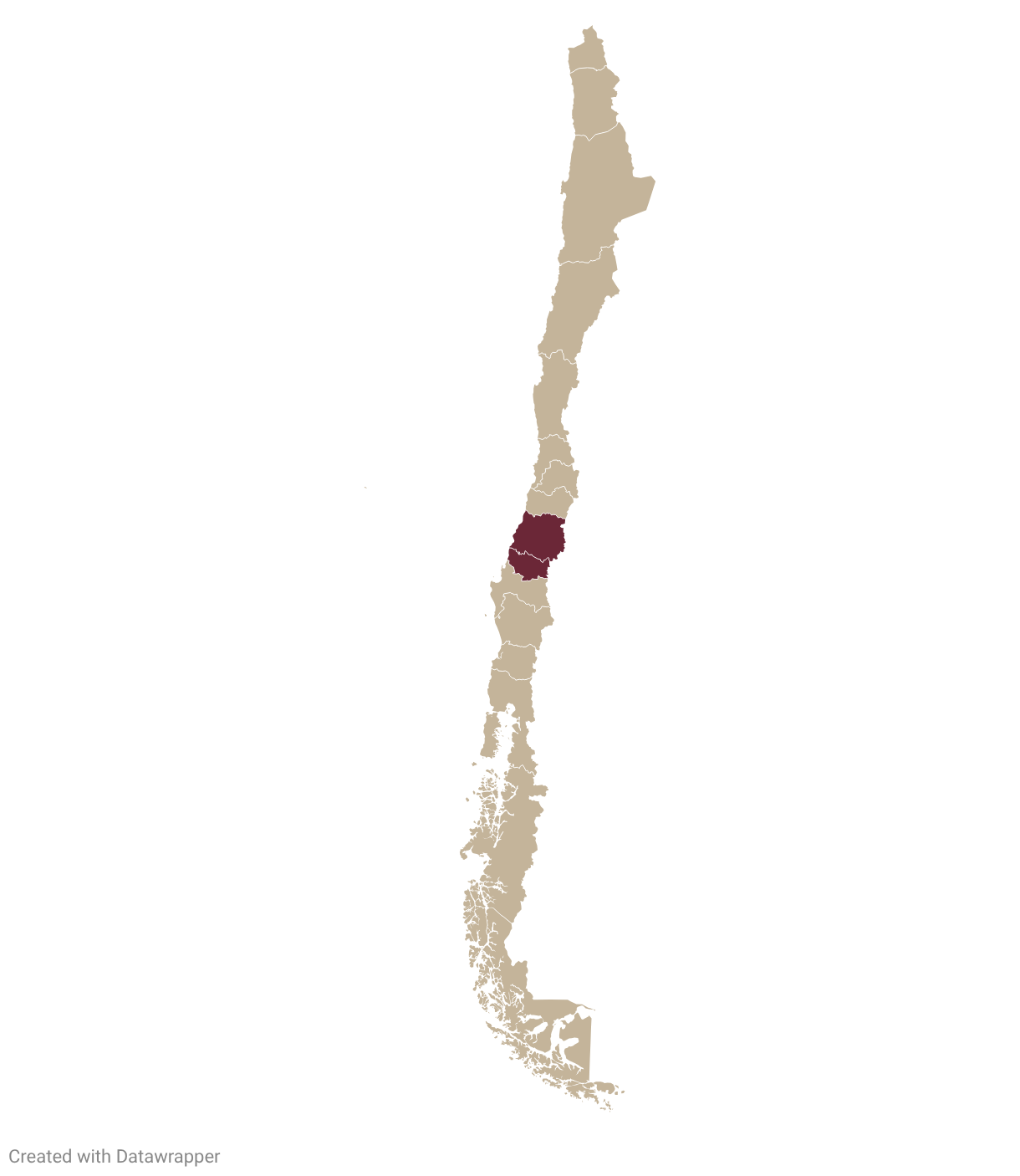
Maule and Itata are the South’s memory. In these regions, south of the Central Valley, you will find gnarled vines planted before the phylloxera crisis reached Chile, bush-trained specimens of País (also called Listán Prieto) and Carignan that have survived 100, sometimes 150 years without grafting, their roots driven deep into granite soils and clay. These vineyards are not museums—they are working land, mostly neglected for decades by the industrial wine economy that favored irrigated, replanted young vines. For the bulk of the twentieth century, Maule’s old-vine Carignan was blending wine, a utility player added for color and acidity to someone else’s flagship bottling. Then, beginning in the 2000s, a coalition of winemakers—Leonardo Erazo, Pedro Parra, Christian Sepúlveda—began asking whether these ancient vines deserved to be heard as solo voices.
Maule’s landscape is a contradiction: industrial bulk production sprawls across the valley floor, while in the Secano Interior—the dry interior—sit the old-vine parcels that are now attracting international attention. Carignan, once quantity’s tool, has become the region’s standard-bearer, its wines expressing a mineral austerity and dark-cherry depth that speaks to the granitic soils and lean farming practices. País, the variety that sustained colonial Chile, has been rediscovered for its wild, untamed character when treated as a primary grape rather than a blending afterthought. Itata carries an even older lineage—pre-phylloxera genetics that survived because the louse never fully took hold in these southern districts. The VIGNO movement (Viñadores de Carignan), formalized in 2009, codified standards for old-vine Carignan production: dry-farmed, gobelet-pruned, vines older than 30 years, a minimum of 65 percent Carignan in the blend, and aging in barrel for at least two years. In enforcing these rules, VIGNO transformed what might have remained a marginal agricultural resource into a collective brand of integrity.
What the Old Vines Remember
A vine that has spent a century in the same soil accumulates knowledge—knowledge expressed not in words but in the mineral signature of the wine it produces. Pedro Parra, the terroir specialist who has become a central figure in Maule’s old-vine renaissance, speaks of granite as a text to be read. His white-granite soils of Itata and southern Maule carry particular purity. The granite that produces the finest wines, he explains, is nearly colorless, low in ferric oxidation, and characterized by what he calls the “chambolic” sensation—that chalky, flinty minerality that emerges in the mid-palate and lingers long after the wine is swallowed. This minerality is not a hint of barrel or a winemaking artifact; it is the direct expression of soil, visible only in wines made from old vines in low-yield parcels.
Maule remains a region of profound contradiction. On the valley floor, corporate operations manage thousands of hectares of young, irrigated vines destined for bulk production and industrial blending—a necessary economic engine for rural employment but a force that, for decades, made artisanal old-vine farming economically unviable. Prices for Carignan grapes languished at cents per kilo; farmers saw no reason to maintain vines that would never be recognized or compensated fairly. VIGNO reversed this equation. By creating a collective brand and enforcing quality standards, the movement raised prices dramatically, allowing farmers to stay on the land and invest in their vineyards rather than replant. Producers like Garage Wine Co., sourcing from small family plots, have built international reputations on parcels that would have been abandoned a generation ago.
The Industrial Tension
This tension—between industrial agriculture and artisanal revival, between replanting and preservation—is not a liability. It is the engine driving Maule’s current reinvention. The bulk economy provides stability and employment; the old-vine movement provides ambition and identity. Neither can exist without the other. Carignan from 80-year-old, dry-farmed vines carries the “chambolic” signature as distinctly as any noble grape. So does País, when its vines are treated with the care and respect the plant demands. The new generation of Maule and Itata winemakers understands that the old vines are not relics but resources—living archives of pre-industrial viticulture that produce wines of complexity no young vineyard can replicate.
Itata and Maule represent a different model of terroir expression than the coastal cool-climate valleys or the Andean foothills. Here, the story is not about climate precision or elevation manipulation but about time—the time it takes for a root system to explore hundreds of centimeters of soil, the time needed for a grape variety to evolve from novelty to mastery, the time required for a generation of winemakers to convince the market that old, humble varieties deserve attention. For those willing to approach these wines with patience and curiosity, they offer a reward that newer regions cannot: the taste of deep history, the evidence of a place asserting itself across decades. This is not marketing. This is memory made drinkable.
“There are many kinds of granites, and my focus has been on the search for a particular granite that provides what I call the ‘chambolic’—that means a chalk sensation of minerality, elegant with good mid palate and providing finesse in the wines.”
— Pedro Parra, Terroir Consultant and Winemaker
The Sub-Appellations
Ancient País vines and a natural wine renaissance in Chile’s ancestral heartland.
DO
Itata Valley
Colonial wine pioneer now quietly significant, producing wines of heritage and character. Traditional mixed farming preserves old Muscat and País vines on granitic soils with centuries of unbroken viticulture.
País · Cinsault · Carignan · Muscat
DO
Maule Proper
Commercial heart of the macro-region, producing diverse and approachable reds and whites with genuine terroir clarity. Warm continental conditions tempered by coastal maritime influence from the Pacific.
País · Cinsault · Carménère · Carignan
DO
Loncomilla
Andean foothills sub-zone where elevation and mountain influence create mineral precision. Higher sites produce cooler-climate expressions — structured Carignan with notable aging potential.
Carignan · País · Cinsault · Muscat
Last updated: April 2026
Related Stories
TERROIR’s coverage of Itata & Maule — old-vine producers, natural wine, and the southern heartland of Chilean wine.
The next one arrives Thursday.
Vintage intelligence, producer profiles, and curated cellar picks — before the critics weigh in. Weekly dispatch.