

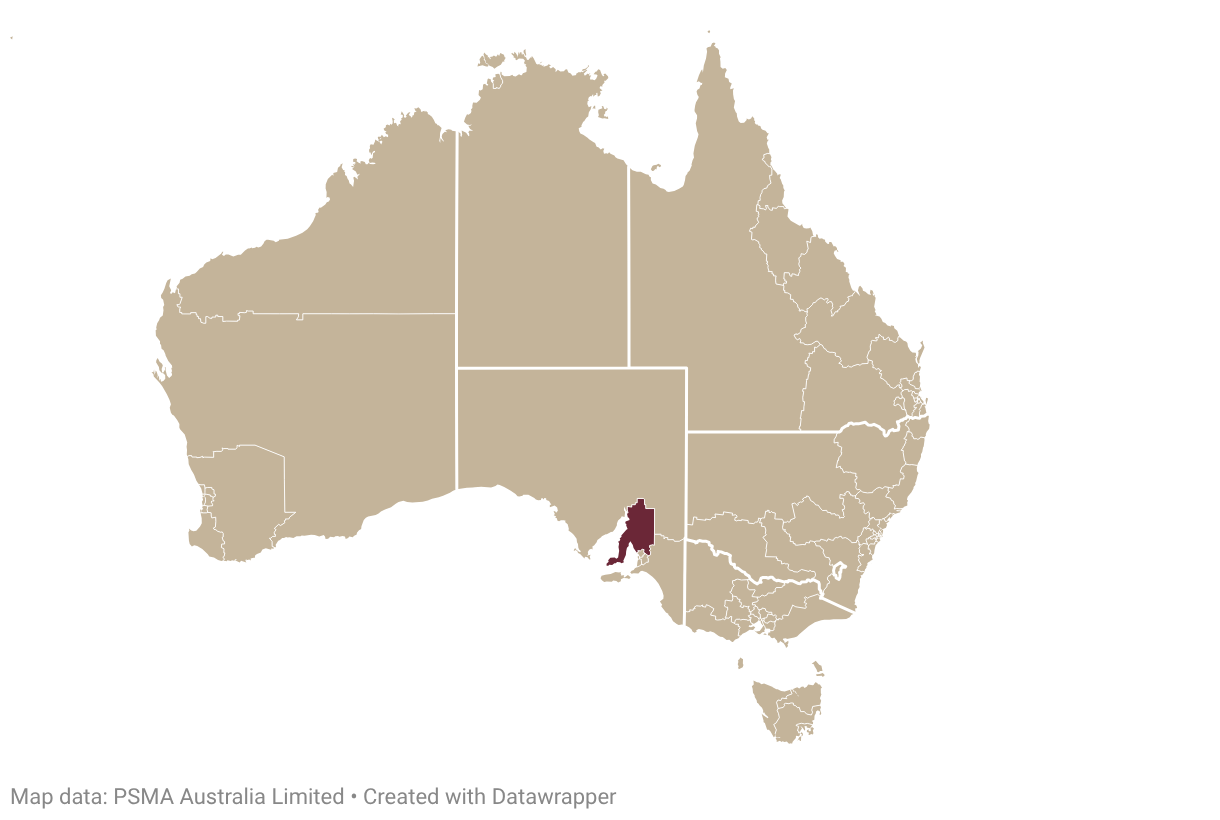
Barossa Valley
Where German heritage meets Australian sun, creating bold, full-bodied Shiraz of legendary intensity.
2
·
Hot Continental
·
~26,000 ha
·
1842
VARIETIES
Shiraz · Grenache · Riesling · Mataro · Cabernet Sauvignon
In 1842, Silesian Lutheran refugees arrived at Bethany, a settlement 70 kilometres northeast of Adelaide, carrying with them more than six generations of wine knowledge and a determination to preserve their faith through viticulture. George Fife Angas, an English shipping merchant and philanthropist, had purchased the Barossa Valley land and sought immigrant tenants; the Lutherans fleeing religious persecution in Prussia found refuge and purpose in a shallow basin of red-brown loam that would become one of the New World’s most consequential wine regions. The settlers established their vineyards in the traditional Hufendorf pattern, long narrow holdings along Tanunda Creek, and in doing so preserved vine stocks that would survive the phylloxera outbreak ravaging Europe. This accident of geography created a living heritage: pre-phylloxera Shiraz plantings from the 1840s and 1850s that produce barely a tonne per hectare from root systems that penetrate metres into the subsoil, yielding fruit of extraordinary density with dark plum, black olive, cedar, and iron-rich earth character that younger plantings on grafted rootstock have not matched in comparative tastings conducted by the Barossa Grape and Wine Association.
The Barossa’s climate is unambiguous. Summer temperatures regularly exceed 35°C, annual rainfall barely reaches 300 millimetres concentrated in winter, and the growing season is long and dry in a way that concentrates sugar, extract, and flavour to levels that have defined Australian wine globally. The region’s reputation was established most decisively by Penfolds Grange, whose first commercial vintage was produced by chief winemaker Max Schubert in 1951, against the explicit wishes of company management, and vindicated by decades of bottle development into a wine that auction houses now catalogue alongside classified Bordeaux and Grand Cru Burgundy. Grange demonstrated that the Barossa could produce wines built for the long haul, and in doing so shifted the region’s identity from a source of bulk wine into a serious competitor for collector attention.
The Paradox of Preservation
The Barossa’s old-vine legacy faces a paradox that defines the region today. The 1970s saw devastating grape surplus and estate consolidation that threatened to uproot vineyards planted by settlers’ descendants. Peter Lehmann, who established his winery in 1979, made a decisive choice: “I’ll take your grapes and turn them into wine,” he told growers desperate to preserve their patrimony. Since then, the region has cultivated what the Barossa Old Vine Charter, introduced in 2007, now recognises as more than 100 hectares of vines exceeding 100 years in age. Yet the economics of old-vine viticulture remain unforgiving. Gnarled Shiraz and Grenache vines planted in the 1850s produce yields of barely one tonne per hectare; commercial pressure drives consolidation toward higher-yielding, younger plantings. A younger generation of producers—Standish, Torbreck, and Hentley Farm among them—has complicated Barossa’s monolithic Shiraz reputation by reaching deeper into its heritage, rescuing Grenache and Mataro from old bush vines and fermenting them with the seriousness once reserved for the flagship variety.
This preservation is not nostalgic whimsy but a conscious rebuttal to a reductive narrative. For decades, the region marketed itself as the home of “big Barossa Shiraz,” a phrase that subordinated complexity to power. The reality is far more layered. Shiraz from the valley floor, Grenache from century-old bush vines, Mataro from parcels overlooked during the modernization wave: these varieties expressed in old-vine form create a texture and discipline that younger vineyards cannot achieve. The question facing the Barossa today is whether this old-vine heritage can be preserved against the pressures of climate warming, estate consolidation, and the relentless logic of agricultural economics.
The Architecture of Terroir
The Barossa’s geography reveals itself most clearly in the contrast between its two distinct zones. The valley floor, red-brown loam over clay, uniformly hot and dry, produces Shiraz of plush concentration and power. Eden Valley, rising from the valley’s eastern edge to between 400 and 600 metres, provides a structural counterpoint that fundamentally rewrites the region’s narrative. Temperature differentials of two to three degrees Celsius during the day and five to seven degrees at night create diurnal variation that preserves natural acidity. The soils shift from red-brown clay to metamorphic gravel over clay, free-draining, porous terrain that yields wines of angular precision. Here, Riesling achieves a lime-blossom and slate-mineral expression that James Halliday has ranked alongside Clare Valley as Australia’s two definitive Riesling regions, while Shiraz develops a restrained pepper-and-spice character that reads as counterpoint to the valley floor’s plush density.
TERROIR recognises that the Barossa’s greatest wines emerge not from a single zone or grape, but from the interplay of old-vine root systems responding to subtle variations in elevation, soil, and thermal regime. Yalumba’s The Octavius Old Vine Shiraz, sourced from vines dating to 1854, 1901, 1919, and 1920, demonstrates what pre-phylloxera material can express when permitted to mature into naturally-sculptured form. The region’s response to climate warming, earlier harvesting, elevation-seeking, dry-farming discipline, reads as the opening chapter of an adaptation story that will define Barossa wine for the next generation. In this moment, the region’s oldest vines are not relics but protagonists, their longevity a form of insurance against a future in which consistency and mineral precision become rarer than power.
“’The Barossa of today is a bustling wine region, full of confidence about its future, its history and culture proudly displayed wherever you look.”
— James Halliday, Wine Companion
The Sub-Zones
From the heat-soaked valley floor to the cool ridge of Eden Valley — Barossa’s two distinct zones each bring a different expression of the region’s old-vine legacy.
Prestige
Eden Valley
Barossa’s elevated counterpoint — rising to 400–600 metres, Eden Valley trades raw valley heat for structural elegance. Riesling achieves a lime-blossom and slate precision here that has no peer in Australia, while Shiraz develops a peppery restraint in marked contrast to the valley floor’s plush density.
Shiraz · Riesling · Cabernet Sauvignon · Viognier
Major
Barossa Valley Floor
The historic core of the region — red-brown loam over clay, phylloxera-free since European settlement, where 150-year-old Shiraz vines yield barely a tonne per hectare. The valley floor is where the Barossa’s legend was built and where its most powerful wines continue to originate.
Shiraz · Grenache · Mataro · Cabernet Sauvignon
Heritage
Seppeltsfield
The historic heartland of the Barossa, home to Seppeltsfield Estate’s living centennial wine collection — the only winery in the world releasing a 100-year-old barrel-aged tawny every year. Creek-fed red-brown loam soils here produce Shiraz of exceptional richness and longevity.
Shiraz · Grenache · Mataro · Tawny
Last updated: April 2026
Related Stories
The latest from our Barossa Valley coverage.
The next one arrives Thursday.
Vintage intelligence, producer profiles, and curated cellar picks — before the critics weigh in. Weekly dispatch.