

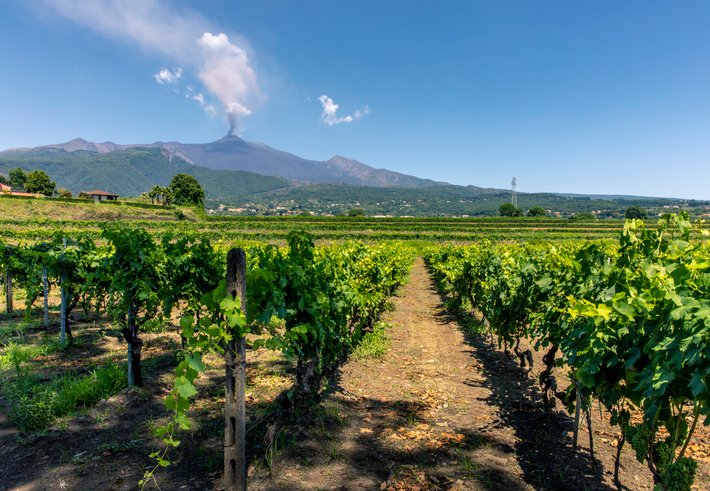
On the east face of Mount Etna, above the village of Milo, the vines work a different geometry. The alberello-trained Carricante that grows in the Caselle contrada at 800 meters above sea level loses the sun by five o’clock. It faces the Ionian Sea. The soil is sand-and-pumice, the legacy of lava flows whose dates the growers cite the way Burgundy cites climats. And Etna Bianco, the wine that comes from those vines, was until very recently treated as a secondary product of a region defined by its reds.
That premise has been quietly collapsing. On 10 November 2023 the Consorzio Tutela Vini Etna voted by a strong majority to seek DOCG elevation for the appellation, with Etna Bianco at the structural center of the proposal. In late October 2025 the Italian Ministry of Agriculture’s deputy chief of staff, Patrizio D’Andrea, framed the final stretch as a 60-day, 100-signature push toward the double majority of producers and registered land that an elevation requires. The Consorzio is targeting ratification in time for the 2026 harvest. The growers themselves think 2027 is the realistic floor.
The Vote and the Sprint
The thesis underneath the petition is older than the news cycle. SevenFifty Daily reported, in coverage of the appellation’s first-half 2023 trade data, that Etna Bianco DOC volume had risen 19 percent year on year and the Superiore designation by 120 percent over the same period. Consorzio president Francesco Cambria expected the whites to approach parity with the reds in the near term. The grower count tells the same story at the producer scale: where the appellation had around 200 growers in 2013, it has roughly 474 registered operators today, a near-doubling that makes the signature-collection logistics of a DOCG bid genuinely complicated.
Like this? The TERROIR Letter arrives every Thursday.
The petition reaches beyond Bianco. The scope, as DoctorWine reported after the November 2023 vote and as the Italian trade press has covered through October 2025, includes a Spumante category built on Carricante with a Pas Dosé option and a tightening of yields in Etna Rosso. Further elements covering the appellation’s contrada count and municipal labelling have been discussed in trade press but await confirmation in the finalised petition text. It is a single regulatory move engineered to land a category that has spent a generation arguing for itself.
Caselle and the Argument for Altitude
The grape at the center of the petition is Carricante. The DOC rules require 60 percent of the blend in Etna Bianco and 80 percent in the Superiore designation, and the Superiore is allowed from a single sub-zone: Caselle, within the commune of Milo on the volcano’s east face. The combination of altitude, with most vineyards sitting above 600 meters, Ionian-facing aspect, and shortened afternoon sun produces a wine of measurable acidity and a saline finish that does not soften the way warm-climate whites typically do. The sandy, loose volcanic soils have a second consequence: phylloxera, the louse that destroyed European viticulture in the late nineteenth century, struggles to take hold in them. A meaningful percentage of east-face Carricante grows on ungrafted vines, many of them more than a century old.
Three Producers, One Volcano
Benanti’s Pietra Marina is the bottle that did the early arguing. Sourced from the Rinazzo contrada in Milo at 800 meters, the vines are alberello-trained bush vines, many of them decades old. Pietra Marina rests for an extended period on its lees in stainless steel before further bottle aging, a regime that places it closer in spirit to white Burgundy than to the picked-young coastal whites Sicily is more often associated with. Pietradolce’s Archineri Bianco takes the case further: some of its vines pre-date phylloxera’s arrival in Sicily in the 1880s. The wine is steel-aged with extended bottle rest before release.
Graci’s Arcurìa Bianco offers the counterpoint. Arcurìa sits on the north face of Etna near Passopisciaro, on the opposite side of the volcano from the east-face Grand Cru argument. The wine is aged in large neutral oak. The north slope is cooler and the soils differ. That a grape can produce a structurally serious wine from two opposed exposures is the argument against treating Caselle as Carricante’s only legitimate home, even as the appellation’s regulatory framework moves to anoint it.
What Time Does to Carricante
Young Carricante reads as citrus pith, white blossom, grapefruit skin, and a smoke-and-salt finish. With 10 years in the cellar, the wine moves into a register often described as preserved lemon, candied ginger, chamomile, toasted almond, and beeswax. Older bottles develop a flint-and-petrol note that is genuinely Riesling-adjacent. The category of age-worthy Italian whites is narrow: Soave Classico from named producers, Fiano di Avellino from the Mastroberardino school, and a handful of north-east whites. Carricante earned its place in that company before the DOCG petition was drafted.
The terroir argument has one more wrinkle. Each major lava flow that has reshaped the volcano, with 1614, 1879, and 1928 among the catalogued ones, deposits a distinct mineral profile and rebuilds the soil from a different starting point. Contrada boundaries trace flow lines as often as they trace cadastral lines. A vineyard planted on older soils sits on more weathered mineralogy than the parcel across the road planted on a younger deposit. The vintage of the lava becomes a terroir variable, terroir as chronology rather than fixed map.
Already Important
When the DOCG paperwork lands, in 2026 or 2027 or whenever the signatures and the Ministry align, Carricante will not become important. It has been quietly important since Benanti began bottling Pietra Marina in the late 1980s and since a generation of east-face growers decided the appellation deserved a serious white. What ratification does is signal that the rest of the wine world has caught up to what the Consorzio’s growers, and the volcano itself, have been saying for years. The bottle has not been waiting for permission.
The TERROIR Letter
The story behind every bottle.
One feature. One dispatch. One bottle worth opening. Every Thursday — free.