

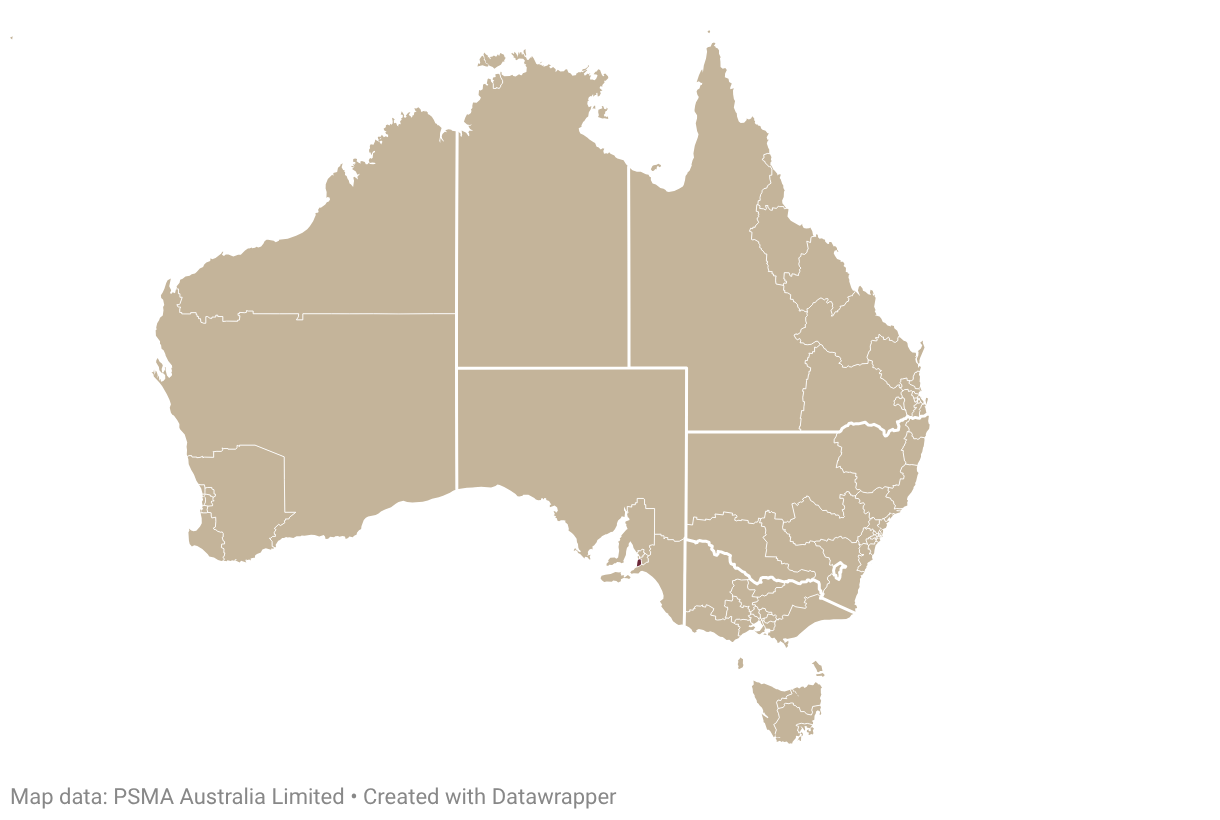
McLaren Vale
A coastal paradise where maritime influence and ancient soils produce Shiraz and Grenache of remarkable character.
~3,600 ha
·
Mediterranean
·
2 Sub-Regions
·
1838
VARIETIES
Shiraz · Grenache · Cabernet Sauvignon · Mourvèdre · Vermentino
In 1838, John Reynell arrived in South Australia with vine cuttings from his travels through Egypt and the Cape, and planted them on a sloped parcel of land 35 kilometres south of Adelaide. He released his first vintage in 1842. That single act—a farmer from Devonshire bringing foreign rootstock to an unfamiliar climate—planted the seed for what would become Australia’s oldest continuous wine region. Reynell’s gamble proved the McLaren Vale peninsula could produce wine worthy of the name: not trophy wines of industrial power, but wines of balance, of place, of a particular and transferable idea about how warmth and maritime moderation could marry on a single vineyard floor.
For nearly a century and a half, Reynell’s descendants and the winemakers who followed cultivated this peninsula with minimal fanfare. McLaren Vale supplied bulk wine to the Barossa, filled cooperages for larger houses, and remained a footnote in Australia’s wine story. It took until the 1980s and 1990s for the region to claim its own identity, not despite its Mediterranean character, but because of it. The combination of latitude, the Mount Lofty Ranges to the east, the Gulf St Vincent to the west, and a reliable afternoon sea breeze that can cool temperatures by as much as 10°C in late afternoon proved to be not a limitation but a defining asset. What Reynell intuited in 1838, the region’s modern producers came to understand in their bones: McLaren Vale’s restraint was its argument.
The Stereotype That Obscures the Actual Wine
For decades, McLaren Vale suffered under a particular critical shadow: it was known for “big warm Shiraz,” for wines of power and ripeness, for the kind of fruit-forward expression that seemed to confirm every cliché about Australian warmth. The stereotype persisted even as the region’s best producers had already moved beyond it. D’Arenberg, Wirra Wirra, Yangarra Estate, and others had spent years cultivating Shiraz of fragrant complexity: dark chocolate, dried herbs, graphite minerality, wines that bore little resemblance to the caricature. What actually distinguishes McLaren Vale Shiraz is not its power but its silkiness, not blunt extraction but savoury precision. The wines ripen fully under the Australian sun, yes, but the evening sea breeze extends the growing season and preserves acidity. The result tastes markedly different from the northern Barossa: less dense iron-and-earth architecture, more perfume, more balance.
More recently, Grenache has emerged as the region’s most compelling expression of this terroir. Old-vine plantings in Blewitt Springs and Willunga, vines planted as far back as 1896 growing in the region’s distinctive deep Maslin sand over ironstone and clay, now produce wines of rose-petal fragrance and blood-orange complexity. A younger generation of winemakers has pushed further still, exploring minimal intervention and alternative Mediterranean varieties that thrive in the region’s climate: Vermentino, Nero d’Avola, Fiano, Sangiovese, and Tempranillo. The McLaren Vale of 2026 looks nothing like the McLaren Vale that critics caricatured. Yet the old reputation persists, a ghost story no one quite believes but everyone still tells.
The Land Reads as Flavour
The region’s soils are its most articulate argument. Over 40 distinct soil types have been mapped across the peninsula: sandy loams and clay on the valley floor, ironstone and quartzite on hillside slopes, the Maslin sands of Blewitt Springs that amplify Grenache’s aromatics, and in certain pockets a fossil-limestone matrix that imparts saline minerality to everything it touches. A vine planted in red-brown earth near McLaren Flat will produce a wine tasting markedly different from one grown 10 kilometres away in Willunga’s clay-rich soils, which will taste again different from Clarendon’s higher-elevation sites. Stephen Pannell, one of the region’s most articulate voices, has observed that terroir should be the primary conversation in wine: “The most important thing about wine is that it should taste like it comes from somewhere.”
This specificity has become McLaren Vale’s true signature. Not a region that makes one type of wine, but a region where the land itself dictates what the wine will say. The sea breeze arrives each afternoon without fail, moderating heat and extending the ripening window. The peninsula’s various microclimates reward different varieties: Shiraz on the warmer sites, Cabernet on elevated slopes, Grenache in Blewitt Springs’ ancient sands, Fiano and other whites in cooler maritime pockets. The best producers, those building lasting reputations rather than chasing points, have learned to listen to what each vineyard is trying to say. TERROIR tastes McLaren Vale not as a warm region, nor as a big wine country, but as a maritime terroir of quiet authority and sensory precision.
“The most important thing about wine is that it should taste like it comes from somewhere. Grape varieties express that. They’re like the colours that paint the landscape.”
— Stephen Pannell, S.C. Pannell Wines
McLaren Vale's Sub-Regions
Two distinct sub-zones define McLaren Vale’s cool southern arc — each shaped by proximity to the Gulf St Vincent and elevation above the valley floor.
Prestige
Blewitt Springs
Fossil-limestone corridor producing wines of saline mineral precision. Old-vine Grenache from ancient sandy soils here ranks among the most distinctive in Australia.
Grenache · Shiraz · Cabernet Sauvignon · Vermentino
Major
Clarendon & Willunga
Elevated Clarendon sites deliver structured Cabernet of genuine complexity, while maritime-cooled Willunga channels the Gulf St Vincent’s moderating influence into wines of coastal elegance.
Cabernet Sauvignon · Shiraz · Chardonnay · Grenache
Last updated: April 2026
Related Stories
TERROIR’s McLaren Vale coverage — appellations, producers, and vintages worth knowing.
The next one arrives Thursday.
Vintage intelligence, producer profiles, and curated cellar picks — before the critics weigh in. Weekly dispatch.