

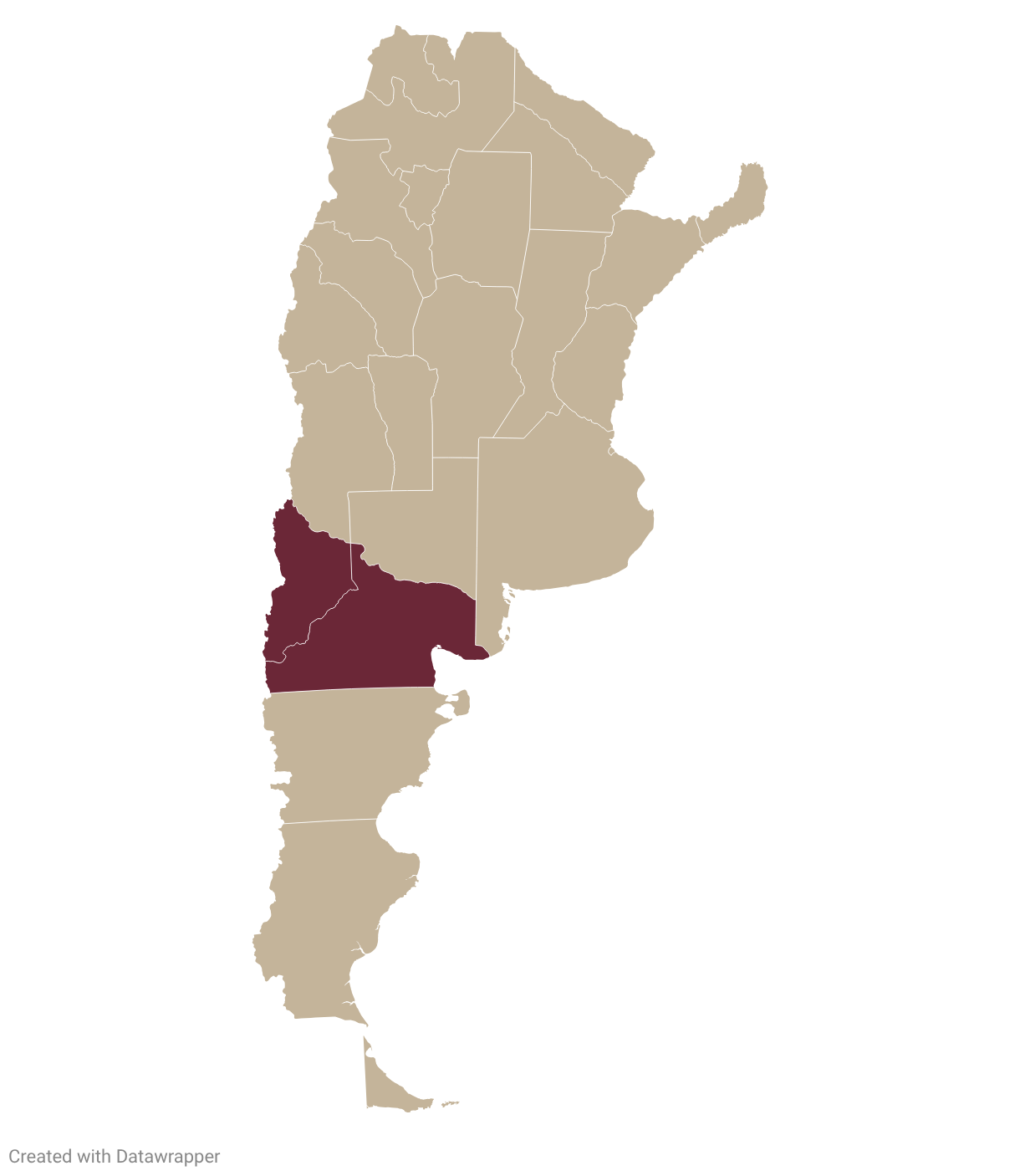
Patagonia
Where southern latitude and continental drift converge to forge Pinot Noir on the precipice of possibility.
2
·
Cool Continental
·
Pinot Noir
·
~4,000 ha
VARIETIES
Pinot Noir · Chardonnay · Riesling · Merlot
In 1909, Humberto Canale arrived in Río Negro with an audacious conviction: that the harsh, wind-scoured floodplains of Patagonia could yield wines. He acquired 400 hectares of what locals deemed inhospitable territory, imported the tools for viticulture, and planted his first vines in 1912. A century later, five generations of his family are still there, proving that some acts of faith compound with age. But Patagonia’s true metamorphosis came a century on, when an Italian nobleman tasted a Pinot Noir at a New York wine bar and saw in its structure the mirror of a region he had never visited. In 2003, Piero Incisa della Rocchetta founded Bodega Chacra on a 1932 vineyard that had been quietly sleeping. That vineyard, those few acres of old vines, became the foundational argument: Patagonia was not marginal. It was inevitable.
Río Negro’s cool continental climate—where day-night temperature swings exceed 20 degrees Celsius—slows ripening and preserves acidity in a way that few terroirs south of 40° South can achieve. The region’s gravel-rich alluvial soils, legacy of ancestral glaciation, demand that vines work for water and nourishment. Elevation hovers around 300 metres, low enough that autumn frost remains a calculated risk, high enough that the sun’s intensity is tempered by the Southern Hemisphere’s latitude. The region’s defining feature, though, is not geology but meteorology: the Patagonian wind, constant and south-bearing, is less an affliction than an architect. It drives down humidity, reduces fungal pressure, and forces the vine’s canopy into a perpetual state of structural reinvention.
Where the Wind Is Winemaker
The productive tension in Patagonia is not between tradition and innovation, but between constraint and precision. The region’s climate and altitude impose non-negotiable limits: if you violate them, the wine suffers visibly. Pinot Noir dominates not because marketing chose it, but because the cool conditions and acidic terroir make Cabernet and Syrah difficult to ripen fully. The vine, here, is under constant negotiation with its environment. Yields must stay low, ripening must be coaxed rather than assumed, and the winemaker’s hand must remain light. There is no room for excess.
Hans Vinding-Diers, the Danish winemaker who established Bodega Noemía in the Maiqué microclimate, has embedded himself in this philosophy for two decades. His vineyards sit at just 218 metres above sea level, yet the thermal amplitude and soil composition yield Malbec, Pinot Noir, and Sauvignon Blanc with an intensity that recalls cool-climate northern Europe. His approach is old-world in practice and minimalist in intervention: natural yeast, low sulfite additions, and a belief that the wine’s character emerges from restraint, not manipulation. This is not an aesthetic choice. It is a necessity born from terroir that brooks no carelessness. The soil’s high gravel content, mixed with limestone and alluvial deposits, creates a natural filter that forces the vine’s roots deep and slow.
The Frontier That Chose Pinot Noir
Patagonia is, fundamentally, an argument against the notion that greatness requires pedigree or antiquity. Humberto Canale’s century-old bodega operates under the weight of history, yes, but also under the freedom of a region that was permitted to choose its own identity rather than inherit one. Bodega Chacra’s Pinot Noir, now benchmarked against notable cool-climate expressions worldwide, was built not on received wisdom but on an act of discovery. The region’s growers learned Pinot not through European apprenticeship but through the plant itself—through seasons of observation, failure, and incremental adjustment. This is how frontier terroirs mature. Not by copying what worked elsewhere, but by listening to what the land demands.
The proof of this philosophy is in the glass. Matthew Luczy of Robert Parker’s Wine Advocate awarded Bodega Chacra’s Cincuenta y Cinco a 96+ rating, calling it “a spectacular example of Patagonian Pinot Noir and one to measure others against.” In barely two decades, Bodega Chacra has established a new benchmark. The wind, the glacial soils, the latitude—these are not obstacles that the winemakers have overcome. They are the winemakers themselves. TERROIR finds in Patagonia not a region following a map drawn by others, but a frontier that drew its own map and, against all historical precedent, discovered that Pinot Noir was the compass all along.
“A spectacular example of Patagonian Pinot Noir and one to measure others against.”
— Matthew Luczy, Robert Parker’s Wine Advocate
The Sub-Appellations
Two river valleys at the 38th to 40th parallel south, where Atlantic winds and Andean cold create Argentina’s most delicate, European-inflected wines.
AVA
Río Negro Valley
Desert river valley running east from the Andes to the Atlantic. Gravel and sandy soils, a 120-day growing season, and Atlantic influence produce lean Pinot Noir of unexpected elegance. Home to Humberto Canale — one of Argentina’s oldest continuously operating wineries, established 1909.
Pinot Noir · Chardonnay · Riesling · Merlot
AVA
Neuquén
Andean foothills at the 40th parallel, where volcanic and limestone soils at higher elevation create wines of tighter mineral structure. Home to Chacra — founded on ungrafted Pinot Noir vines planted in 1932, among the oldest in the Southern Hemisphere.
Pinot Noir · Chardonnay · Riesling · Syrah
Last updated: April 2026
Related Stories
TERROIR’s coverage of Patagonian wine.
The next one arrives Thursday.
Vintage intelligence, producer profiles, and curated cellar picks — before the critics weigh in. Weekly dispatch.