

Baden
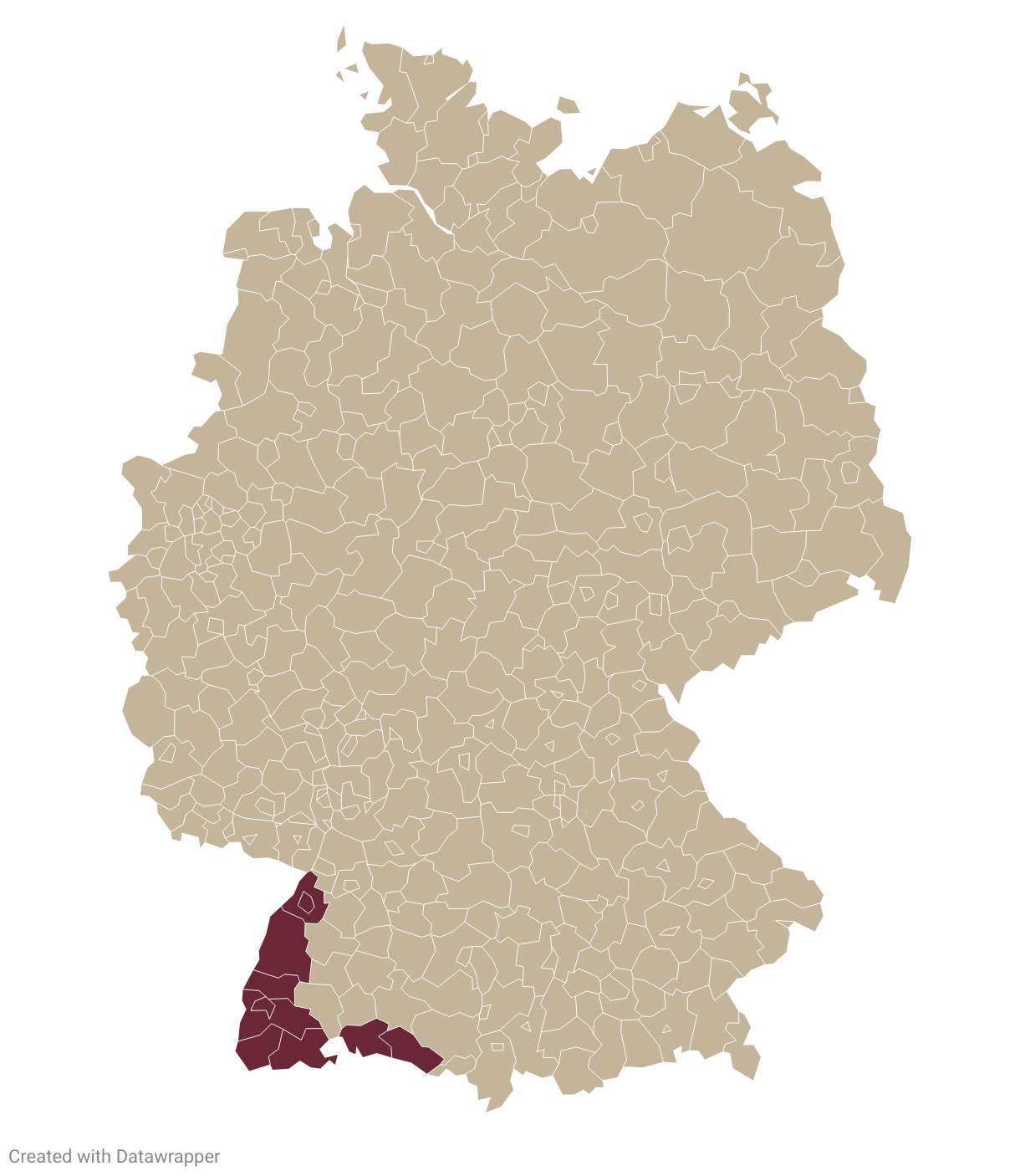
Germany’s warmest and southernmost region produces the nation’s most Mediterranean wines—ripe, full-bodied, food-friendly expressions of volcanic terroir.
3
·
Warmest
·
Spätburgunder
·
Volcanic
VARIETIES
Spätburgunder · Grauburgunder · Müller-Thurgau · Gutedel
The Kaiserstuhl rises like a fist from the Rhine plain, an extinct volcano whose ancient basalt still warms the vineyards that cling to its slopes. This 200-square-kilometer formation, born from eruptions 16 to 19 million years ago, is Germany’s warmest microclimate—a place where the Vosges mountains shield the region from Atlantic moisture and the loess soils hold the Mediterranean sun like a cupped palm. Baden’s founding as a wine region did not happen in a single moment, but rather over centuries of Roman settlement, medieval monasticism, and 19th-century industrialization. Yet the Kaiserstuhl’s geology wrote the story that mattered most: here, in the southwestern corner of the German wine map, conditions arrived that allowed Spätburgunder to ripen with a ripeness and character impossible elsewhere in the country. The region’s official EU classification as Zone B—a designation shared only with Alsace and the Loire Valley—is not ceremony. It is acknowledgment that Baden operates under different rules.
What the Kaiserstuhl created was paradox, and that paradox remains Baden’s defining tension today. The warmth permits yields and ripeness; the fame of the region’s cooperative structure amplified both. Badischer Winzergenossenschaft, one of Europe’s largest wine cooperatives, controls roughly one-third of Baden’s vineyard area. For decades, this arrangement produced volume—reliable, approachable wines that sustained thousands of small growers who could never afford their own cellars. But volume and prestige are not allies, and as the 1990s turned the attention of German wine collectors toward Spätburgunder, Baden’s cooperative model began to feel like a ceiling. The region needed a different identity. It needed proof that volcanic soil and Mediterranean heat could yield wines of complexity, ageability, and command.
The Cooperative Ceiling
This is where the picture fractures into two irreconcilable truths. The Badischer Winzergenossenschaft remains a towering force: it produces at a scale and consistency that few operations in the wine world can match, and it has modernized its production to a degree that deserves respect. Yet standing against this mass are estates—Bernhard Huber, Fritz Waßmer, Salwey, and a cohort of others—whose Spätburgunder bottles have become arguments for a different Baden. Huber’s work in particular has defined the conversation: his dry fermentations, his long aging on the yeast, his insistence on naturally lower yields have produced wines that drinkers in Burgundy recognize as peers. Not homages. Not pale imitations. Peers.
The presence of VDP—the association of Germany’s finest estates—in Baden signals the completion of a generational shift. Twenty years ago, few serious collectors imagined a badge-wearing VDP member in this region. Today the association has chapters throughout the Kaiserstuhl and the three sub-appellations: Markgräflerland to the south, Ortenau to the north, and the volcanic heartland itself. Prices reflect this metamorphosis. A Bernhard Huber Malterdinger Bienenberg Spätburgunder Großes Gewächs trades on the international market at levels that rival village-level Burgundy. The cooperative’s best selections remain modestly priced—€12 to €18 for sophisticated, food-friendly Spätburgunder—yet the estates pushing toward €30, €40, and beyond have reframed what Baden’s climate is capable of producing. These are not wealthy operations selling prestige; they are small producers whose volcanic terroir and decades of estate work have aligned to create wines of dimension that did not exist in the collective imagination of Baden just two decades ago.
The Fire Beneath the Loess
The Kaiserstuhl’s volcanic identity is not merely geological; it is sensory. The loess soils that blanket the extinct volcano’s slopes—glacial deposits laid down tens of thousands of years ago—sit atop a substratum of basalt and volcanic rock that radiates the day’s heat into the night. This thermal mass, combined with the region’s southerly position and the shelter of the Black Forest, allows Spätburgunder to achieve levels of phenolic ripeness that produce wines with a different silhouette than those from the Ahr Valley or the smaller Pinot regions of eastern Germany. Baden’s Spätburgunder is broader in the shoulders, richer in structure, yet retains the delicate tannin architecture that makes the variety transcendent. This is terroir at work—the marriage of soil, heat, and human skill that produces wines no other German region can replicate.
The Markgräflerland and Ortenau sub-regions, though they lack the Kaiserstuhl’s volcanic drama, express their own distinct identities through loess, sandstone, and clay soils that yield wines of surprising minerality. Yet it is the Kaiserstuhl that holds the region’s philosophical weight. When a serious drinker tastes Spätburgunder from Baden and finds something unexpected—a richness that does not collapse into overripeness, a depth that invites reconsideration—they are tasting volcanic inheritance. The wines carry within them the evidence of a geological event millions of years past, translated through modern knowledge of soil and canopy management into an aesthetic argument about what German Pinot can be.
Baden’s future rests not on choosing between the cooperative tradition and the estate revolution, but on recognizing them as two expressions of the same resource: a region whose climate and soils demand excellence and whose growers, from the largest collective to the smallest family operation, are finally understanding what their land was designed to yield. The question is no longer whether Baden can produce Spätburgunder of international standing. The wines have answered that. The question now is whether the region’s identity—its story in the minds of collectors and sommeliers—will catch up to what the Kaiserstuhl’s slopes have already proven possible.
“Baden’s Spätburgunders have quietly achieved a status equal to many Burgundy villages while remaining a fraction of the price—they represent perhaps Germany’s greatest opportunity for serious wine lovers seeking quality and value in equal measure.”
— TERROIR Editorial
The Sub-Appellations
Three distinct zones within Baden each bring their own terroir expression, shaped by volcanic geology, climate, and the influence of French and Swiss viticulture traditions.
Prestige
Kaiserstuhl
Germany’s singular volcanic island rising from the Upper Rhine plain near Freiburg. Weathered basalt and loess soils deliver mineral intensity and heat-retention capacity that define Baden’s finest Spätburgunder and Grauburgunder.
Spätburgunder · Grauburgunder · Müller-Thurgau · Weissburgunder
Major
Tuniberg
A smaller volcanic formation west of Freiburg, adjacent to the Kaiserstuhl, with fertile loess-rich soils. Produces approachable Spätburgunder and Grauburgunder with fruit-forward character and genuine regional typicity.
Spätburgunder · Grauburgunder · Müller-Thurgau · Silvaner
Regional
Markgräflerland
Baden’s southernmost zone near the Swiss border, where limestone and loess soils produce Gutedel of quiet mineral elegance and generous Spätburgunder shaped by the warmth of the Upper Rhine plain.
Spätburgunder · Grauburgunder · Gutedel · Müller-Thurgau
Last updated: April 2026
Related Stories
TERROIR’s coverage of Baden — appellations, producers, and vintages worth knowing.
The next one arrives Thursday.
Vintage intelligence, producer profiles, and curated cellar picks — before the critics weigh in. Weekly dispatch.