

Alentejo
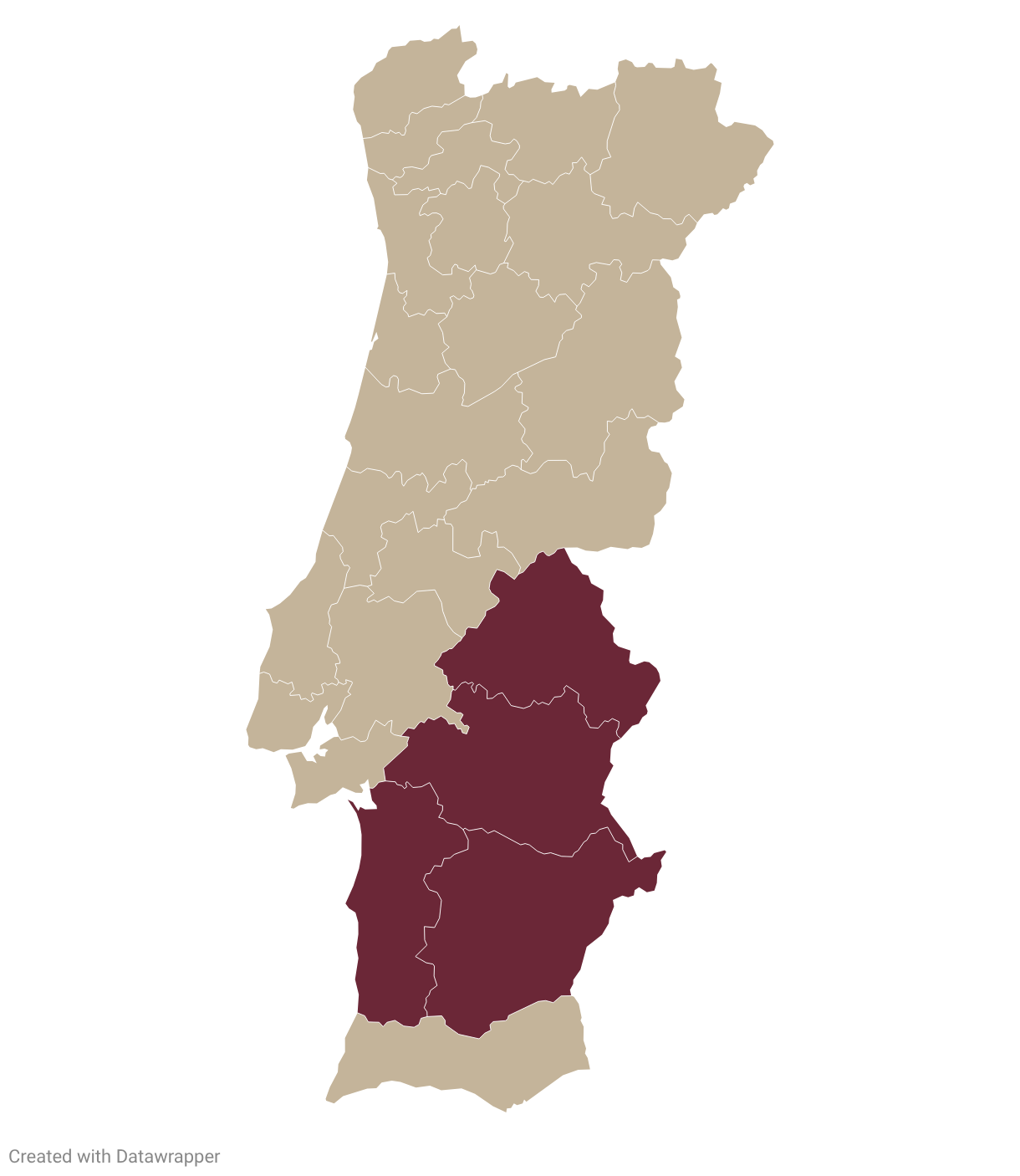
Portugal’s most generous wine country — bold reds born from ancient soils and relentless sun.
22,000 ha
·
8
·
1995
·
~50%
VARIETIES
Alicante Bouschet · Aragonez · Trincadeira · Antão Vaz
On November 11th each year in the Alentejo, a ritual older than Portugal itself reaches its annual terminus. Jars of terra-cotta, some buried in earth for generations, are unsealed and their contents tasted for the first time since harvest. This ceremony recalls a moment when the Romans first pressed grapes into clay vessels on the Iberian peninsula, a practice so resilient it survives in the very villages—Vila de Frades, Vidigueira, Cuba—where it has been performed continuously since the classical era. The talha, as these amphora are known locally, are not mere tools but archaeological witnesses. They hold wine the way medieval monasteries held faith: with reverence for process, patience for time, and acceptance that transformation requires stillness. This tradition, now under consideration for UNESCO Intangible Cultural Heritage status, stands as the Alentejo’s most legible claim to antiquity. Yet for five centuries, the talha remained folklore, a folk memory preserved only in rural hamlets while grand latifúndios shaped the region’s economic reality. Not until the soil itself was redistributed, after 1974, could the Alentejo dream of wine beyond bulk commodity.
The Alentejo that emerged from the Carnation Revolution of 1974 was transformed in ways that transcended politics. The ancien régime had distributed land such that 5% of agricultural operations possessed 85% of the territory, leaving the vast majority as landless laborers. The land occupations of 1974–1975 dispossessed these latifúndios and established some 400 cooperatives across the province, many bearing names that announced their ideological pedigree. What might have become a footnote in agricultural history instead became the condition for modern wine. The cooperatives, however uneven their initial success, seeded a new class of farmer-proprietors who could, for the first time, imagine quality over volume. The Alentejo carried this dual inheritance—the phantom of ancient Roman viticulture, and the fresh memory of land redistribution—into the late twentieth century. By the 1980s, as Portugal opened to European markets, this inheritance was ready to be claimed by a new generation.
The Thirty-Year Reinvention
In 1988, the first Alentejo wine appellations were formally recognized. By 1989, the Comissão de Viticultura da Região de Alentejo was founded. And in the spring of 1990, three winemakers—Herdade do Esporão (established 1973), João Portugal Ramos, and Cortes de Cima—arrived at a quiet understanding: the Alentejo could compete not by imitating the granular elegance of the Douro or the mineral precision of the Dão, but by embracing what the land itself demanded: concentration, ripeness, and the bold fruit-forward architecture of wines made in heat. Esporão, a large-scale operation, engineered technologically ambitious reds that signaled international ambition. Ramos, the former consultant winemaker turned proprietor, moved between supermarket fruit and single-parcel terroir expressions with equal facility. The Jørgensens at Cortes de Cima, émigré winemakers from Denmark, combined precision with innovation, proving that modernism and locality need not be opposing forces.
Yet a productive tension defines Alentejo wine even today. The region produces approximately 50% of the world’s cork supply, a distinction that has shadowed its wine identity for generations. Cork oaks dominate the landscape; wine grapes occupy 22,000 hectares across eight sub-regions (Borba, Évora, Granja-Amareleja, Moura, Portalegre, Redondo, Reguengos, and Vidigueira). An outsider might ask: Is Alentejo a wine region that happens to grow cork, or a cork empire that has seconded itself to wine? The answer lies not in hierarchy but in coexistence. Cork forests allow for vineyard interplanting on the same estate. Several leading producers manage both operations simultaneously, their identity not split but enlarged. The wine, once bulk commodity destined for cooperatives and tank exports, commands international prices and premium restaurant placements. The cork, paradoxically, retains its humbler role. This apparent inversion points to a deeper truth: that Alentejo’s wine authority is only thirty years old, while its cork authority spans centuries. The wine must prove itself each vintage; the cork is already proven.
Clay, Stone, and the Amphora Imperative
To understand Alentejo terroir is to understand why clay vessels remain central to the region’s identity. The soils across the eight sub-regions vary more than in any other Portuguese wine zone: granite and schist dominate the northern highlands (Portalegre, Borba), while limestone, marble, and clay blanket the southern plains (Vidigueira, Reguengos). This geological diversity forces a question of winemaking philosophy. Modern technique—stainless steel, temperature control, selected yeasts—offers precision and predictability. Yet the talha tradition insists on intervention-free contact with skin, oxygen, and the slow oxidative aging that occurs beneath a floating seal of olive oil. A wine in talha is not sealed; it is shielded. The amphora itself, porous and thermal-regulating, moderates the punishing summer heat that sun-blasted regions endure. No thermostat, no cooling jacket, no sulfur dioxide: only terra-cotta and time.
The regional Alentejo DOC, established in 1995 and incorporating sub-regional appellations first recognized from 1988, encompasses approximately 22,000 hectares of vineyard. The diversity of soils—schist bringing power and structure, limestone imparting softness and elegance, granite anchoring acidity—means that two adjacent estates can produce wines of utterly different profiles. A Touriga Nacional or Trincadeira from the cooler schist slopes of Portalegre will carry mineral tautness; the same varieties from the warmer marble terroirs of Reguengos will express black fruit opulence. This soil multiplicity explains why the eight sub-regions exist not as marketing constructs but as geological necessities. A producer who works across multiple sub-regions does not blend for consistency; they blend to orchestrate the region’s full sonic range.
The editorial stakes in Alentejo wine today rest precisely on this tension between heritage and innovation. The talha represents the pre-industrial past: grapes pressed, skin contact prolonged, transformation achieved through patience. The private estates represent the globalized present: targeted ripeness, branded distinction, wine as a commodity with narrative. Yet the most compelling Alentejo wines recognize that these modes need not cancel each other. A winemaker might employ stainless steel for white varieties and talha fermentation for reds, understanding that the method serves the material. What matters is not purity of approach but honesty of intention. The Alentejo’s claim to enduring significance rests on its willingness to hold both the talha and the international market in mind simultaneously—to be a region that respects its amphora-bearing ancestors while vinifying for a global palate that may have tasted Portuguese wine for the first time only at dinner, only last month.
“Alentejo has found its own voice — warm, generous, and unmistakably Portuguese. The best producers here are among the most exciting in the country.”
— Jancis Robinson MW, The Oxford Companion to Wine
The Sub-Regions
Eight sub-regions spread across Portugal’s vast interior south, each shaped by distinct soils, elevation, and the heat of a continental climate moderated by Atlantic influence at higher ground.
Prestige
Évora & Borba
The historic heartland of Alentejo wine, where the UNESCO-listed city of Évora anchors a corridor of marble-limestone soils. Borba’s distinctive mineral character produces structured, age-worthy reds — some of Portugal’s most celebrated traditional estates operate within this corridor.
Aragonez · Trincadeira · Alicante Bouschet
Major
Reguengos
Home to Herdade do Esporao, one of Portugal’s most progressive estates, Reguengos produces bold, fruit-forward reds of consistent quality across all price points. Modern winemaking and ambitious native varieties combined to establish Alentejo’s international reputation.
Aragonez · Trincadeira · Antão Vaz
Regional
Vidigueira
Alentejo’s coolest sub-region, where higher elevation and schist-clay soils temper the region’s signature heat. Antão Vaz achieves remarkable freshness here — producing the region’s most distinguished whites and a striking counterpoint to the broader bold red identity.
Antão Vaz · Roupeiro · Trincadeira
Last updated: April 2026
Related Stories
Recent articles featuring Alentejo wines, producers, and vintages.
The next one arrives Thursday.
Vintage intelligence, producer profiles, and curated cellar picks — before the critics weigh in. Weekly dispatch.