

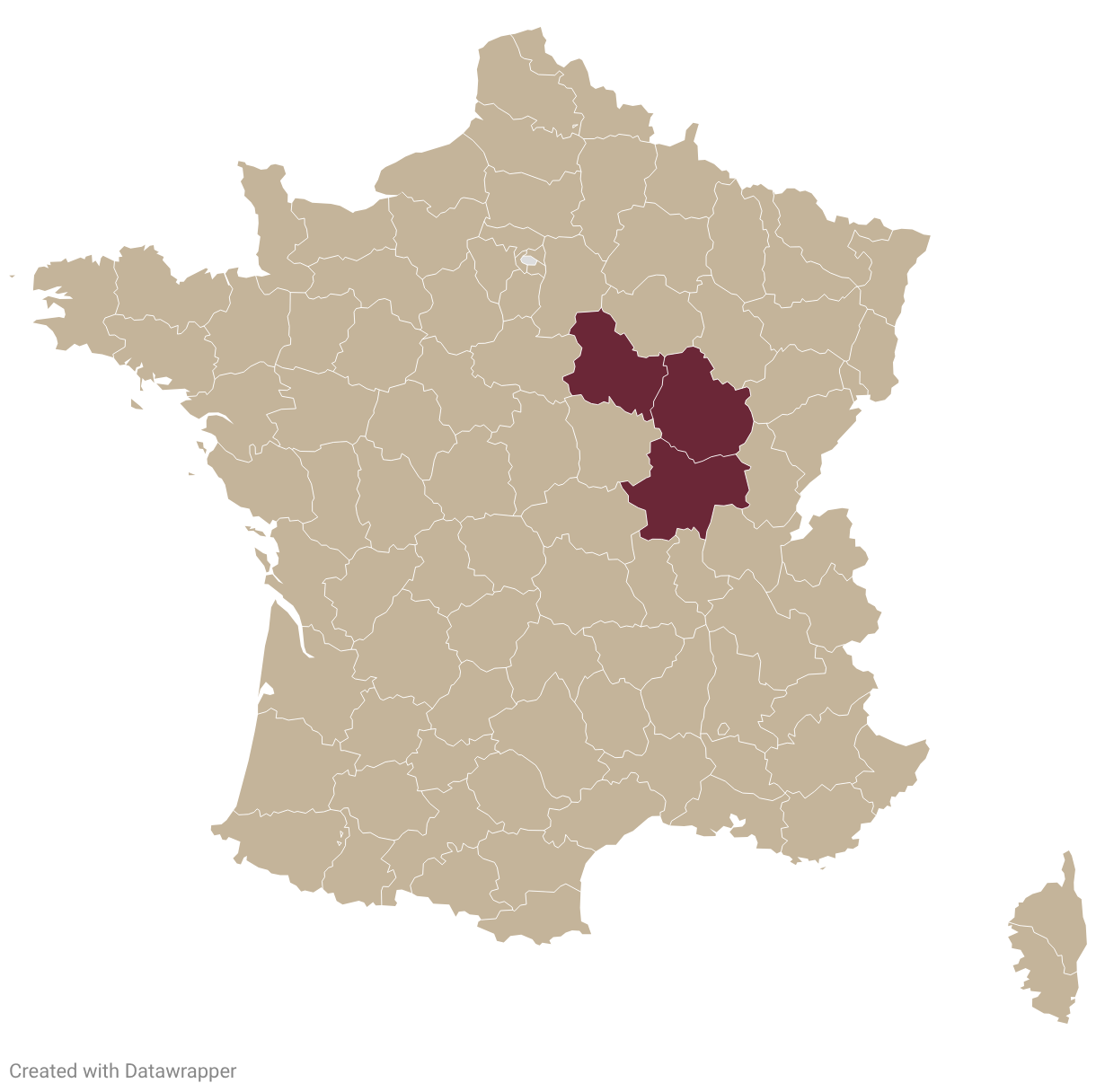
Burgundy
The finest expression of Pinot Noir and Chardonnay, where soil and site reign supreme.
29,500 ha
·
1,247
·
200–400m
·
1936
VARIETIES
Pinot Noir · Chardonnay · Gamay · Aligoté
Long before Burgundy became the collector’s obsession it is today, the region’s identity was being written by Cistercian monks who treated viticulture as a form of spiritual discipline. Beginning in the twelfth century at Clos de Vougeot and expanding across the Côte d’Or, these monks recorded yield differences between adjacent rows of vines — an empirical method that predated formal soil science by seven hundred years. What they produced was not a wine style but a classification philosophy: the conviction that a few metres of lateral distance can separate the ordinary from the transcendent. That idea, refined through centuries of monastic record-keeping, ecclesiastical investment, and ducal patronage, became the foundation for France’s entire appellation system.
Burgundy’s modern appellation structure reflects this inheritance with uncommon granularity. The region’s approximately 100 appellations are organized across four tiers — regional, village, Premier Cru, and Grand Cru — each tier defined not by winemaker ambition but by the demonstrated capacity of specific soil to produce wines that repay attention over decades. Within the Côte d’Or alone, more than 1,200 individually named vineyard plots, called climats, carry legal recognition as distinct terroirs — a density of geographic specificity unmatched by any other wine region on earth. UNESCO inscribed these climats as a World Heritage Site in 2015, acknowledging what the monks intuited nine centuries earlier: that the land here speaks with a precision that rewards those who listen.
The Price of Fragmentation
The same inheritance laws that preserved Burgundy’s classification created the conditions for its current scarcity. When Napoleon’s Code Civil abolished primogeniture in 1804, vineyard holdings that had been consolidated under monasteries and noble estates began fragmenting across generations of heirs. Today, the 50-hectare Clos de Vougeot — a single Grand Cru walled vineyard — is divided among more than eighty different owners, each producing wines that range from transcendent to forgettable depending on their parcel’s position and their cellar practices. This fragmentation is Burgundy’s defining paradox: the same legal framework that democratized ownership also made consistent quality a matter of individual skill rather than institutional guarantee.
For collectors, the practical consequence is a secondary market where allocation, not price, determines access. Domaines like Leroy, Rousseau, and Domaine de la Romanée-Conti produce so little wine from their classified parcels that bottles enter a closed loop of mailing lists and auction houses, rarely appearing on retail shelves. But the fragmentation that restricts supply at the top also creates opportunity below it. Village-level wines from conscientious domaines — Roulot in Meursault, Fourrier in Gevrey-Chambertin, Tollot-Beaut in Chorey-lès-Beaune — offer site-specific expressions that producers from Oregon to New Zealand have spent decades trying to replicate, often at a fraction of the classified price.
What the Slope Reveals
Burgundy’s wines are shaped less by winemaker intervention than by the geological accident of the Côte d’Or escarpment, a limestone ridge that runs southwest-to-northeast for roughly 50 kilometres between Dijon and Santenay. The best vineyards occupy a narrow mid-slope band where drainage, sun exposure, and soil depth converge — too high and the vines struggle in thin, chalky soil; too low and clay-heavy ground produces wines that lack the tension Burgundy’s reputation demands. The Côte de Nuits, the escarpment’s northern half, favours Pinot Noir across a spectrum that runs from the structured intensity of Chambertin to the perfumed delicacy of Musigny. The Côte de Beaune, to the south, shares the same limestone spine but with deeper clay and marl deposits that give Chardonnay — particularly from Meursault, Puligny-Montrachet, and Corton-Charlemagne — a textural richness that no other region achieves with quite the same discipline.
What makes Burgundy’s best wines irreplaceable is not concentration or power but a quality of transparency: the sense that the wine is transmitting information about a specific piece of ground rather than expressing a winemaker’s intent. The Kimmeridgian limestone that defines Chablis, 150 kilometres to the northwest, produces Chardonnay of a completely different character — leaner, more saline, marked by fossilized oyster shells embedded in Jurassic-era seabed — yet it belongs unmistakably to the same philosophical tradition. This is Burgundy’s foundational gift to wine: not a grape variety or a technique, but the demonstration that soil, when respected, has more to say than the person who farms it. That argument, first articulated by monks in the twelfth century, remains the organising principle that connects Armand Rousseau’s Chambertin to Dujac’s Morey-Saint-Denis — and the reason producers on every continent still look to this narrow ridge as the place where the idea of terroir was born.
“In Burgundy, the vine speaks first and the winemaker, if he is wise, merely listens.”
— Kermit Lynch, Adventures on the Wine Route
The Appellations
Four appellations along the Côte and beyond, each shaped by subtle shifts in slope, exposure, and limestone.
Grand Cru
Côte d’Or
The Golden Slope—barely two kilometres wide, home to the world’s most collectible Pinot Noir and Chardonnay. Slope, aspect, and limestone-rich soils create complexity that ages for decades.
Pinot Noir · Chardonnay
Premier Cru
Chablis
Burgundy’s northern outpost—cool-climate Chardonnay defined by Kimmeridgian limestone and bracing minerality. The style is leaner and more precise than its southern counterparts.
Chardonnay
Regional
Côte Chalonnaise
The approachable entry to serious Burgundy—Mercurey, Givry, Montagny, and Rully offer quality that rivals Côte d’Or at a fraction of the price.
Pinot Noir · Chardonnay · Gamay
Regional
Mâconnais
Burgundy’s white wine heartland—Chardonnay at its most accessible, with fruit-forward character and elegant mineral restraint. Built for pleasure, not reverence.
Chardonnay · Gamay
Last updated: April 2026
Related Stories
Recent articles featuring Burgundy wines, producers, and vintages.
The next one arrives Thursday.
Vintage intelligence, producer profiles, and curated cellar picks — before the critics weigh in. Weekly dispatch.