

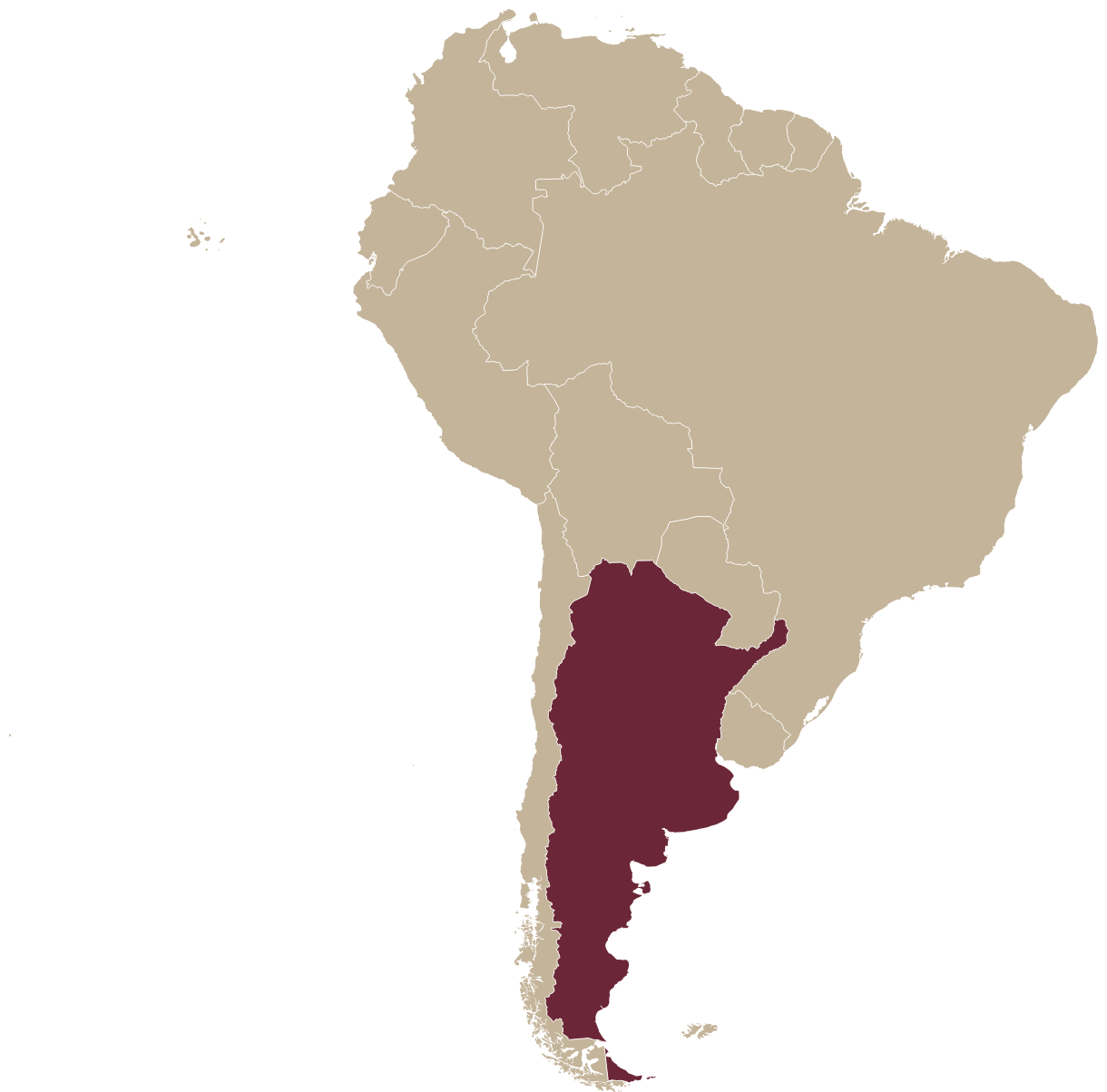
Argentina
When a French agronomist arrived in 1853 with a vineyard’s worth of seeds, Argentina discovered not just a grape, but its own voice.
3
·
5th
·
215K ha
·
1853
VARIETIES
Malbec · Torrontés · Bonarda · Cabernet Sauvignon
On April 17, 1853, Michel Aimé Pouget stood in Mendoza at the helm of Argentina’s first agricultural school, Quinta Agronómica. In his hands—among saplings and seeds from the Quinta Normal de Chile—was Malbec, a French Bordeaux grape that would become the nation’s defining variety. Pouget was thirty-two. He had come at the request of President Domingo Faustino Sarmiento to modernize Argentine viticulture, and he would transform the country’s wine future with the contents of a single nursery. The grapes he brought—Cabernet Sauvignon, Pinot Noir, Merlot, but most fatefully, Malbec—would take root in an entirely new terroir, one that none of the Old World agronomists had fully anticipated. That April date, now celebrated as World Malbec Day, marks not a harvest or a vintage, but a beginning: the moment a colonial nation began to speak its own wine language.
From that 1853 act of transplantation, Argentina built nothing less than a parallel wine civilization. For nearly a century, the industry remained provincial and domestic—bulk wine for local consumption, Spanish colonial practices clinging to the foothills. But in the 1990s, as the country stabilized politically and economically, Argentine winemakers began to ask a different question: what if Malbec, planted here, could match the finest wines on the planet. Investment followed. Modern technology arrived. The French consultant Michel Rolland helped pioneer wholesale modernization of the industry. By the turn of the millennium, Argentine Malbec had entered the international market with quality that was impossible to ignore. Today, Argentina crushes approximately 1.8 million tons of grapes per vintage, with red varieties accounting for forty-two percent of all production. Mendoza alone produces 72.5% of the country’s wine, across 165,000 hectares of vineyard tended by nearly 800 individual wineries. The nation sits fifth globally in production volume, yet its trajectory—from imported vine to global contender in barely a century—has no real parallel in the wine world.
The Monoculture Question
Yet success, as it often does, has bred its own contradiction. Over three decades, Malbec became Argentina’s commercial identity—so dominant that it began to feel inevitable, even monotonous. The wine world began to ask: Is Argentina more than Malbec. The question, which should feel like an insult, has instead become productive. Winemakers across Mendoza, San Juan, and emerging regions have begun exploring what lies beyond—not because Malbec has failed, but because it has succeeded so thoroughly that the country can now afford to look deeper into itself. Riesling, Gewürztraminer, Cabernet Franc, Petit Verdot, even natural wine experiments in the margins—these are not rejections of Argentina’s flagship, but rather conversations within a growing identity.
The tension is structural and real. Malbec exports generated $850 million for Argentina in 2023, a figure that concentrates enormous economic weight on a single grape. Most producers cannot afford to ignore it—and they don’t want to. Instead, they’ve adopted what might be called a “both/and” strategy: deep commitment to Malbec alongside measured experimentation with other varieties. Bodega Catena Zapata’s director of winemaking Alejandro Vigil has spoken to this tension directly, noting that Malbec “is so transparent to the place where it grows that when you realize it, you also begin to respect certain things.” The philosophy is not about abandoning Malbec—it’s about understanding it more precisely, through a lens of specific place rather than uniform style. Lighter, leaner, unoaked expressions are emerging alongside traditional, oak-aged bottles, reflecting winemakers’ search for the true terroir voice of the grape, zone by zone.
The Altitude Revelation
If Malbec gave Argentina its voice, altitude has given that voice texture and nuance. The highest commercial vineyards in Argentina sit between 600 and 1,400 meters above sea level—among the most extreme growing conditions for fine wine anywhere. In 1993, Nicolás Catena made what appeared to be a reckless bet: he planted vines at 5,000 feet in Mendoza’s Uco Valley, in the Gualtallary district. Most growers thought he would fail. The frost risk was severe, the ripening season punishingly short, and conventional wisdom held that grapes could not mature at such elevation. Catena installed weather stations, studied the microclimates, and introduced drip irrigation to manage the severity of the landscape. What he discovered was revelatory: the temperatures mimicked Champagne, yet the extra hours of sunlight and the desert’s relentless brightness allowed grapes to reach the combination that defines great wine—fully mature tannins, natural acidity, and controlled alcohol, all ripening at the edge rather than at full saturation.
This expansion upward—into the Andes, into the cold, into the light—represents Argentina’s most significant current evolution. Altitude has become the new frontier precisely because it strips away artifice. At 5,000 feet, you cannot compensate through winemaking technique or oak regime. The place demands authenticity. TERROIR sees this altitude-driven turn as a maturation in Argentine wine culture—a move from nation-building through sheer production volume and modernization toward a more geological understanding of what it means to grow wine in Argentina. The conversation has shifted from “Can we compete globally” to “What can only Argentina produce.” That second question, once asked, cannot be unasked. It explains why new plantings continue climbing the Andes, why organic certification has grown 15% in the past three years, and why even established producers speak of their work as exploratory rather than established. A nation that once imported its winemaking identity has begun to excavate it.
“When you walk through our vineyards at altitude, you breathe the same air as the vine. That connection between place and plant is what makes Argentine Malbec impossible to replicate anywhere else in the world.”
— Alejandro Vigil, Bodega Catena Zapata
The Regions
Argentina’s winemaking landscape spans vast elevational and climatic zones, from the workhorse valleys of Mendoza to the high-altitude frontiers where viticulture becomes an act of defiance against the elements.
Mendoza →
Andean rain shadow and cold nights give Malbec architectural precision—dense, mineral, age-worthy. Argentina’s unmovable center, from workhorse Maipú to prestige Luján de Cuyo heights.
Malbec · Cabernet Sauvignon · Syrah · Sauvignon Blanc
Salta & Cafayate →
2,000-meter altitude where day-night extremes create wines of taut precision and mineral intensity. Torrontés whites of haunting beauty and reds that challenge everything you thought you knew.
Torrontés · Malbec · Syrah · Tannat
Patagonia →
Atlantic winds and ice-field chill create Argentina’s coolest frontier—lean, mineral Pinot Noirs and Rieslings of classical structure. Scarce and experimental, for those seeking European restraint.
Pinot Noir · Riesling · Sauvignon Blanc · Merlot
Last updated: April 2026
Related Stories
TERROIR’s coverage of Argentine wine.
The next one arrives Thursday.
Vintage intelligence, producer profiles, and curated cellar picks — before the critics weigh in. Weekly dispatch.