

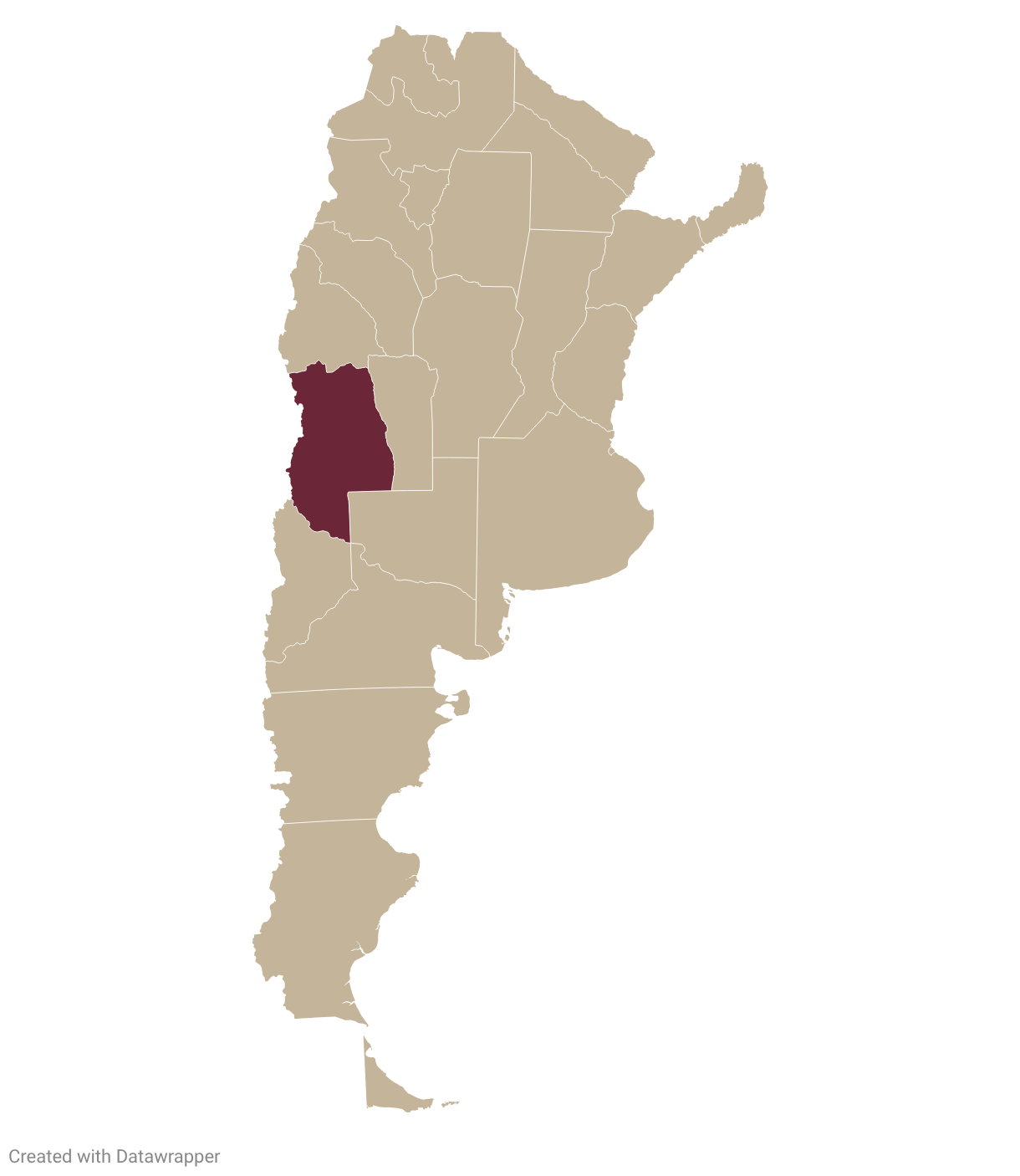
Mendoza
The highest vineyards in the world are not in the Andes—they are in the Andes’ shadow, where cold light and altitude conspire to remake what wine can be.
3
·
148K ha
·
600–1,200m
·
1853
VARIETIES
Malbec · Cabernet Sauvignon · Bonarda · Torrontés
Mendoza is not where wine comes to be made. It is where wine comes to be tested. The province sits at the eastern foothills of the Andes, and its vineyards—now spanning 165,000 hectares across 800 individual estates—climb from the valley floor into an elevation range that most wine regions would consider prohibitive. Average plantings sit between 600 and 1,100 meters above sea level. The highest experimental blocks scrape 1,400 meters. For context: Champagne averages 100 meters, Burgundy barely exceeds 300, the Napa Valley sits at sea level to 400. When Mendoza viticulturists speak of their region, they speak not of soil composition or rainfall—though both matter—but of the clarifying power of altitude. It is the region’s foundational fact, the single terroir-modifier that shapes everything else: the quality of light, the diurnal temperature swing, the length of the growing season, the ripeness curve of the grape itself.
The region’s modern identity was born in the 1990s, when Nicolás Catena Zapata’s decision to plant at extreme elevation—against all established precedent—revealed what altitude could accomplish. Today, Mendoza crushes more than 1.1 million hectoliters annually and accounts for 72.5% of Argentina’s total wine production. It is the economic engine of Argentine wine, the source of Malbec’s global ascendancy, and the laboratory where winemakers are testing the outer limits of what a vineyard can withstand. Yet this dominance obscures a more compelling story: Mendoza has begun to move beyond industrial production into geological autobiography. The conversation is no longer about volume or even about Malbec’s supremacy. It is about what specific altitudes, microclimates, and subregions can reveal about the very nature of fine wine.
The Uco Valley Frontier
The most important vineyard land in Mendoza is land that did not exist as vineyard until the 1990s. Uco Valley, approximately 60 miles south of the provincial capital, sits in the highest and coldest reaches of Mendoza’s central foothill belt. Elevations here range from 900 to 1,400 meters. When Nicolás Catena began installing weather stations throughout the region in preparation for his 1993 planting, conventional viticulture had already written Uco’s verdict: the frost risk was unmanageable, the growing season too short, the landscape too austere for commercial grape production. But Catena’s meteorological work revealed something that topographic maps alone could not: yes, temperatures in Uco mimicked Champagne’s cold-zone profile, but the hours of intense sunlight were dramatically superior. The introduction of drip irrigation—expensive, precise, but giving the viticulturist full control over water stress—made the impossible possible. What emerged was a Malbec unlike any other: focused, mineral-driven, architecturally precise.
The Uco story illustrates Mendoza’s broader ethos: take the apparent limitation and press deeper into it. Where other regions might retreat from altitude, Mendoza continues climbing. The combination of alluvial soils, scarce rainfall, extreme diurnal temperature swings, and more than 250 sunny days per year has created a natural laboratory for understanding how elevation shapes wine. In 2025, Master of Wine Tim Atkin visited Mendoza for an intensive twenty-five-day harvest assessment, tasting over 1,700 wines from nearly 300 producers. His report specifically highlighted the emerging high-elevation plantations—Las Compuertas, El Peral, and Gualtallary—as the region’s most vital current work, a recognition from one of the world’s most rigorous critics that Mendoza’s altitude obsession is producing results of global significance.
Terroir as Argument
The word “terroir” has become a cudgel in wine writing—used to close conversations rather than open them. In Mendoza, terroir functions differently. It is not a romantic or mystical claim about place. It is a testable, measurable argument about what the land demands and what the grapes deliver in response. Laura Catena, physician, fourth-generation vintner, and a leading scientific voice on Argentine wine, has articulated this philosophy with particular clarity: “I want to understand what defines terroir as a source of individual place flavor, so that I can study how to preserve it.” Catena has spent decades analyzing soil composition, climate patterns, and varietal selection across Mendoza’s subregions precisely to understand the mechanisms by which altitude, aspect, and water availability shape flavor. Her work—both at Bodega Catena Zapata and through the Catena Institute—treats terroir as a scientific discipline rather than a romantic notion.
This attitude—skeptical toward hype, rigorous in execution, confident in the region’s structural advantages—defines Mendoza’s character. The province has earned the right to speak with authority about what altitude produces: wines of focused mineral precision and aging potential anchored in measurable terroir differences between subregions. Yet Mendoza is only beginning to fully articulate this voice. Organic certification has grown 15% in the past three years as producers commit to vineyard management that works with the region’s constraints rather than against them. Experimental plantings of white varieties—Riesling, Gewürztraminer—are testing whether altitude’s lessons can extend beyond Malbec. TERROIR’s position is clear: Mendoza’s current moment—this expansion upward into the cold light, this scientific rigor applied to ancient questions about place—represents the maturation of Argentine wine culture. The region has moved beyond the question of whether it can compete with the world’s wine capitals. It is now asking what only Mendoza can make.
“I want to understand what defines terroir as a source of individual place flavor, so that I can study how to preserve it.”
— Laura Catena, Bodega Catena Zapata & Catena Institute of Wine
The Sub-Appellations
Three zones at ascending altitude — from the established alluvial plains of Maipú to the high-frontier Uco Valley, each bringing its own elevation and soil signature to Mendoza Malbec.
Prestige
Luján de Cuyo
Argentina’s first Denominación de Origen Controlada (1989) — older vineyards above 900 meters on decomposed granite and alluvial soils produce Malbec of mineral clarity and structural depth, built for extended cellaring.
Malbec · Cabernet Sauvignon · Merlot · Torrontés
Major
Maipú
The historic heartland of Argentine wine — family-owned bodegas on alluvial gravels producing deeply concentrated, structured Malbecs capable of aging 15 or more years. The foundation on which modern Argentine wine was built.
Malbec · Cabernet Sauvignon · Bonarda · Syrah
Emerging
Uco Valley
Argentina’s viticultural frontier at 1,000–1,200 meters, where extreme altitude and limestone-alluvial soils create Malbec of surgical precision and Cabernet Franc of surprising complexity. The address for single-vineyard ambition.
Malbec · Cabernet Franc · Pinot Noir · Chardonnay
Last updated: April 2026
Related Stories
TERROIR’s coverage of Mendoza wine.
The next one arrives Thursday.
Vintage intelligence, producer profiles, and curated cellar picks — before the critics weigh in. Weekly dispatch.