

The Atlas > The Americas > USA > Willamette Valley
Willamette Valley
Oregon’s cool-climate masterpiece, where volcanic soils and Pacific fog have shaped America’s most compelling expression of Pinot Noir.
6
·
45°N
·
Cool Maritime
·
1965
VARIETIES
Pinot Noir · Chardonnay · Pinot Gris · Riesling
Willamette Valley’s first serious vine was planted not by a winemaker but by a visionary acting on conviction. David Lett arrived in Oregon’s Willamette Valley in 1965 and planted Pinot Noir at Eyrie Vineyards in the Dundee Hills—a decision that confounded the California wine establishment. Lett had studied viticulture in California and concluded, against prevailing opinion, that the cool latitude of Oregon’s Willamette Valley at 45°N, equivalent to northern Burgundy, was better suited to Pinot Noir than the warmer climates he had left behind. His argument was tested publicly in 1979, when Eyrie’s 1975 South Block Reserve Pinot Noir placed within a fraction of Drouhin’s 1959 Chambolle-Musigny at a Paris tasting organized by Robert Drouhin. The result drew international attention to Oregon as an appellation capable of Pinot Noir at European standard. Drouhin returned in 1980 with a second tasting; Eyrie placed second again.
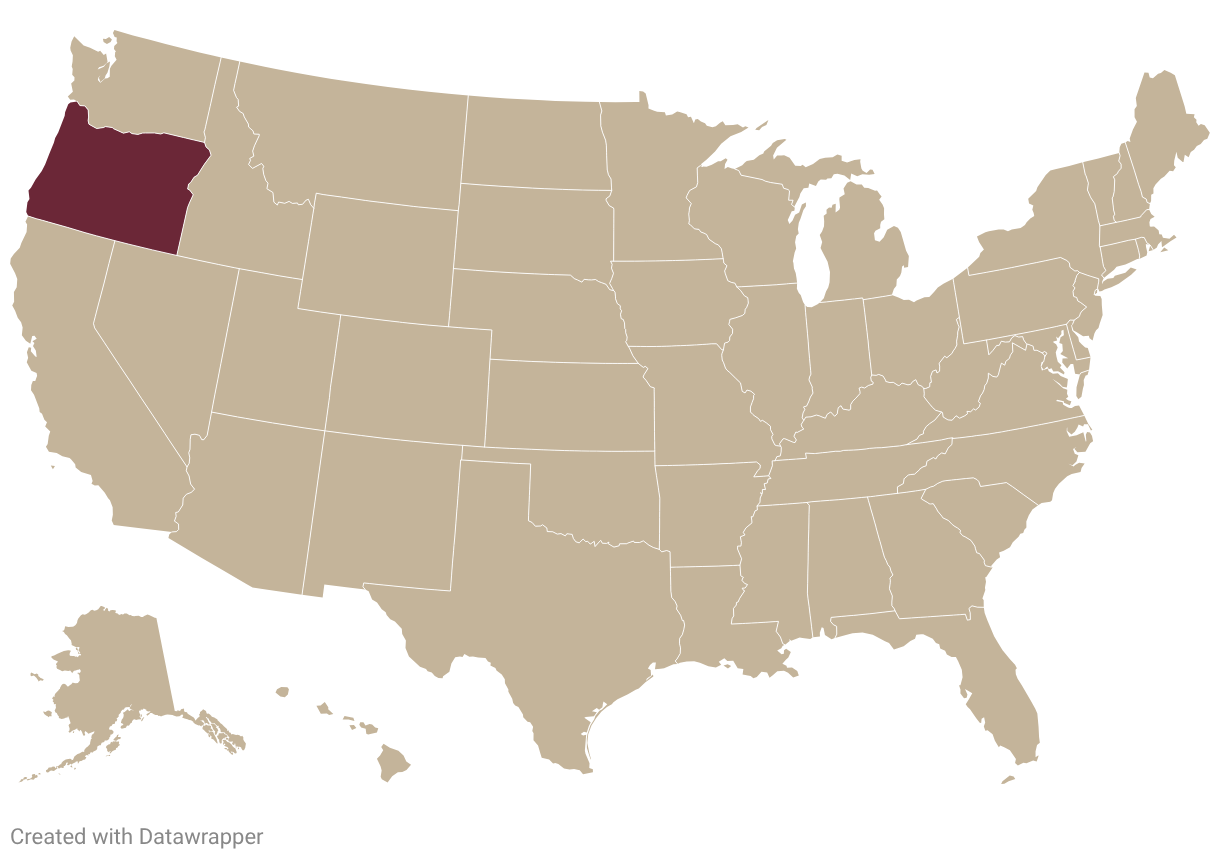
The valley runs roughly 150 miles from the southern suburbs of Portland to Eugene, enclosed between the Coast Range to the west and the Cascade Mountains to the east. The Coast Range admits enough Pacific maritime influence to keep summers warm but reliably cool, while the Cascades block cold continental air. Diurnal temperature swings of 40°F or more during the growing season are routine, preserving acidity and extending aromatics without overripening. The dominant soils are Jory—a deep, iron-rich volcanic clay formed from Columbia River basalt flows—and Willakenzie, a shallower marine sedimentary soil found at lower elevations. These two soil types produce wines of distinctly different character even within the same AVA, and the valley’s sustained conversation about site-specificity reflects that distinction with growing clarity.
The Latitude Bet
The Burgundian house of Robert Drouhin purchased vineyard land in the Dundee Hills in 1987 and founded Domaine Drouhin Oregon—a declaration of confidence from one of Burgundy’s most respected names. Further Old World investment followed: Maison Louis Jadot acquired Resonance Vineyard; the Bollinger group took a stake in Adelsheim. Each arrival was a vote that Willamette’s latitude and soils could produce wines worthy of serious winemakers’ attention and investment. Willamette Pinot now occupies a distinctive register between Burgundy and California: lighter in body than most California expressions, more richly fruited than much village Burgundy, with cherry, forest floor, and volcanic-soil minerality as hallmark characteristics.
The finest examples carry structural capacity for development over a decade or more, and the valley’s six sub-AVAs—each shaped by distinct soil type and elevation—continue to sharpen that argument. Dundee Hills rests on iron-rich Jory volcanic soils on gentle ridgeline slopes and produces wines of mineral precision and structural depth. Yamhill-Carlton, with its marine sedimentary Willakenzie soils at elevated terrain, yields leaner, more austere expressions built less for immediate charm than for longevity. Chehalem Mountains encompasses three distinct soil types within a single range—Jory volcanic, Willakenzie sedimentary, and Laurelwood wind-blown loess—creating a stylistic range unusual for one AVA.
Old World Investment
What distinguishes Willamette Valley from other cool-climate American regions is the depth of Old World commitment. Burgundian producers do not invest lightly in foreign terroir; their presence in Dundee Hills signals genuine belief that the site can produce wines of European caliber. That investment has changed the conversation. Where Willamette once asked simply “Can we make Pinot Noir?”, it now argues about which soils produce which expressions, which elevations favor which styles, which vintages show greatest aging potential.
The region’s future lies not in replicating Burgundy—an impossible and unnecessary goal—but in understanding what Willamette’s volcanic soils, latitude, and maritime influence create that no other place can replicate. Those wines are beginning to emerge: bottles from Dundee that carry ten, fifteen, even twenty years’ potential; expressions from Yamhill-Carlton that reward extended cellaring with complexity and grace; Chehalem wines that demonstrate that soil diversity is its own form of terroir complexity. Willamette Valley rewrote the map of serious Pinot Noir. What Lett proved in the 1970s—that America’s cool northern margins could equal Europe’s finest—has since been confirmed by the investment of those same Europeans in Dundee Hills soil.
Grapegrowing in western Oregon is an adventure. The climate of western Oregon constitutes the risk, and also the reason, for this adventure.
— David Lett, Eyrie Vineyards
The Sub-AVAs
Oregon’s Pinot Noir heartland — six designated sub-appellations where Jory volcanic soils and Pacific maritime air produce wines of genuine site expression.
Prestige
Dundee Hills
The valley’s most celebrated sub-zone, where iron-rich Jory volcanic soils on gentle ridgeline slopes produce wines of mineral precision and structural depth. Eyrie, Beaux Frères, and Domaine Drouhin anchor the conversation.
Pinot Noir · Chardonnay · Pinot Gris
Premier
Yamhill-Carlton
Marine sedimentary Willakenzie soils at elevated terrain produce leaner, more austere expressions. Yamhill-Carlton is the intellectual reserve of Willamette’s stylistic range — built less for immediate charm than for longevity.
Pinot Noir · Chardonnay · Pinot Gris
Premier
Chehalem Mountains
Three distinct soil types within a single mountain range — Jory volcanic, Willakenzie sedimentary, and Laurelwood wind-blown loess — create a stylistic range unusual for one AVA. Chehalem proves that soil diversity is its own form of terroir complexity.
Pinot Noir · Chardonnay · Pinot Gris · Riesling
Regional
McMinnville
Cooler northwest-facing slopes and ancient marine soils yield wines of pale color, elevated acidity, and a saline minerality that rewards extended cellaring. McMinnville asks for patience — and charges less for it than its neighbors.
Pinot Noir · Chardonnay · Pinot Gris
Last updated: April 2026
Related Stories
TERROIR’s Willamette Valley coverage — appellations, producers, and vintages worth knowing.
The next one arrives Thursday.
Vintage intelligence, producer profiles, and curated cellar picks — before the critics weigh in. Weekly dispatch.