

Vinho Verde
Portugal’s lush northwest — fresh, aromatic, and endlessly misunderstood.
20,000 ha
·
9
·
1,200–1,800 mm
·
Alvarinho / Loureiro
VARIETIES
Alvarinho · Loureiro · Arinto · Azal · Trajadura
The Minho River cuts through northern Portugal like a thread of continuity, and for a thousand years the vineyards above it have grown according to a logic born of necessity. In the medieval period, with flat land precious for feeding a population, growers in the Minho trained their vines vertically—high on granite posts and wooden pergolas, their leaves reaching toward Atlantic light while the soil beneath remained available for wheat, corn, and vegetable cultivation. This pergola system became more than a solution to scarcity; it became an aesthetic, a signature. The minifúndio tradition followed: smallholdings fragmented across generations, each family tending their own patches, their own trellised vines. These were not grand estates but a dense network of microvineyards, each with slightly different exposure, soil composition, and microclimate. Out of constraint emerged character.
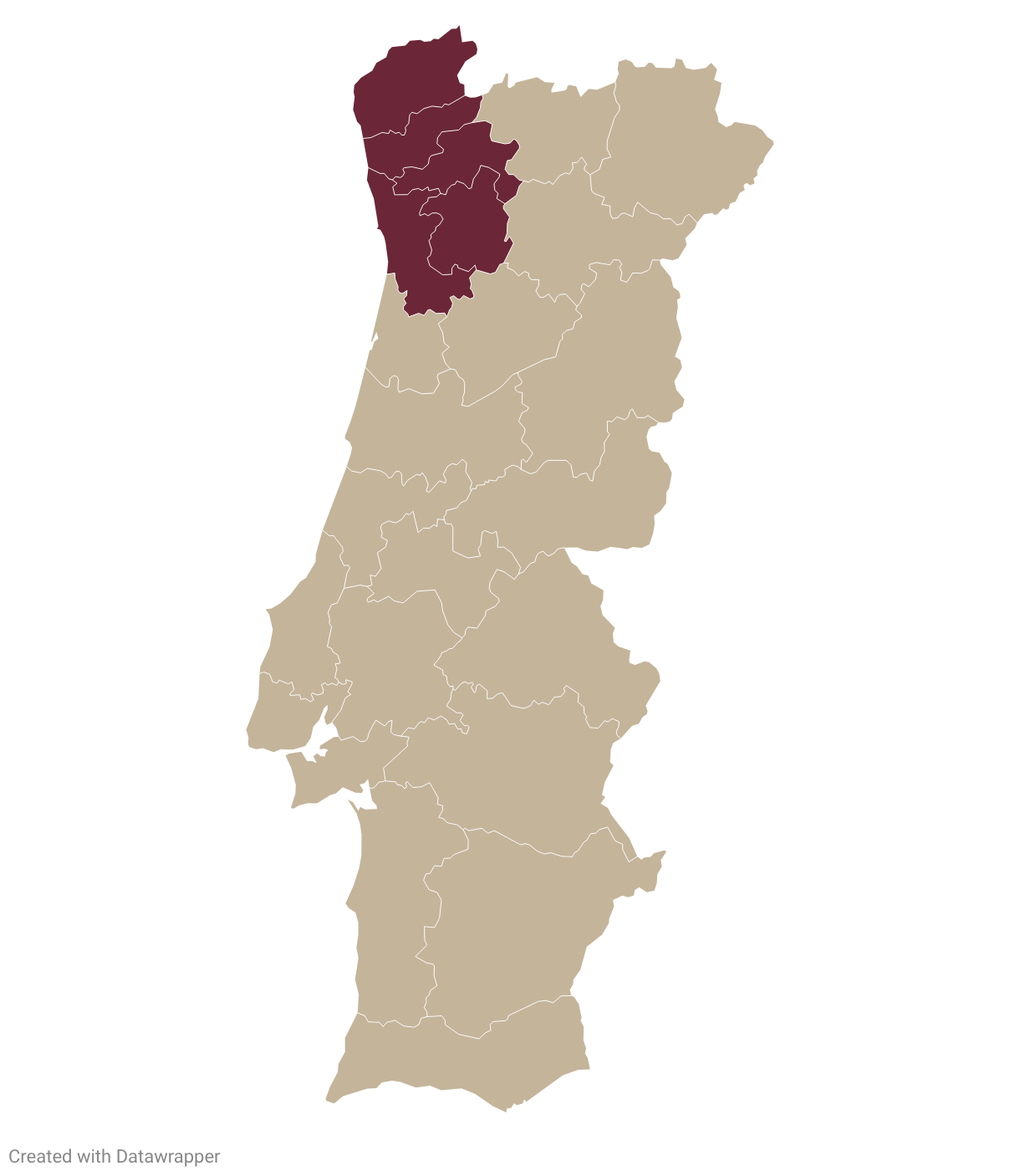
That origin shaped everything that followed. Today, Vinho Verde encompasses 20,000 hectares across the Minho region, but it remains fundamentally a patchwork—nine distinct sub-regions, each with its own personality, its own preferred varieties. The region’s minifúndio structure persists, meaning that quality is not controlled by a handful of large producers but is distributed across thousands of small growers and a second tier of merchant houses that source fruit and blend. The pergola tradition has partly given way to modern trellising, but the logic remains: work with the land’s geometry, not against it. Rainfall averages 1,200 to 1,800 millimeters per year—among Europe’s highest—and the Atlantic breeze tempers heat and extends harvest windows, allowing grapes to ripen with energy and acidity intact.
The Export That Became a Revolution
For decades, Vinho Verde was known by a single image: a slightly fizzy, lightly sweet, cheap white wine for casual export consumption. That image—the €3 bottle on a supermarket shelf—became the region’s commercial gold mine and its artistic prison. Beginning in the 1980s and accelerating through the 2010s, a quiet revolution challenged that monopoly. The highest-quality sub-regions, particularly Monção e Melgaço in the north, began bottling single-varietal wines, especially Alvarinho, with depth, salinity, and age-worthiness that surprised skeptics. Producers like Anselmo Mendes, Soalheiro, and Quinta do Ameal proved that Vinho Verde was not a category defined by its sweetness or its slight carbonation but by its origin and its varieties.
Monção e Melgaço Alvarinho became the spearhead of this transformation. The grape itself—known as Albariño in Spain’s Rías Baixas, just across the border—had always been present in the Minho, but it was rarely vinified alone or with serious intent. Now, premium bottlings from Soalheiro (Cota 27, a wine that can age a decade) and Constantino Ramos (Zafirah) command €15 to €25 at retail—not cheap for Vinho Verde, but affordable for wines of genuine complexity. Simultaneously, single-varietal bottlings of Loureiro, Avesso, and Trajadura from other sub-regions demonstrated the individuality of indigenous white grapes that had been blended away for generations. The image problem persists—many drinkers still default to the fizzy export cliché—but the architecture beneath has transformed. The revolution is not complete, nor is the old image obsolete, but the tension between them has become productive rather than limiting.
Terroir in Europe's Wettest Corner
The Minho is not a Mediterranean fantasy. It is the antithesis: a wet, green, Atlantic-influenced region where the challenge is not bringing sugar to ripeness but managing water and acidity. Its nine sub-regions—Monção e Melgaço, Ponte da Barca, Ponte de Lima, Barcelos, Argivai, Camarão, Felgueiras, Penafiel, and Lima—are distinguished by their soils, their altitudes, and their historic varietal preferences. The highest regions (Monção e Melgaço sits at 100–200 meters) experience cooler nights and granite soils that yield racy, mineral wines. The lower, warmer sub-regions gravitate toward softer, rounder expressions and alternate varieties like Madalena and Trajadura. This internal diversity is where Vinho Verde’s true terroir resides: not in a single canonical expression, but in a spectrum.
The granite bedrock and schist soils of the Minho are, quite literally, the skeleton of the landscape. Weathered into fine particles, they release minerals into root zones and impart a flinty, saline quality to the finished wines. The Atlantic wind is not metaphor but climate; it moves through the valley daily, slowing ripening, lowering temperatures, and reducing the risk of botrytis in a region where humidity runs perpetually high. Indigenous varieties—Loureiro, Avesso, Trajadura, Arinto—are the original languages spoken here, adapted over centuries to this specific combination of wet, cool, and granite. To drink a proper Avesso from Penafiel or a Trajadura from Barcelos is to taste soil, wind, and timing; it is to understand that Vinho Verde’s terroir operates on the same principle as any European wine region, rooted in the interaction between climate, soil, and place.
The revolution in Vinho Verde is therefore not a rupture but a returning. The €3 export wine and the €25 Alvarinho need not be enemies; they serve different markets and different moments. What changes is the conversation. For too long, Vinho Verde was discussed in isolation, a regional curiosity rather than an expression of one of Europe’s most geologically and climatically demanding terroirs. The Minho’s 1,200 to 1,800 millimetres of annual rainfall, its Atlantic exposure, its granite geology, and its deep varietal heritage constitute a complete terroir story. The emergence of serious, age-worthy single-varietal bottlings from Monção e Melgaço and the central sub-regions proves that the region is defined not by residual sugar or slight fizz but by its capacity to transmit sense of place: acidity, salinity, green fruit, mineral spine. The smallholder tradition that gave rise to pergola viticulture is also the foundation for the region’s current proliferation of micro-expressions, each producer and vineyard block telling a slightly different story within the larger Minho narrative. The wine has been there all along, waiting for drinkers willing to listen beneath the fizz.
“In the north lies Vinho Verde, the most Atlantic of all Portuguese wines, covering a granite landscape that feels very much part of northern Europe.”
— Richard Mayson, The Wines of Portugal, Infinite Ideas, 2020
The Sub-Appellations
Nine sub-regions span Vinho Verde’s river valleys and granite uplands, from the Alvarinho-dominant north to the multi-variety blending zones of the south.
DOC Sub-Region
Monção & Melgaço
The northernmost and most prestigious sub-region, hugging the Minho River along the Spanish border. This is where Alvarinho reaches its apex: fuller-bodied, richer, more aromatic, and genuinely age-worthy. Palácio da Brejoeira, Anselmo Mendes, and Soalheiro define the benchmark.
Alvarinho (dominant) · Trajadura
DOC Sub-Region
Lima
The natural home of Loureiro, Vinho Verde’s most floral and aromatic variety. Wines from Lima are delicate and perfumed — peach blossom, lime zest, a whisper of herbs — with a lightness that makes them among Portugal’s most food-friendly whites. Single-quinta barrel-aged Lourerios offer something considerably more complex.
Loureiro · Arinto · Trajadura
DOC Sub-Region
Basto & Cávado
The more interior sub-regions produce wines with greater structure and mineral edge than the coastal zones, shaped by granitic soils and a less Atlantic-influenced climate. These zones also yield the region’s most distinctive red Vinhos Verdes — light-bodied, served slightly chilled, and unlike anything else in Portugal.
Azal · Arinto · Espadeiro (reds)
Last updated: April 2026
Related Stories
The latest from our coverage of Vinho Verde.
The next one arrives Thursday.
Vintage intelligence, producer profiles, and curated cellar picks — before the critics weigh in. Weekly dispatch.