

Dão
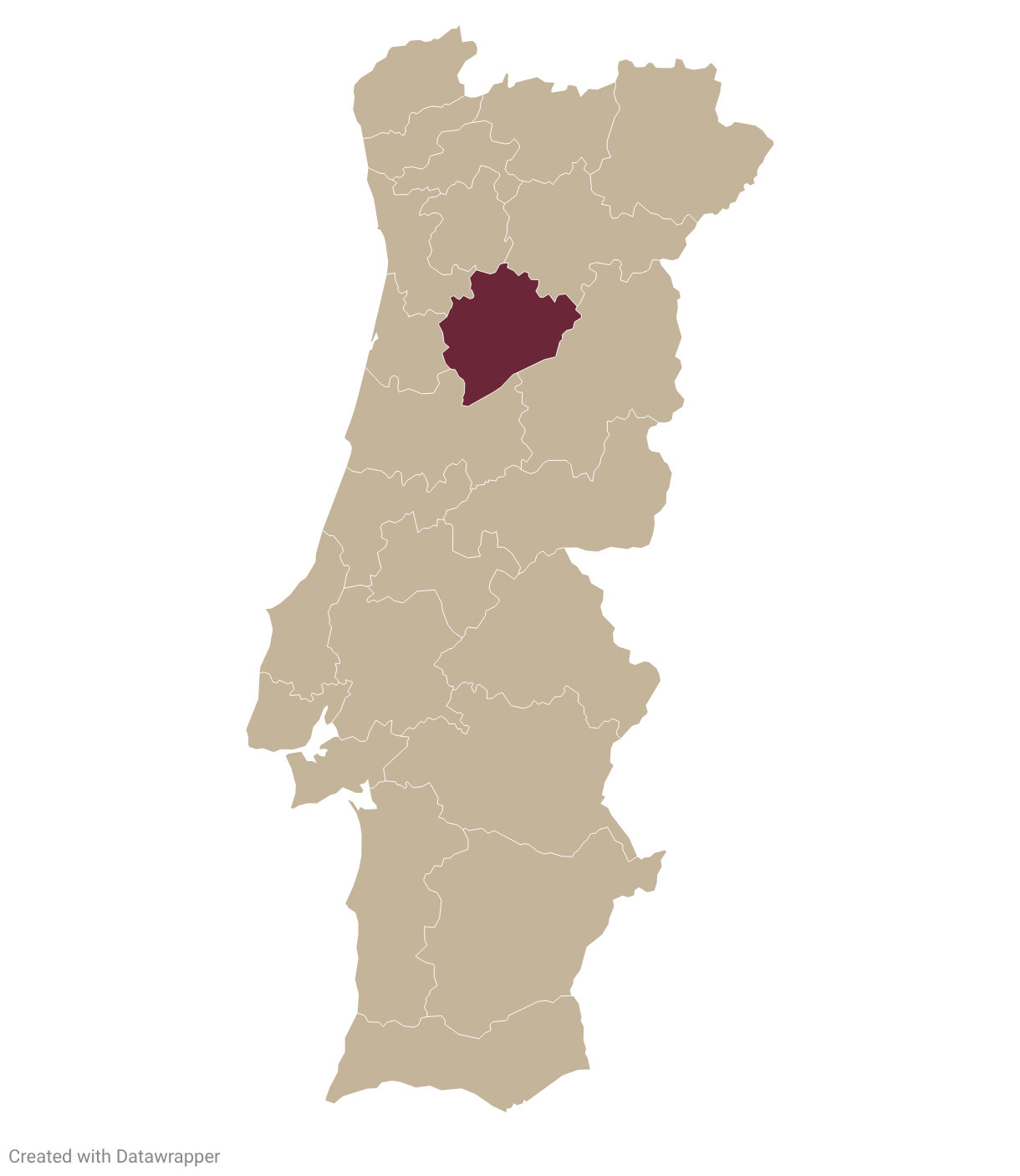
Granite mountains, Touriga Nacional, and Portugal’s most elegant reds — a cool highland plateau where ancient soils and patient viticulture produce something genuinely rare.
~20,000 ha
·
Granite
·
400–900m
·
1908
VARIETIES
Touriga Nacional · Encruzado · Jaen · Alfrocheiro
In 1908, a crucial line was drawn on a map of central Portugal. The Dão demarcation—one of the country’s earliest legal wine designations, predating even Port’s formal recognition—codified what growers in the granite highlands had long known: this territory produced wines of distinctive structure and pedigree. Yet this historic moment contained an irony that would shape Dão for nearly a century. That same legal framework handed near-absolute control to a handful of regional cooperatives, which became gatekeepers to production, aging, and sale. For generations, quality winemaking in Dão meant conforming to cooperative protocols. The small family estates that dotted the region’s 20,000 hectares had little choice but to sell fruit or lodge their casks in cellars not their own. Innovation stalled. The region’s potential remained locked in amber.
The 1990 Portuguese law change that dismantled the cooperative monopoly did not liberate Dão overnight—but it cracked the seal. Suddenly, visionary producers like Álvaro Castro at Quinta da Pellada, António Madeira, and the team at Quinta dos Roques could bottle under their own names, age as they saw fit, and stake their reputations on terroir rather than compliance. The cooperatives themselves began to evolve, some modernizing their facilities and practices. Regional reputation, in short, became contestable again. What had been a consensus region—reliable, predictable, occasionally dull—became a terrain of ambition and rediscovery. The granite and the altitude remained exactly as they had been in 1908. What changed was who got to speak for them.
The Long Captivity
The shift from cooperative stranglehold to private estate emergence is not a story of simple good-versus-evil. The cooperatives, for all their constraints, preserved a typicity—a recognizable Dão character—that kept the region viable through decades when other Portuguese areas struggled for visibility. But typicity enforced is not the same as typicity earned. The real question that haunted Dão in the 1990s was acute: if every wine tastes like Dão protocol, how can Dão wines speak to distinct places within Dão? The liberation invited exactly that conversation.
Contemporary Dão has crystallized around a central productive tension: Touriga Nacional’s role as identity anchor—or as identity cage. This grape, which reaches back to the region’s own soils, produces the dark, structured wines that typify Dão reds. Portugal’s regulatory framework now mandates that at least 20 percent of Dão reds contain Touriga Nacional, a legal floor meant to preserve regional character. Yet this same requirement raises an uncomfortable question for ambition-driven estates: Is Touriga Nacional the instrument of Dão’s nobility, or does regional law conscript producers into its shadow? Some of Dão’s most striking recent reds argue for blending Touriga Nacional with other local varieties—Baga’s pepper, Jaen’s spice, even Aragonez from lower elevations—creating wines that feel rooted in Dão without bowing to a single varietal dogma. The question remains unresolved, and productively so: a region confident in its terroir debates its own identity rather than accepting it as inheritance.
What the Granite Remembers
The bedrock beneath Dão speaks a geological language wholly distinct from the Douro to the north. Where the Douro built its reputation on power—full-bodied, alcohol-rich wines from schist-based slopes below 200 meters—Dão rises. Vines here occupy elevations between 400 and 900 meters, where night temperatures drop sharply and granite outcrops dominate the soil. This granite—ancient, well-draining, low in organic matter—forces vine roots deep into the earth, where they encounter mineral density and cool water that slows sugar accumulation. The result is wine with architecture: acidity preserved, tannins refined, alcohol kept in proportion. This is the soil grammar that earned Dão its historical comparison to Burgundy—not a claim of equivalence, but recognition that both regions have learned to make elegance from adversity.
Altitude compounds the effect. At 400 to 500 meters, where most of Dão’s production occurs, the growing season compresses. At the highest reaches—800 and beyond—ripening becomes an act of geological patience. A cooler, more continental climate than the Atlantic-influenced Douro intensifies the acidity and mineral expression that granite invites. The fruit that emerges from this combination carries a distinctive signature: it tastes like place in a way that high-power wines rarely do. There is restraint here, but not austerity; structure that invites age without demanding it. For twenty years, this typology remained almost theoretical, constrained by cooperative uniformity. Now, growers at Quinta da Pellada, Quinta dos Roques, and smaller estates scattered across Mangualde and Viseu can showcase precisely what these specific slopes and elevations contribute to the glass.
This is where Dão’s future crystallizes. The region has spent three decades proving it could compete on power—that Touriga Nacional from granite could spar with Douro’s biggest wines. The real frontier now is demonstrating what it does best: wines in which terroir and restraint become synonymous, where a high-altitude granite slope doesn’t impose a flavor profile so much as ask a fundamental question about what wine, at its most eloquent, might be. Dão was always capable of that conversation. It simply needed permission to have it.
“The Dão doesn’t announce itself. It rewards patience — wines that open slowly, that reveal granite and cedar and wild herbs over hours in the glass.”
— TERROIR Editorial
The Sub-Appellations
The Dão’s sub-zones follow the region’s varied granite topography — from the high-altitude slopes of Serra da Estrela pressing against Portugal’s tallest peak, to the warmer interior valleys of Castendo, each expressing a distinct character from the same ancient bedrock.
Prestige
Serra da Estrela
The highest sub-zone of the Dão, pressing against Portugal’s tallest peak. Extreme diurnal shifts — warm days and cold nights — preserve aromatic intensity in both reds and whites. Encruzado here produces textural, mineral whites built for a decade of aging; Touriga Nacional shows hauntingly perfumed, fine-grained tannins.
Encruzado · Touriga Nacional · Alfrocheiro
Major
Terras de Azurara
The most expansive sub-zone, centred on the ancient city of Viseu. Old-vine Touriga Nacional in deep granite soils produces wines of serious structure, restrained fruit, and remarkable longevity. Historic cooperatives and ambitious single quintas represent the full spectrum of Dão expression.
Touriga Nacional · Jaen (Mencía) · Alfrocheiro
Regional
Castendo
The eastern edge of the Dão, where ancient granite soils and low-yielding old vines concentrate wine character into something intense and particular. Touriga Nacional here produces wines of striking mineral depth and quiet power — the region’s most distinctive and underexplored sub-zone.
Touriga Nacional · Tinta Roriz · Jaen
Last updated: April 2026
Related Stories
The latest from our coverage of Dão wines and producers.
The next one arrives Thursday.
Vintage intelligence, producer profiles, and curated cellar picks — before the critics weigh in. Weekly dispatch.