

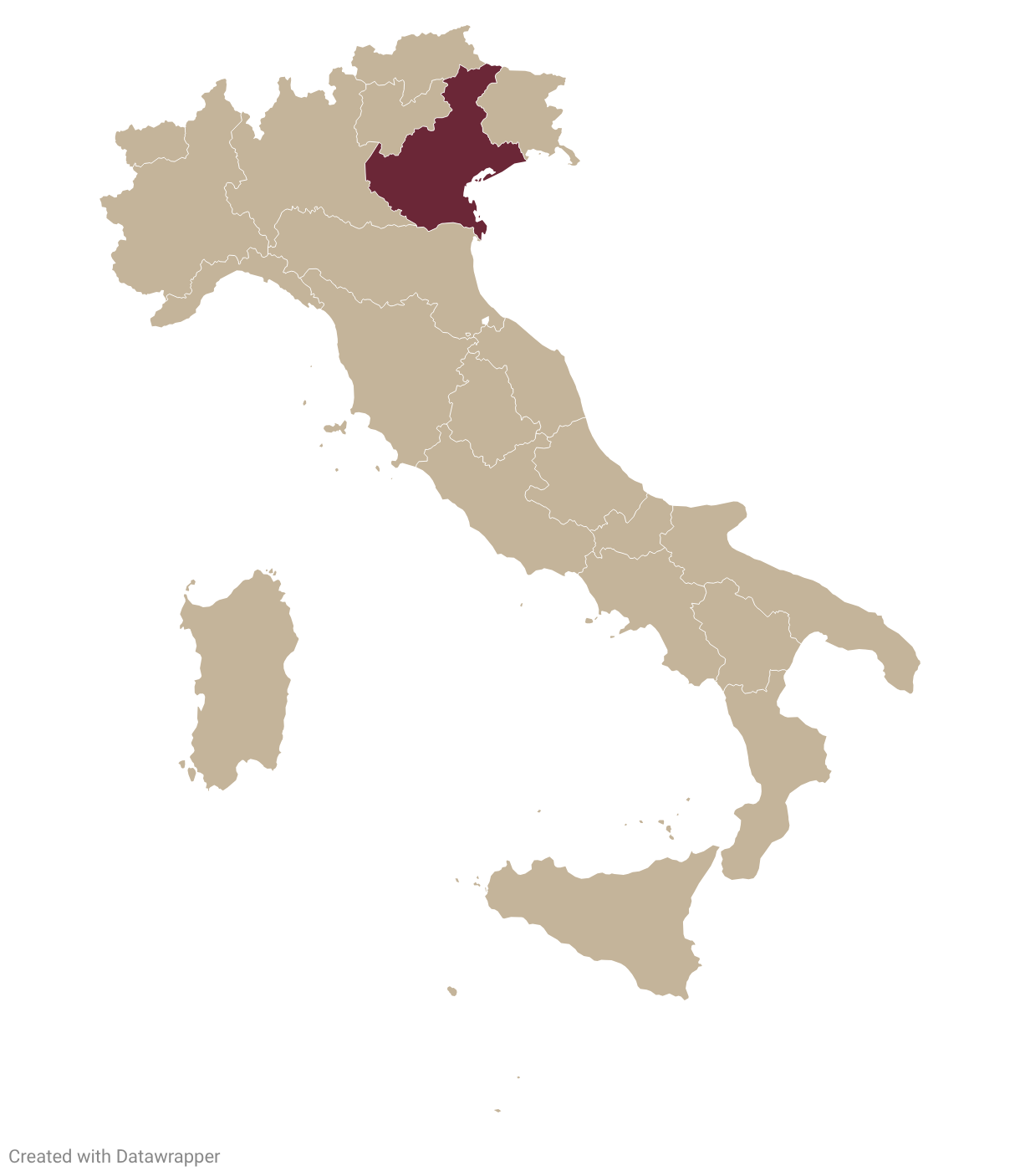
Veneto
The region that gave the world Prosecco—and also Amarone, one of Italy’s most distinctive wines.
~95,000 ha
·
14
·
1st
·
90–120
VARIETIES
Glera · Corvina · Garganega · Pinot Grigio · Corvinone · Rondinella
The story of Veneto wine begins not in the vineyard but in the loft. For centuries, the hills above Verona and Treviso held a tradition born of necessity and refinement: the appassimento, the deliberate drying of harvested grapes on wooden racks and woven bamboo in well-ventilated rooms. In Valpolicella Classico, where the tradition remains strongest, this process is documented back to medieval times. But it was Venice that transformed appassimento from mere practice into poetry. By the 14th century, Recioto della Valpolicella—a sweet wine made from raisined grapes concentrated over three to four months—had become the city’s wine of choice, prized not as an everyday drink but as a mark of refinement. This is where Veneto’s deepest identity lives: in the understanding that great wine comes not from quantity but from patience, from allowing time to concentrate flavor into something worth keeping.
Today, Veneto is Italy’s most prolific wine region by volume, producing more wine than any region in the country. And therein lies the region’s fundamental contradiction. The same land that gave the world Recioto now produces vast quantities of industrial Pinot Grigio and generic Soave destined for restaurant by-the-glass pours around the world. This is not a failure; it is a choice made decades ago, one that allowed the region to thrive economically. But it means that the contrast between Veneto’s highest and lowest expressions is greater than almost anywhere else in Italy. At one end: anonymous bulk wine. At the other: Amarone della Valpolicella, a wine that embodies everything appassimento promised. Made from Corvina grapes that have spent 90 to 120 days drying on racks, Amarone achieves 15–16% alcohol and concentrated depth that can age for decades, rivaling Barolo and Brunello as one of Italy’s longest-lived reds. These two expressions share nothing but geography.
Between Tank and Loft
The modern Amarone era begins in the 1950s and 1960s, when producers began releasing commercially significant volumes. But it was international critical recognition in the 1980s and 1990s that transformed Amarone from regional specialty into serious competitor on the world stage. Producers like Quintarelli established themselves as custodians of appassimento, crafting wines from hand-selected fruit that spend months in wood. Dal Forno and Allegrini followed, each bringing their own intensity and longevity to the traditional form. These are not industrial wines. They are the product of small harvests, long drying times, and the patience to wait years before release. The appassimento lofts of Valpolicella became monuments to a philosophy: that some wines are worth waiting for, both in the cellar and in the marketplace.
Meanwhile, in the Treviso hills, a different logic took hold. Prosecco, made from Glera using the Charmat method (secondary fermentation in sealed tanks rather than individual bottles), offered something opposite: freshness, approachability, immediate pleasure. When the Prosecco market exploded in the 1990s and 2000s, becoming a global aperitif phenomenon, it validated a different vision of wine’s role. The Conegliano Valdobbiadene DOCG, where steep hillsides often require hand harvesting, produces Prosecco of genuine distinction: mineral, floral, with apple and pear fruit and a lightness that no Champagne-method wine quite replicates. Producers like Bisol and Nino Franco demonstrate that quality Prosecco is not a contradiction in terms. But the broader Prosecco DOC covers a much larger area with highly variable quality, and the gap between the hills and the plains is as significant as any distinction in Amarone. The choice of where to buy matters considerably.
What the Volcano Left Behind
Outside the narratives of Prosecco’s explosion and Amarone’s renaissance sits Soave, a wine that has never quite claimed the cultural prominence its terroir deserves. The volcanic soils of the Lessini hills—remnants of eruptions that shaped this landscape millions of years ago—give Garganega a mineral intensity and food-friendliness that rivals any white wine in Northern Italy. Produttori del Soave and other serious makers have spent decades proving that Soave Classico is capable of complexity and aging potential, with saline notes and subtle stone fruit that develop over years in bottle. Yet Soave remains, for many drinkers, a second thought—a compromise choice, a default restaurant order, a wine that suffers from its own popularity and ease of drinking.
This is Veneto’s hidden strength. Beyond the headlines of Amarone and Prosecco lies a landscape of careful craftspeople making wines that few international critics taste and fewer still understand. Whites from volcanic clay, reds from indigenous varieties like Corvina and Rondinella, even sparkling wines from smaller appellations that predate Prosecco’s fame. These are wines made for the table, for seasons, for a particular place at a particular meal. They do not demand attention or collection. They reward curiosity.
That is precisely why they matter: they remind us that wine’s greatest gift is not rarity or concentration or international recognition, but the simple ability to connect a place to a moment. Veneto offers both: the monumental Amarones that demand respect and waiting, and the quieter whites and reds that ask only to be drunk with food, with friends, with an understanding that pleasure need not be earned.
“Amarone is a modern red for modern tastes, made from ancient grapes by an ancient process.”
— Burton Anderson, The Wine Atlas of Italy
The Appellations
From the appassimento reds of Valpolicella to the volcanic whites of Soave to the hillside Prosecco of Conegliano—three distinct world-class expressions from Italy’s most productive region.
Prestige
Valpolicella & Amarone
The appassimento tradition: 90–120 days of grape drying concentrate Corvina into Amarone’s concentrated density—dark dried cherry, chocolate, iron, spice aged in large oak for 2–4 years. Among Italy’s longest-lived reds. Ripasso offers a halfway point at accessible prices.
Corvina · Corvinone · Rondinella · Molinara · Oseleta
Major
Soave
Garganega on the Classico zone’s ancient volcanic hills creates among Italy’s most expressive whites: almond, white peach, mineral with a textural weight that surprises. The Classico zone is markedly different from generic Soave—single-vineyard bottlings from Pieropan or Gini are benchmarks of what the grape can achieve.
Garganega · Trebbiano di Soave · Chardonnay · Pinot Grigio
Regional
Prosecco & Conegliano
Italy’s most popular sparkling wine: Glera fermented in sealed tanks preserves fresh apple, pear, and white flower character. Conegliano Valdobbiadene DOCG—steep hillsides often requiring hand harvesting—produces mineral, complex Prosecco at a fraction of Champagne prices.
Glera · Perera · Verdiso · Bianchetta Trevigiana
Last updated: April 2026
Related Stories
TERROIR’s Veneto coverage—regional reporting, market dispatches, and the stories shaping what ends up in your glass.
The next one arrives Thursday.
Vintage intelligence, producer profiles, and curated cellar picks — before the critics weigh in. Weekly dispatch.