

Alto Adige
Italy’s northernmost wine region—where Austrian precision meets Italian ambition across 5,500 hectares of Alpine vineyard.
5,500 ha
·
7
·
300–900m
·
Bilingual
VARIETIES
Pinot Grigio · Gewürztraminer · Pinot Nero · Lagrein · Schiava
Alto Adige (Südtirol in German) entered the twentieth century as Austrian and entered the twenty-first as Italian—a shift formalized by the Treaty of Saint-Germain in 1919, when the region transferred from the Austro-Hungarian Empire to Italy. The German-speaking majority maintained its cultural inheritance with deliberate precision: the language persists on road signs and school rosters, in cooperative cellars and family vineyards. The wines carry both inheritances visibly. Labels print in two languages. The German convention of naming the grape variety on the label sits alongside the Italian DOC framework that encompasses production rules and geography. Preferred styles echo Austrian tradition—dry, precise whites built on acid and mineral structure—within an Italian regulatory system. The result is a region that feels unlike the rest of Italy: cooler, more tightly coiled, more focused on structural clarity than the ripeness that defines wine further south.
The cooperative tradition deepened this duality. Cantina Terlano, founded in 1893, established a model that would define the region: small growers pooling resources, maintaining individual vineyard identity while building collective scale. Today, 5,500 hectares of vineyard across seven subzones operate within this framework of shared facilities and individual expression. That tension—between community and singularity, between Austrian precision and Italian ambition—shaped not only how the region organized itself economically, but how its wines came to taste: neither purely Alpine nor purely Mediterranean, but a productive synthesis of both.
The Bilingual Inheritance
Identity in Alto Adige functions at the level of the label itself. Pick up a bottle from Elena Walch or Alois Lageder, and you encounter two names for one place, two languages for one people, two wine traditions negotiating a shared soil. Gewürztraminer—a variety traditionally associated with the village of Tramin, from which it takes its name—carries this duality in its very existence: an Austrian classic grown in an Italian region, producing wines that reflect both lineages. At Cantina Terlano, winemakers steward Pinot Grigio with German precision and Italian regulatory rigor, resulting in expressions that bear little resemblance to the neutral bulk wine that floods global markets under the same name. J. Hofstätter, one of the region’s defining producers, represents another model: a family operation that maintains bilingual identity while building international reputation. The wines emerging from these houses—and dozens like them—refuse easy categorization. They are not Austrian because they are Italian. They are not Italian because they are Austrian. They are Alto Adige because they honor both inheritances simultaneously.
The bilingual label is not merely decorative. It signals a cultural persistence and an approach to winemaking that privileges precision over power, structure over sweetness. The cooperative system that defines production across the region—where individual growers maintain vineyard control while sharing fermentation and aging facilities—ensures that small terroir differences remain visible in the final wine. The result is consistency of style across the region paired with meaningful expression of individual vineyard character. A Pinot Grigio from Colli di Bolzano reads differently than one from Terlano; both read differently than comparable expressions from Friuli or the Veneto. These differences exist precisely because the region has maintained its dual identity rather than collapsing into a single Italian idiom.
What the Alpine Climate Produces
The Adige river valley cuts north-south through the Alps, and the vineyards planted on its steep terraced sides occupy an unusual position: high altitude (300 to 900 meters depending on subzone) that filters moisture from the air, intense mountain sunshine, and cold nights that preserve acidity in every vintage. Geography here functions as syntax. The valley walls around Mazzon and Ora block afternoon sun long enough to slow ripening, creating conditions under which Pinot Nero achieves transparency and delicacy that echoes Burgundian village wines—not through imitation but through shared climate pressures on the same grape. The copper-hued intensity of Terlano’s Pinot Grigio traces directly to the clay and limestone soils of that specific terroir, combined with altitude that checks alcohol development while building phenolic precision. Gewürztraminer, grown nowhere else with quite the same restraint, channels its natural floral intensity through the valley’s cool nights: rose petal and lychee present but controlled, the grape’s potential sweetness disciplined by Alpine acidity. These are not elegant wines despite their power. They are elegant wines because of their refusal to surrender to easier, riper expressions.
Lagrein—an indigenous red grown almost exclusively in Alto Adige—provides the counterpoint. Darker than Pinot Nero, fuller in structure, marked by a characteristic bitter-cherry finish and peppery tannin that reflects the specific mineral composition of the region’s soils, Lagrein demands food and time. It tastes like no other wine because it grows nowhere else.
The wines emerging from Alto Adige’s seven subzones, across 5,500 hectares at elevations that test what ripeness means in a cool climate, represent an instructive lesson in how geography shapes wine’s architecture. They reward patient exploration precisely because they refuse the shortcuts of power or obvious appeal. For those willing to meet them on their own terms—in food-centric bottles built to age, structured for meals rather than meditation—they offer a different kind of pleasure: one grounded in specificity, in the voice of a particular place, in the accumulated knowledge of two wine cultures negotiating their shared inheritance.
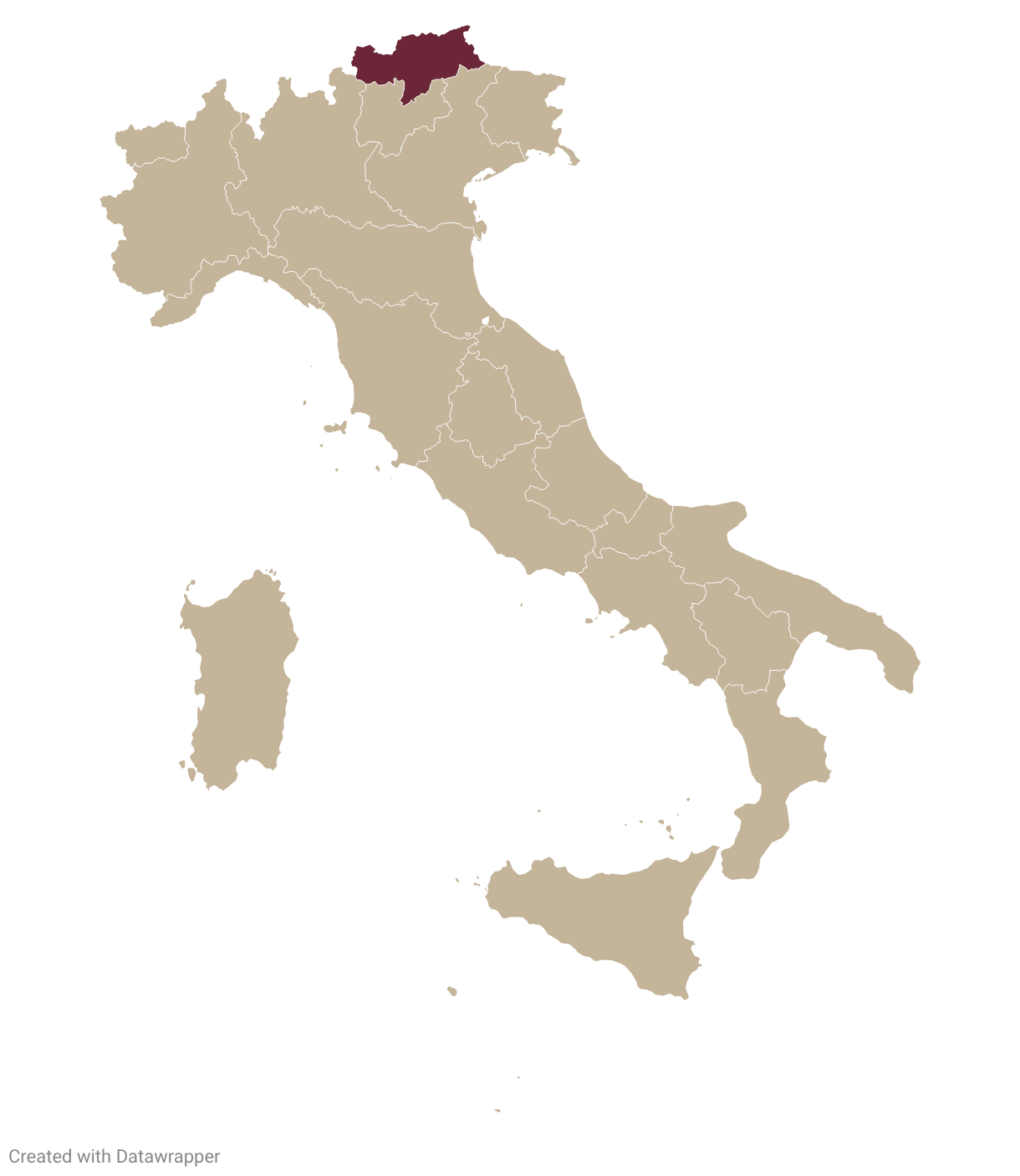
“Alto Adige is Italy’s most northerly wine region, and one of its most beautiful, with vineyards climbing up steep slopes beneath the Alps.”
— Hugh Johnson & Jancis Robinson, The World Atlas of Wine
The Appellations
Three expressions across Italy’s alpine north—aromatic whites, Austrian-influenced precision, and indigenous reds found nowhere else.
Prestige
Terlano & White Varieties
The benchmark for Alto Adige whites: Cantina Terlano’s Pinot Bianco and Sauvignon Blanc from porphyry and quartz-rich soils achieve a mineral tension and aging ability that has drawn comparisons to top white Burgundy. Pinot Grigio here—copper-hued, smoky, weighty—is among the variety’s most compelling expressions.
Pinot Grigio · Pinot Bianco · Sauvignon Blanc · Gewürztraminer · Riesling
Major
Gewürztraminer & Aromatic Whites
Traminer Aromatico (Gewürztraminer) takes its name from the village of Tramin/Termeno—a traditional claim to the grape’s origins. Here the lychee and rose intensity is tempered by alpine acidity into something elegant rather than overwhelming. Müller-Thurgau and Kerner round out the aromatic range with local character.
Gewürztraminer · Müller-Thurgau · Kerner · Muscat
Major
Lagrein & Pinot Nero
The reds that prove Alto Adige’s full range: Lagrein’s dark, bitter-cherry intensity grown almost nowhere else; Pinot Nero from cool subzones like Mazzon and Ora achieving a delicacy that draws comparisons to Burgundy village wine. Both represent strong value—quality that, by most critical assessments, exceeds international recognition.
Lagrein · Pinot Nero · Schiava · Cabernet Sauvignon · Merlot
Last updated: April 2026
Related Stories
TERROIR’s Alto Adige coverage—regional reporting, market dispatches, and the stories shaping what ends up in your glass.
The next one arrives Thursday.
Vintage intelligence, producer profiles, and curated cellar picks — before the critics weigh in. Weekly dispatch.