

Rheingau
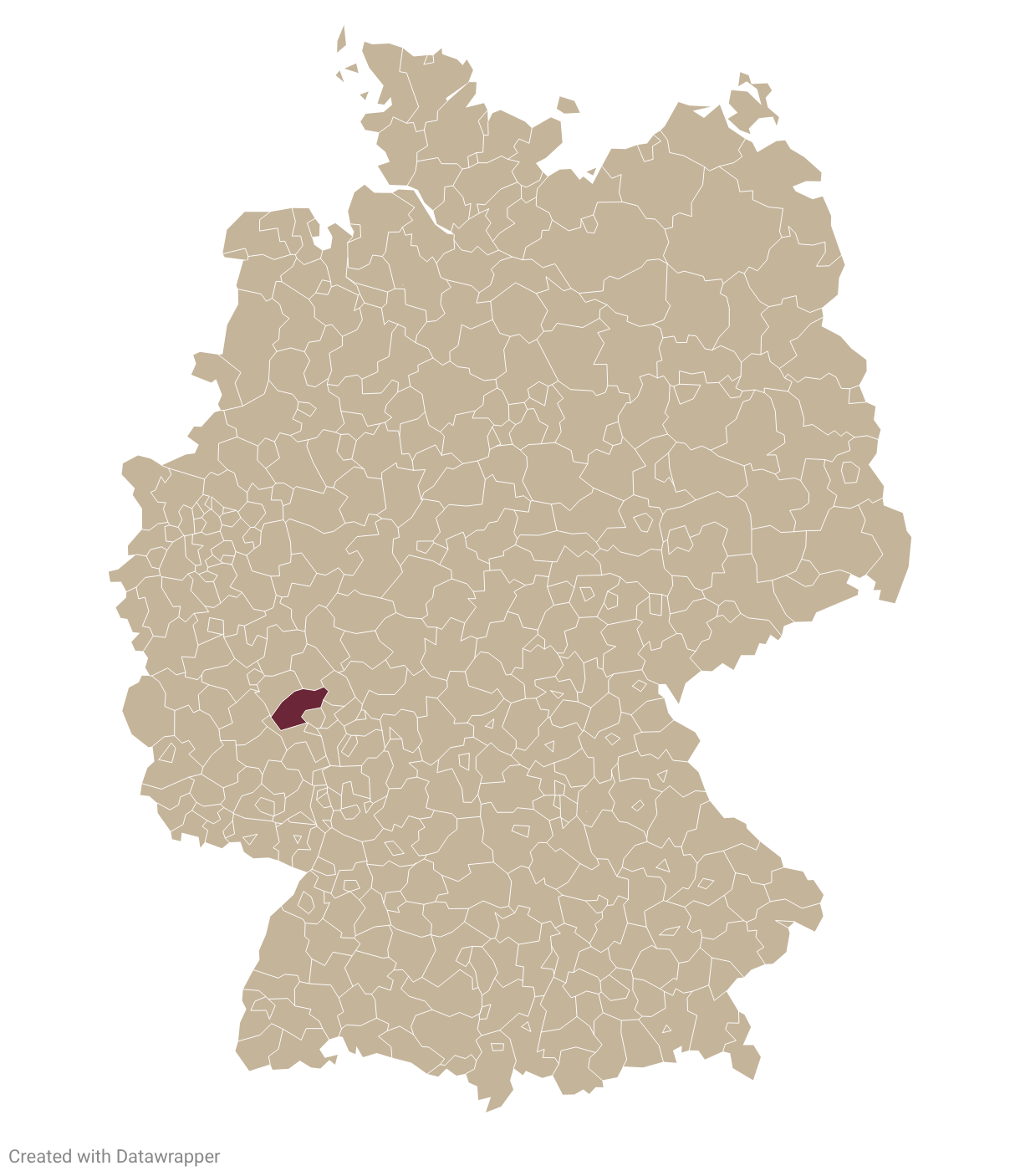
Germany’s most prestigious region produces elegant Rieslings and age-worthy Spätburgunders from sun-blessed hillsides on the Rhine’s strategic bend.
3,200 ha
·
80%
·
4
·
1,200+
VARIETIES
Riesling · Spätburgunder · Müller-Thurgau
In 1136, Bernard of Clairvaux dispatched thirteen Cistercian monks to a bend in the Rhine where the river turns west. They arrived at an abandoned Benedictine settlement in what would become the Rheingau, and within thirty years, the monastery they built—Kloster Eberbach—owned nine estates, two wineries, and a network of holdings across the region. The monks brought viticulture not as tradition but as theological ambition: wine for the altar and for commerce, wine as the economic foundation of monastic life. By the 15th century, before any region could claim the title in Europe, Kloster Eberbach was the largest winery on German-speaking soil, with over 750 acres of vineyards producing wines that moved bishops and princes. What those monks recognized, standing on the riverbank eight centuries ago, was geography as destiny. The Rhine’s dramatic westward arc over thirty kilometers creates an amphitheatre of south-facing slopes, sheltered from northern winds by the Taunus Mountains, where the combination of reflected sunlight, stable temperatures, and heat-retaining water creates conditions that allow Riesling to ripen fully even at this northerly latitude.
That observation shaped everything that followed. Today, the Rheingau occupies 3,200 hectares across four sub-appellations (Rüdesheim, Johannisberg, Rauenthal, and Hallgarten), with eighty percent of its vineyard devoted to Riesling. The region has produced twelve centuries of continuous winemaking history. Yet Rheingau’s relationship with that legacy remains complicated, caught between historical prestige and the market realities of the present.
The Weight of Legacy
The Rheingau’s problem is not obscurity. In 1775, the monks at Schloss Johannisberg, waiting for permission from the Prince-Bishop to harvest, received their courier eight days late. The grapes had already been affected by noble rot, their skins shrivelled. In desperation, they pressed them anyway—and discovered Spätlese, the late-harvest wine that would eventually give birth to the German Prädikat classification system. That single accident of timing established Rheingau as the birthplace of a category of wine that would influence German viticulture for the next two and a half centuries. The region’s contribution to global wine culture is real and measurable. What has become difficult to sustain is the notion that historical achievement automatically translates to contemporary market dominance.
For much of the 20th century, Rheingau commanded the highest prices among German regions, a premium anchored in medieval manuscripts, monastic records, and the Spätlese legend. The 1971 German Wine Law and the subsequent flood of industrial Liebfraumilch under inexpensive labels corroded that authority. By the 1990s, Rheingau had to compete not just with its own reputation but against the negative associations of cheap, sweetened wines wearing false claims of heritage. The VDP (Verband Deutscher Prädikatsweingüter) response—a classification system separating Grosse Lage (grand cru) and Erste Lage (premier cru) sites from commodity production—represented a reclamation effort. Estates like Robert Weil, which produces dry Grosses Gewächs from the Kiedrich Gräfenberg (classified as Grosse Lage), and the historic Kloster Eberbach have rebuilt credibility by insisting on terroir precision rather than region-wide acclaim. These top designations now command prices between €80–€150 per bottle at release, positioning them firmly within Germany’s quality conversation. Yet the paradox persists: a region with more history than any other claims no more market share than its younger, smaller competitors in the Mosel or the Pfalz.
Where the River Turns South
The geology of the Rheingau is not subtle. Where the Rhine bends westward, the bedrock shifts: the Taunus Mountains, rising to the north, are composed of phyllite schist and quartzite. The vineyards sit on weathered decomposition of these metamorphic rocks, creating soils with particular mineral density. In Hallgarten and Rauenthal, phyllite dominates—a crystalline schist with violet shimmer, composed primarily of quartz and mica, formed under immense pressure. The Lenchen vineyard harbours a geological secret: beneath the fertile loess-clay run red quartzite veins rich in iron oxide. This loess itself—a sediment blown during the ice ages from vegetation-free cold deserts—forms deep, fertile soils with excellent water retention, allowing vines to root deeply and find moisture even in dry periods. The minerality in a Rheingau Riesling comes not from branding but from thirty centimetres below the surface.
What distinguishes Rheingau Riesling from its Mosel counterpart is not just minerality but structure. The south-facing slopes of the Rhine bend capture more cumulative sunlight than any other Riesling region north of Alsace. The river reflects additional warmth, acting as a thermal battery that moderates temperature swings and minimizes frost risk. The Taunus Mountains block the northerly winds that would otherwise chill the vines during the growing season. The result is a Riesling with more glycerol weight, rounder phenolic structure, and citrus minerality that sits deeper in the glass than the electric, crystalline character typical of the Mosel. Hallgarten and Rauenthal exemplify this: wines of palpable volume and persistence, where stone fruit and honey marry with slate-like mineral grip.
TERROIR Atlas exists to move past legend and polite marketing language. The Rheingau’s claim to attention rests not on twelve centuries of monks and princes but on the simple fact that eight kilometres of west-facing slopes on the only dramatic bend in the Rhine’s path through Germany create conditions—phyllite and quartzite bedrock, deep loess soils, reflected sunlight, thermal stability—that allow Riesling to achieve a particular expression of minerality and structure that cannot be replicated elsewhere. That is not heritage. That is geology made manifest in the glass, and it is enough.
“The Rheingau makes Rieslings of the broadest frame in Germany—wines of Apollonian structure, built on the seriousness that comes from stone and angle and a thousand years of human persistence.”
— Terry Theise, Reading Between the Wines
The Sub-Appellations
Four distinct zones within the Rheingau each bring their own terroir expression, shaped by the Rhine’s thermal influence and the region’s varied geological foundation.
Bereich (District)
Johannisberg
Historic monastery heart producing Rheingau’s most celebrated Rieslings. Slate-bound south-facing slopes create wines of legendary finesse—powerful yet precise, with 50+ year ageing potential rooted in a millennium of monastic viticulture.
Riesling · Spätburgunder
Bereich (District)
Rüdesheim
Westernmost zone where the Rhine’s strategic turn creates dramatic south-facing exposure. Bold, muscular Rieslings with the broadest frame in the region—Rheingau’s most age-worthy expressions.
Riesling · Spätburgunder · Müller-Thurgau
Bereich (District)
Geisenheim
Home to Germany’s premier wine research institute and a progressive terroir of surprising complexity. Diverse soils produce Rieslings of mineral precision and serious intent, with Grauburgunder gaining ground.
Riesling · Spätburgunder · Müller-Thurgau · Grauburgunder
Bereich (District)
Winkel
Eastern realm of historic vineyard sites producing wines of classical elegance and mineral restraint. Loam-rich soils create fuller-bodied Rieslings with silky texture and the haunting depth of old-vine cultivation.
Riesling · Spätburgunder · Gewürztraminer
Last updated: April 2026
Related Stories
TERROIR’s coverage of Rheingau — appellations, producers, and vintages worth knowing.
The next one arrives Thursday.
Vintage intelligence, producer profiles, and curated cellar picks — before the critics weigh in. Weekly dispatch.