

Pfalz
Germany’s warmest region produces full-bodied whites and reds with Mediterranean ripeness balanced by crisp acidity and mineral expression.
3
·
Warm Continental
·
~23,600 ha
·
1,500+
VARIETIES
Riesling · Spätburgunder · Grauburgunder · Dornfelder
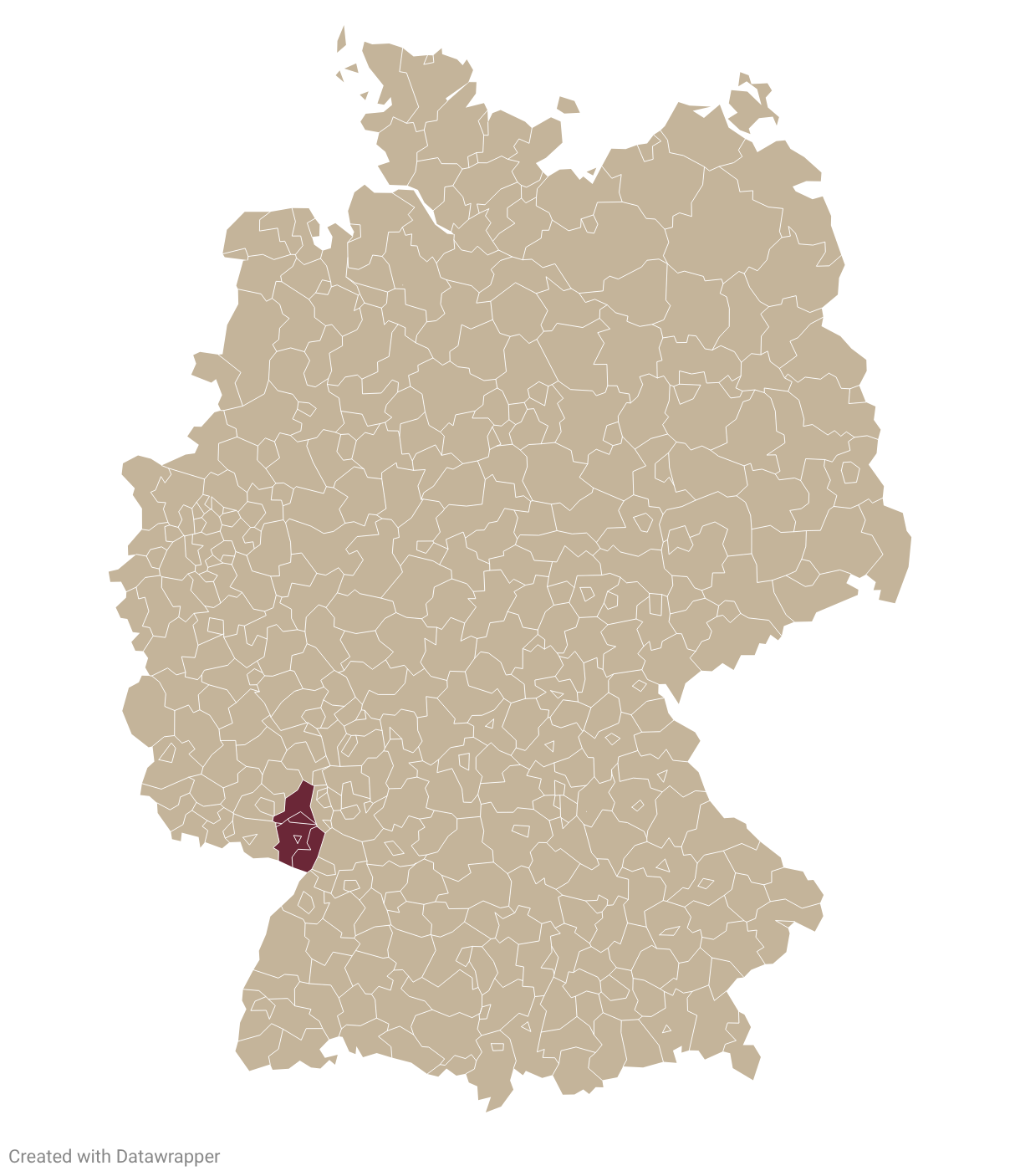
The Pfalz stretches across more than 23,600 hectares of vineyard along Germany’s warmest continental corridor, a region shaped as much by Roman commerce as by medieval politics. The Haardt Mountains form its spine, their limestone and sandstone shelves collecting sunlight and funneling Mediterranean warmth southward from the Rhine Plain. Wine cultivation here began in earnest during the Roman occupation—amphorae have been found bearing inscriptions of local vintners—but the region’s modern identity took root in the Palatinate’s medieval wine trade. By the 18th and 19th centuries, the Pfalz had become Germany’s largest wine-producing region, a distinction it holds today. That heritage of volume, however, masked a deeper ambition that would not fully emerge until the final quarter of the 20th century.
The contemporary Pfalz is the product of a deliberate transformation. Where quantity once reigned, quality now drives reputation. The region is organized into three sub-appellations: the prestigious Mittelhaardt in the north, home to estates of centuries-long standing; the Südliche Weinstrasse in the south, traditionally focused on value production; and the newer, smaller Bereich Landau in between. This tripartite geography reflects not just viticultural zones but competing philosophies about what Pfalz wine should be. The warm continental climate—averaging 1,500 to 1,800 sunshine hours annually, among the highest in Germany—acts as the underlying condition that allows both bulk-wine simplicity and complex, serious expression. The region’s soils, a medley of basalt, sandstone, and limestone, further ensure that no single style dominates.
The Reformation of the Weinstrasse
The story of the Pfalz in the 1980s and 1990s is one of deliberate reformation. The Flurbereinigung—a sweeping restructuring of vineyard plots into rational, mechanically workable parcels—modernized the region’s viticulture just as a new generation of winemakers began arriving with ambitions to compete with Mosel and Rheingau peers. At stake was not merely prestige but the region’s economic future. Estates that had been known for feeding the German market with reliable everyday wines—the Konsumweine—began investing in barrel aging, selective harvesting, and experimentation with Burgundian grape varieties. The tension between this older order and the new ambition runs through Pfalz wine culture to this day, and it is precisely this productive friction that makes the region compelling.
The VDP classification of prestigious estates offers concrete proof of the region’s ascent. Bürklin-Wolf, Bassermann-Jordan, and von Buhl—three houses with centuries of continuous production—anchored the quality hierarchy, but their monopoly has been steadily eroded by newcomers and ambitious producers from the Südliche Weinstrasse who have embraced precision viticulture and experimentation. The pricing structure of Pfalz wines reflects this ongoing negotiation: a top-rated Mittelhaardt Riesling from a VDP estate now commands €40–€100 per bottle at release, while exceptional Spätburgunder from south-based producers sell at equivalent prices. Meanwhile, the cooperative movement, which still plays a significant economic role in the Pfalz, has itself upgraded substantially, with some cooperatives now producing wines that rival private estates in complexity and aging potential. The result is a region with an unusually wide price and prestige spectrum, where discovery remains abundant.
Where the Sun Argues for Red
The Pfalz’s greatest argument rests on climate. With 1,500–1,800 hours of annual sunshine and average vineyard-area temperatures of 11 degrees Celsius, the region enjoys conditions more akin to Alsace or the middle Loire than to the Mosel. This warmth permits Riesling to ripen with body and phenolic maturity that is simply unavailable in cooler German regions—the wines offer flesh without sacrificing the mineral precision and acidity that define German Riesling’s identity. But the warmth also opens possibilities that the region’s traditional identity obscured. The Spätburgunder program began in earnest in the 1990s and has yielded a generation of Pinot Noirs that rank among Germany’s finest, with silky tannins and red-fruit complexity that appeal equally to Burgundy enthusiasts and international markets.
The soil diversity of the Pfalz deserves particular attention. The basaltic soils of the Wachenheim and Forst districts impart mineral tension and spice to both Riesling and Spätburgunder. The sandstone terraces favor aromatic white varieties like Gewürztraminer and Scheurebe, while the limestone-rich parcels of the Mittelhaardt produce Rieslings of impressive structure and aging capacity. This geological heterogeneity means that the Pfalz offers something few other German regions can match: genuine terroir variation within a single wine route. A Riesling from Bad Dürkheim reads entirely differently on the palate than one from Edesheim, fifty kilometers south. This diversity has become a marketing asset and a source of genuine pleasure for collectors willing to do the work of comparative tasting.
The editorial position on the Pfalz is straightforward. This is a region no longer in ascent but firmly arrived. The quality transformation is complete, the diversity of styles is established, and the commitment to serious viticulture is no longer in question. What remains is for collectors and trade to catch up to the reality on the ground—that the Pfalz produces some of Germany’s most interesting and undervalued wines. The productive tension between north and south, between tradition and innovation, between bulk production and prestige expression, ensures that the region will continue to evolve without losing its identity. In the context of global warming and shifting European climate patterns, the Pfalz’s warmth is no longer a liability but an advantage, a place where German wine can achieve ripeness and complexity without compromise.
“Increasing numbers of ambitious young wine producers have been able to make their mark here in some of Germany’s warmest vineyards. As well as being one of Germany’s most exciting wine regions, it is also the biggest.”
— Jancis Robinson MW, jancisrobinson.com
The Sub-Appellations
Three distinct zones within Pfalz each express the region’s warm climate potential while bringing their own terroir nuances shaped by geology and microclimatic variation.
Prestige
Mittelhaardt
Northern prestige zone producing Pfalz’s greatest wines from elevated, cooler sites around Deidesheim, Forst, and Wachenheim. Rieslings of sophistication and mineral intensity rival the finest Rheingau benchmarks.
Riesling · Spätburgunder · Grauburgunder · Dornfelder
Major
Südliche Weinstrasse
Southern frontier producing warm-climate wines with natural power and fruit generosity. Limestone soils create Rieslings of broader spectrum and earlier approachability, alongside expressive reds.
Riesling · Spätburgunder · Dornfelder · Weissburgunder · Grauburgunder
Premier
Bad Dürkheim
Central transition zone balancing altitude and warmth in distinctive terroir. Diverse soils produce versatile Rieslings that range from crisp and mineral to structured and age-worthy.
Riesling · Spätburgunder · Dornfelder · Grauburgunder · Weissburgunder
Last updated: April 2026
Related Stories
TERROIR’s coverage of Pfalz — appellations, producers, and vintages worth knowing.
The next one arrives Thursday.
Vintage intelligence, producer profiles, and curated cellar picks — before the critics weigh in. Weekly dispatch.