

Mosel
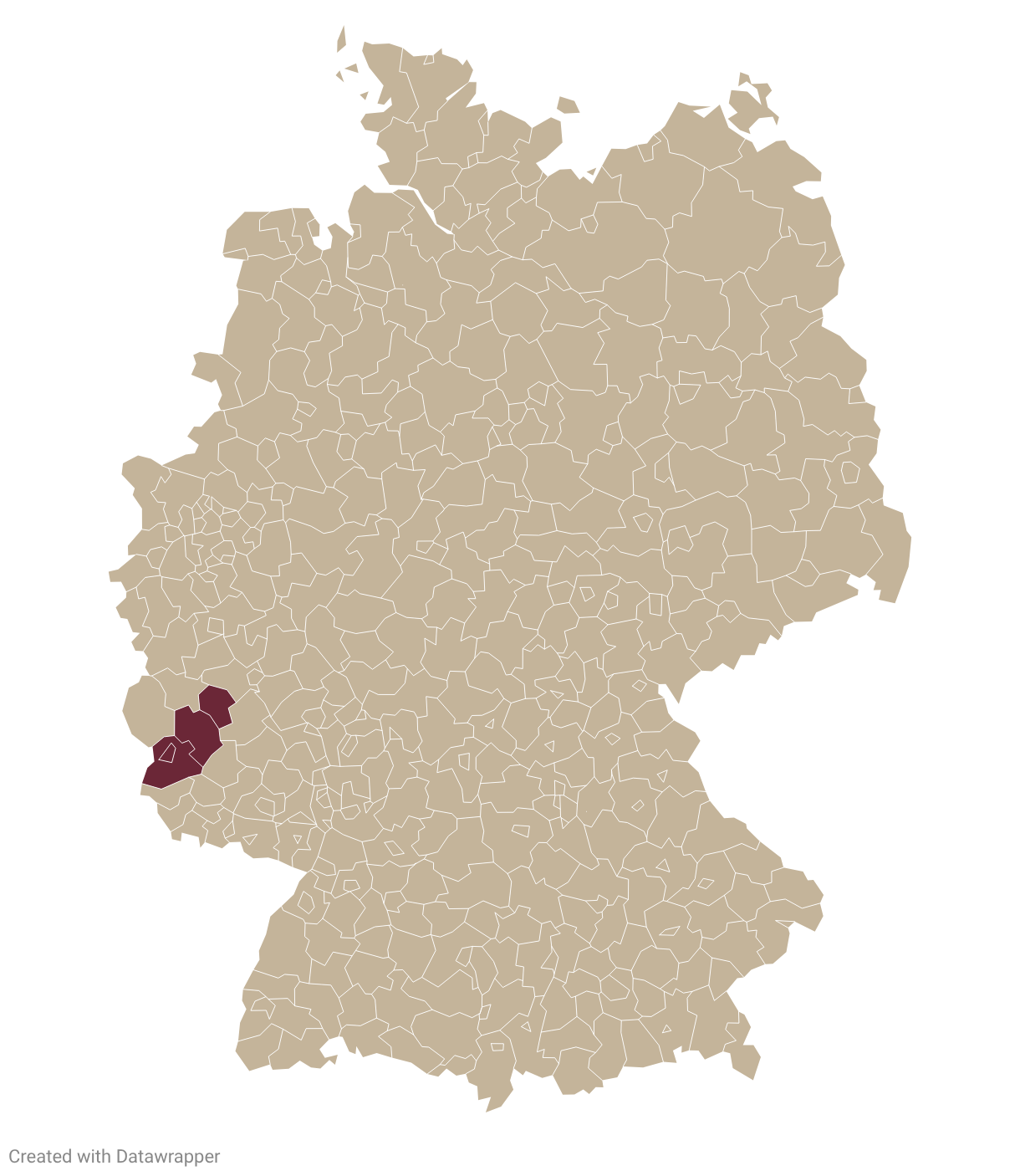
Germany’s great river valley, where Devonian slate and impossible slopes conspire to produce Rieslings of unrivalled precision and age-worthy grace.
~9,000 ha
·
Cool Continental
·
Devonian Slate
·
1971
VARIETIES
Riesling · Müller-Thurgau · Elbling
Two thousand years ago, a Roman merchant commissioned a stone relief to commemorate a wine shipment. The Neumagen wine ship, carved in the second century AD and now housed in the Trier museum, shows the Mosel exactly as it remains: a sinuous ribbon of water cutting through steep valley walls, with the river itself doing the real work of viticulture. For twenty centuries, growers have planted vines on the Mosel’s south-facing serpentine bends, turning the region’s serpentine geometry into an advantage. The river reflects sunlight back onto the slopes; the tight curves create pockets of warmth; the cold water moderates summer heat. What began as Roman pragmatism—planting where the land allowed—became the foundation of European viticultural tradition.
The Mosel is now Europe’s steepest wine region and the second-largest Riesling producer globally, with approximately 9,000 hectares under vine across a cool continental climate. The 1971 Wine Law formalized what centuries of practice had proven: that the region’s terroir—its slate soils, its cool nights, its precise seasonal rhythms—could express itself most eloquently through Riesling. Three centuries of continuous viticulture speak to the region’s capacity to endure, adapt, and ultimately define what cool-climate white wine could be.
The Steep Price of Perfection
Mosel’s greatest asset is also its cruelest burden. The steepest vineyard sites—like the Bremmer Calmont, with gradients exceeding 65 degrees—demand 800 to 1,000 hours of hand labor per hectare annually. On flat land, the same work takes 150 hours. This economic vertigo has consequences. Vineyard abandonment accelerates across the region. Young growers leave for easier slopes or other professions entirely. Mechanization is impossible; the only economics that work are those of meticulous human labor, generational commitment, and the gamble that the market will eventually reward intensity with premium prices.
Yet the paradox persists: these steepest sites produce Rieslings of a mineral intensity, age-worthiness, and terroir transparency that flat-land vineyards in the same region cannot approach. The Wehlener Sonnenuhr, the Brauneberger Juffer, the Ürziger Würzgarten—names that signal not just quality but viticultural sacrifice—remain impossible to replace. Egon Müller at Scharzhof, JJ Prüm in Wehlen, Clemens Busch in Cochem, and Schloss Lieser in Lieser have built their reputations on a resolute refusal to abandon these slopes. They have mapped the slate’s dialects through single-vineyard bottlings, teaching collectors that the cost of steepness is inseparable from the beauty it produces. This is the region’s defining tension: economics that say abandon, quality that demands perseverance.
Reading the Slate
Four hundred million years ago, during the Devonian period, the Mosel basin was a tropical seabed. What remains are layers of slate—blue, red, grey—each shade telling a story of mineral composition and thermal behavior. Blue slate, the densest and coolest, lends crystalline precision to Riesling: high acidity, mineral salinity, and a capacity for decades of graceful evolution in bottle. Red slate, iron-rich and warmer, adds a spice and voluptuous roundness; wines from red slate sites show riper stone fruit and a sensual richness that rewards early drinking. Grey slate occupies the middle ground, delivering floral lift and elegant medium weight.
The Mosel’s cool continental climate—with autumns that stretch long and cold—ensures that Riesling ripens slowly, achieving complexity of flavor precisely because it never rushes toward overripeness. In warmer regions, Riesling tends toward flabbiness; here, in slate valleys where nighttime temperatures plunge, acidity becomes structure, minerality becomes personality, and the quiet work of phenolic development gives the wines a tension and clarity that collectors rank alongside aged Chablis and white Burgundy for sheer intellectual reward. Collectors speak of drinking 30-year-old Mosel Kabinetts with the same reverence they reserve for aged Burgundy or Bordeaux—proof that cool climate and precise terroir can create lasting value and beauty.
The Mosel’s future depends on whether the next generation will accept the steepness, embrace the slate, and carry forward the region’s two-millennia conversation with its land. The economics are brutal. The beauty is irreplaceable.
“The Mosel’s Rieslings possess a quality that exists nowhere else on the vine’s range — that miraculous combination of lightness and depth, of sweetness held in perpetual tension with acid, that can age for half a century and emerge still speaking clearly.”
— TERROIR Editorial
The Sub-Appellations
Four distinct zones within the Mosel Valley, each shaped by the river’s meanders, slate composition variations, and subtle climate gradations — from the Mittelmosel’s famous steep slopes to the austere reaches of the Saar and Ruwer tributaries.
Prestige
Bernkastel
Heart of the Mittelmosel’s legendary steep vineyards, producing Germany’s most celebrated Rieslings. Slate soils and extreme gradients unlock wines of transcendent finesse — from the minerally precise Bernkasteler Doctor to the ethereal Wehlener Sonnenuhr.
Riesling · Müller-Thurgau
Prestige
Piesport
Where the Mosel carves its most dramatic river crescent, creating steep south-facing slopes of remarkable mineral intensity. Piesporter Goldtröpfchen is among Germany’s most storied vineyard sites — delicate, floral, and built to age for decades.
Riesling · Müller-Thurgau · Elbling
Major
Zeltingen
A continuation of the Mittelmosel’s finest zone, where the Wehlener Sonnenuhr vineyard extends into Zeltingen’s steep slate slopes. Rieslings here show riper stone fruit alongside the minerality that defines the Mosel at its most expressive.
Riesling · Müller-Thurgau · Weissburgunder
Major
Wintrich
The Mittelmosel’s southern reaches, where continental warmth moderates the alpine chill without sacrificing mineral elegance. Produces Rieslings of broader fruit weight and approachable character — a gentler counterpoint to the region’s most demanding expressions.
Riesling · Müller-Thurgau · Kerner
Last updated: April 2026
Related Stories
TERROIR’s coverage of the Mosel — wines, producers, and vintages worth knowing.
The next one arrives Thursday.
Vintage intelligence, producer profiles, and curated cellar picks — before the critics weigh in. Weekly dispatch.