

The Atlas > Europe > France > Languedoc-Roussillon
Languedoc-Roussillon
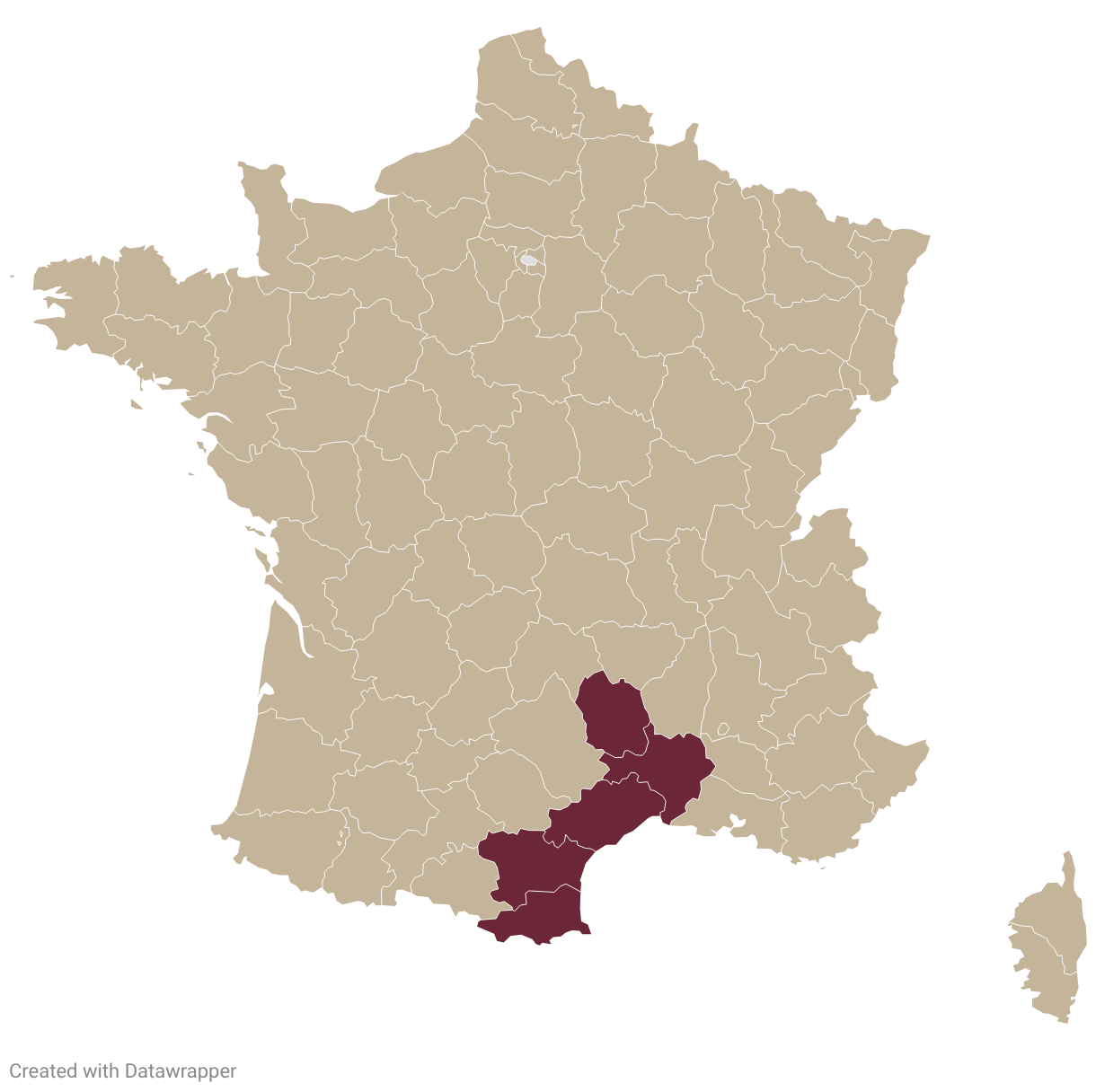
France’s largest wine region by volume, and its most transformed — where old-vine terroir and a spirit of reinvention are rewriting the rules.
200,000+
·
20+
·
300+
·
1980s
VARIETIES
Grenache · Syrah · Mourvèdre · Carignan · Cinsault
For most of the twentieth century, Languedoc-Roussillon supplied the volume that kept France’s wine economy afloat. Spanning over 200,000 hectares — more than fifteen percent of France’s entire vineyard area and among the world’s largest contiguous wine regions — it functioned as an industrial supplier of anonymous red wine. Enormous quantities destined for the blending vat or cooperative tank, Languedoc was the engine of French bulk production, a region famous not for quality but for quantity, not for its own identity but for its service to others. These were the vin de table years, when overcropped plains produced thin, forgettable wines that never bore a vineyard’s name or carried a producer’s reputation. The region was, by design and circumstance, invisible — a footnote in French wine history.
Yet the limestone garrigue west of Montpellier, the mountain foothills of the Massif Central, and the schist terraces of Roussillon near the Spanish border contained something the bulk wine industry had never explored: some of the oldest, most deeply rooted vines in France. The quality revolution that gathered momentum in the 1980s — building on earlier reforms from the 1960s and 1970s — did not merely improve this wine; it changed the entire premise of the region. Producers who looked past the coastal plains discovered that these old vines, if given the chance to express their terroir rather than maximize tonnage, produced something entirely different from the commodity wine that had defined Languedoc’s reputation. A region once known for what it supplied to others began to discover what it could say for itself.
The Laboratory
The transformation was driven partly by outsiders — winemakers from Bordeaux, Burgundy, and abroad who arrived in the 1980s and 1990s, attracted by three converging circumstances: land prices a fraction of what they paid in established regions, old Grenache and Carignan vines of remarkable depth, and the freedom to experiment outside the constraints of appellation law. The region’s IGP (Indication Géographique Protégée) classification became a laboratory. Without the restrictions of AOC regulations, producers could plant Syrah alongside Mourvèdre, blend Grenache with Cabernet, craft single-varietal Carignans, and price everything at levels that rewarded curiosity without demanding a leap of faith. This freedom attracted not just talented outsiders but a spirit of reinvention that would reshape how France itself thought about wine outside its traditional power centers.
Domaines like Mas de Daumas Gassac, Mas Jullien, and Gérard Gauby’s estate in Roussillon demonstrated that the region could produce wines of genuine complexity and structure — and a strong natural wine movement reinforced the sense that Languedoc had something to say that no other French region was saying. The tension between cheap volume and ambitious terroir-driven wines became productive: Languedoc did not simply become “good” in the Burgundian sense; it developed its own voice, rooted in old vines, Mediterranean sun, and the conviction that tradition and innovation need not be enemies. The AOC versus IGP divide remains visible on Languedoc’s label landscape today, a reminder that the region’s reinvention was not inevitable but chosen — won through conviction and experimentation, not inherited from centuries of established prestige.
What the Garrigue Remembers
The Mediterranean climate — with approximately 300 days of annual sunshine and the moderating influence of maritime winds — creates conditions of generous ripeness tempered by occasional stress. But climate alone does not define Languedoc-Roussillon’s character. The geology is the storyteller. Limestone garrigue dominates the western plains, its chalky soils producing wines of mineral precision and structure; schist terraces rise in the foothills and mountains, their dark, weathered stone imparting a distinctive earthiness and intensity. Roussillon, the southern extension bordering Catalonia, brings its own distinct chapter — steep schist-driven topography, the channeled force of the Tramontane wind funneling Atlantic and Mediterranean air currents, and a winemaking tradition shaped by elevation, isolation, and the Spanish border’s historical cultural cross-pollination. These are not subtle distinctions. A wine from the limestone slopes north of Montpellier tastes materially different from one produced on Roussillon’s schist — not better or worse, but expressing different geological voices speaking through the same grape varieties.
Roussillon’s fortified wine tradition — Banyuls, Maury, Rivesaltes, aged in solera and expressing a complex oxidative character — represents one of France’s most distinctive vinous traditions, often overlooked by modern wine culture’s preference for dry wines but essential to understanding the region’s depth. Alongside these, increasingly celebrated dry reds of mineral intensity and structural sophistication emerge from the same steep terraces. What unites Languedoc and Roussillon, despite their significant differences in climate, soil, and tradition, is a shared sense that France’s largest wine region is still discovering what it is truly capable of. The answer, with each vintage and each generation of winemakers willing to listen to the land rather than prescribe to it, keeps improving.
TERROIR watches Languedoc-Roussillon not as a completed story but as an active one — a region still writing its own rules, still discovering the gap between what it supplies and what it can express. The outsiders who arrived in the 1980s are no longer outsiders; they are part of the region’s fabric. The natural wine movement that began as experiment has matured into a philosophical position. The IGP wines that once risked being dismissed as rule-breakers are now recognized as the laboratories where the region tested its own potential. What remains constant is the quality revolution’s fundamental insight: that old vines in Mediterranean sunshine, given the space to express their terroir, have something to say that the world should listen to.
“The most exciting region in France today is not Burgundy, Bordeaux or the Rhône, but the Languedoc-Roussillon.”
— Jancis Robinson, The Oxford Companion to Wine
The Appellations
Languedoc-Roussillon contains over twenty AOC appellations spread across France’s Mediterranean south—from the limestone garrigue west of Montpellier to the schist canyons above the Spanish border. These five zones represent the region’s range: high-altitude finesse, old-vine depth, coastal intensity, and one of France’s most distinctive fortified wine traditions.
Premier
Pic Saint-Loup
A dramatic limestone peak north of Montpellier creates a cooler microclimate that slows ripening and preserves elegance in Syrah and Grenache. Widely regarded as Languedoc’s most refined appellation.
Syrah · Grenache · Mourvèdre · Cinsault
Premier
Faugères & Saint-Chinian
Twin schist-based appellations in the foothills north of Béziers, producing structured reds with distinctive mineral signatures. Among the first Languedoc zones to earn AOC recognition.
Syrah · Grenache · Mourvèdre · Carignan
Major
Minervois & Corbières
Limestone plateaus and garrigue-scented hillsides stretching across the region’s heartland. Old-vine Carignan and Grenache at their most characterful—earthy, structured, Mediterranean in expression.
Carignan · Grenache · Syrah · Mourvèdre · Cinsault
Emerging
La Clape
A limestone massif rising from the Mediterranean coast near Narbonne, granted cru status within the Languedoc AOC in 2015. Intense, mineral-driven reds and whites shaped by maritime winds and chalky soils.
Grenache · Syrah · Mourvèdre · Bourboulenc
Major
Banyuls & Collioure
Schist terraces above the Mediterranean on the Spanish border, scoured by the Tramontane wind. Both dry reds of mineral intensity and the Banyuls fortified wines—oxidative, aged in solera—represent one of France’s most distinctive traditions.
Grenache · Carignan · Syrah · Mourvèdre
Last updated: April 2026
Related Stories
The latest from TERROIR on Languedoc-Roussillon — appellations, producers, and vintages worth knowing.
The next one arrives Thursday.
Vintage intelligence, producer profiles, and curated cellar picks — before the critics weigh in. Weekly dispatch.