

Champagne
Where chalk, cool climate, and tradition transform grapes into the benchmark for sparkling wine.
34,000
·
3
·
300M+
·
1936
VARIETIES
Chardonnay · Pinot Noir · Pinot Meunier
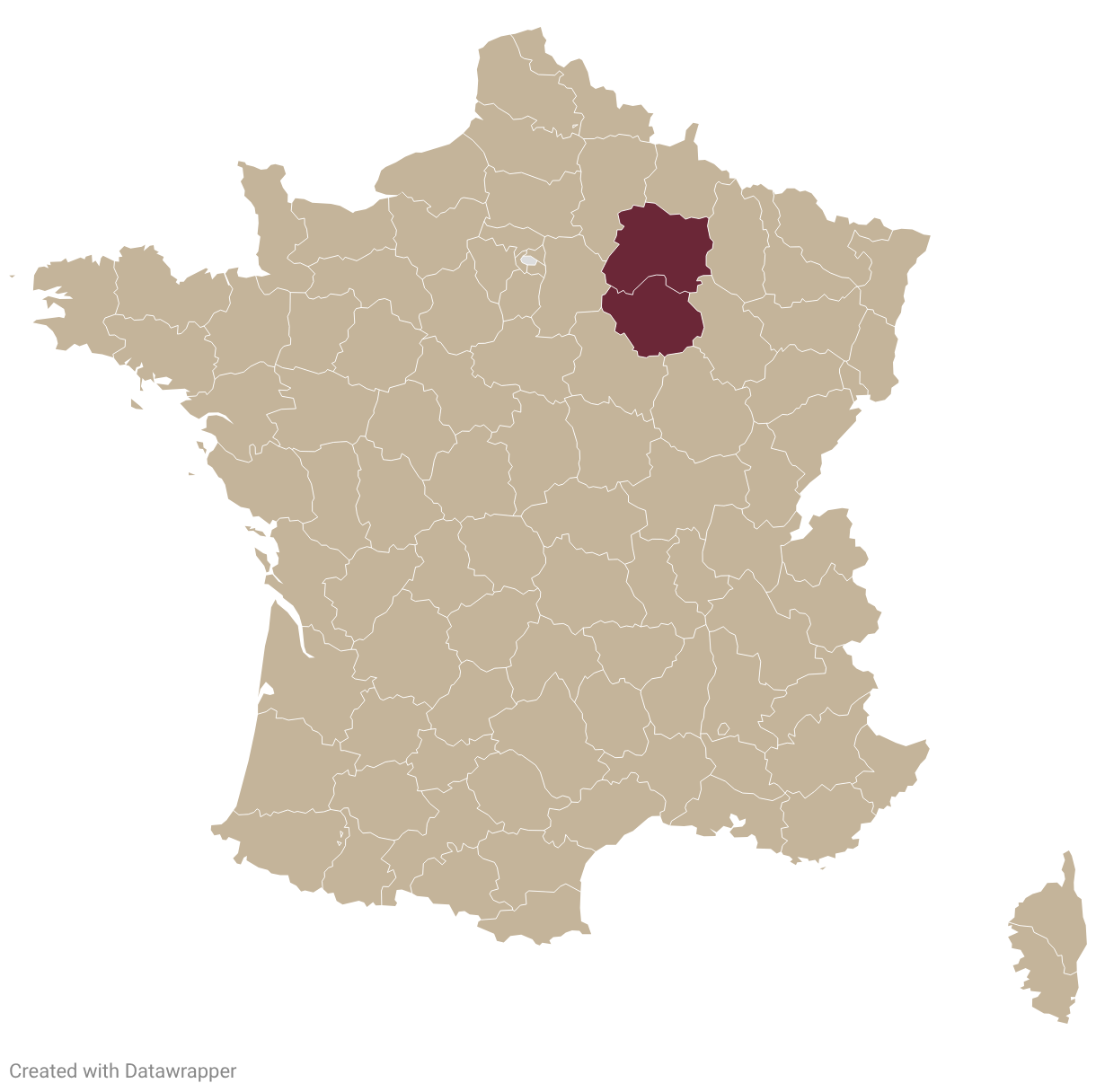
Champagne’s invention was accidental. Winemakers in the cool chalk hills northeast of Paris had always struggled with incomplete fermentation — cold winters would halt the process, and spring warmth would restart it in the bottle, producing unwanted effervescence that shattered glass and baffled cellars. The region sat at the northernmost viable limit for Vitis vinifera, where high natural acidity and low ripeness seemed structural liabilities. What appeared a flaw became the foundation. Dom Pérignon, the Benedictine cellarer at the Abbey of Hautvillers from 1668 to 1715, did not invent sparkling wine; he managed it. His real innovations — stronger bottles, better corks, precision assemblage of grapes from multiple villages — transformed an accident into a controlled expression. The bubbles he could not eliminate became the product.
What followed was two centuries of commercial refinement. Widow Clicquot’s cellar team developed riddling (remuage) around 1816 to clarify wine without losing sparkle. The great houses of Reims and Épernay — Moët, Roederer, Krug, Bollinger — built their reputations on non-vintage blends assembled across dozens of base wines and reserve wines spanning ten or more vintages. Krug Grande Cuvée, for instance, draws on more than 120 wines to achieve a consistent house signature. This blending model, governed since 1941 by the Comité Interprofessionnel du Vin de Champagne (CIVC), established Champagne as a brand-driven market where the house name mattered more than the terroir, and commercial consistency mattered more than vintage variation.
The Grower’s Counter-Argument
Champagne today spans approximately 34,000 hectares, producing around 300 million bottles annually from three permitted grapes — Chardonnay, Pinot Noir, and Pinot Meunier. The landscape is divided between roughly 16,000 growers who own vineyards and 360 houses who own the market. This structural divide — farmer versus trader, terroir owner versus brand custodian — has defined Champagne’s economics since the 19th century. Growers supplied fruit; houses assembled and commercialized. For most of that history, growers lacked the leverage to challenge the arrangement.
The past two decades have shifted that balance. Producers like Cédric Bouchard, Jérôme Prévost, and Anselme Selosse have demonstrated that single-vineyard, single-vintage Champagnes can rival the complexity of multi-vintage house blends — a direct argument for terroir specificity in a region long defined by assemblage. Their success has validated an alternative philosophy: that restraint and precision matter more than ripeness, and that the best expressions come not from blending across many sources but from deep knowledge of a single place. Whether house or grower, the finest Champagnes share this thread. The tension between these approaches — commercial consistency versus terroir specificity — now defines the region’s most interesting conversations.
The Geology Underneath
The underlying genius is geological. Champagne’s chalk — Upper Cretaceous marine deposits laid down roughly 70 million years ago — functions as both drainage and thermal regulation, storing heat during the day and releasing it slowly through cool nights. This moderates the region’s continental climate, where a mean annual temperature near 11°C places vineyards at the absolute boundary of ripeness. Rather than a handicap, this marginal condition produces high natural acidity — the structural backbone around which complexity is built. The three permitted grapes each express this chalk differently. Chardonnay yields mineral, citrus-forward wines with linear elegance; Pinot Noir brings red-fruit structure and floral nuance; Pinot Meunier offers rounder, more immediately approachable fruit. None ripens easily. All benefit from extended aging.
Extended lees aging — the dead yeast cells left in bottle after secondary fermentation — amplifies what chalk and cool climate begin. Non-vintage Champagne must spend a minimum of 15 months on lees under CIVC rules; vintage Champagne requires 36 months. The finest cuvées from houses like Salon, Krug, and Bollinger often rest for seven years or more, developing the biscuit, brioche, and almond notes that have become the global benchmark for sparkling wine quality. Older vintages show honey, hazelnut, and mineral depth that younger Champagnes cannot. This extended aging is where terroir deepens — where chalk and cold become flavor, not just concept. The region’s greatest Champagnes demonstrate that aging potential is not a luxury but a signature, a commitment to complexity that separates true Champagne from every other sparkling wine made elsewhere.
“I drink it when I’m happy and when I’m sad. Sometimes I drink it when I’m alone. When I have company, I consider it obligatory. I trifle with it if I’m not hungry and drink it when I am. Otherwise, I never touch it—unless I’m thirsty.”
— Madame Lily Bollinger, Interview, 1961
The Sub-Regions
Three distinct terroirs that supply the raw material for the world’s most celebrated sparkling wines, each shaped by its grape, its slope, and its chalk.
Grand Cru
Côte des Blancs
Chardonnay’s definitive Champagne territory: a pure chalk plateau yielding elegant, mineral, citrus-forward Blancs de Blancs that age gracefully for 15–20 years, evolving from bright citrus to honeyed complexity.
Chardonnay
Grand Cru
Montagne de Reims
Pinot Noir’s finest Champagne expression: red fruit, floral aromatics, and biscuity toasted complexity from extended aging. Home to six of Champagne’s seventeen Grand Cru villages, including Verzenay, Bouzy, and Ambonnay.
Pinot Noir · Chardonnay
Premier Cru
Vallée de la Marne
Pinot Meunier’s heartland: warmer valley soils produce rounder, fruitier Champagnes with approachable charm. Small growers here offer some of the region’s best value, with food-friendly wines that reward earlier drinking.
Pinot Meunier · Pinot Noir · Chardonnay
Last updated: April 2026
Related Stories
TERROIR’s coverage of Champagne—producers, vintages, and the stories behind the bubbles.
The next one arrives Thursday.
Vintage intelligence, producer profiles, and curated cellar picks — before the critics weigh in. Weekly dispatch.