

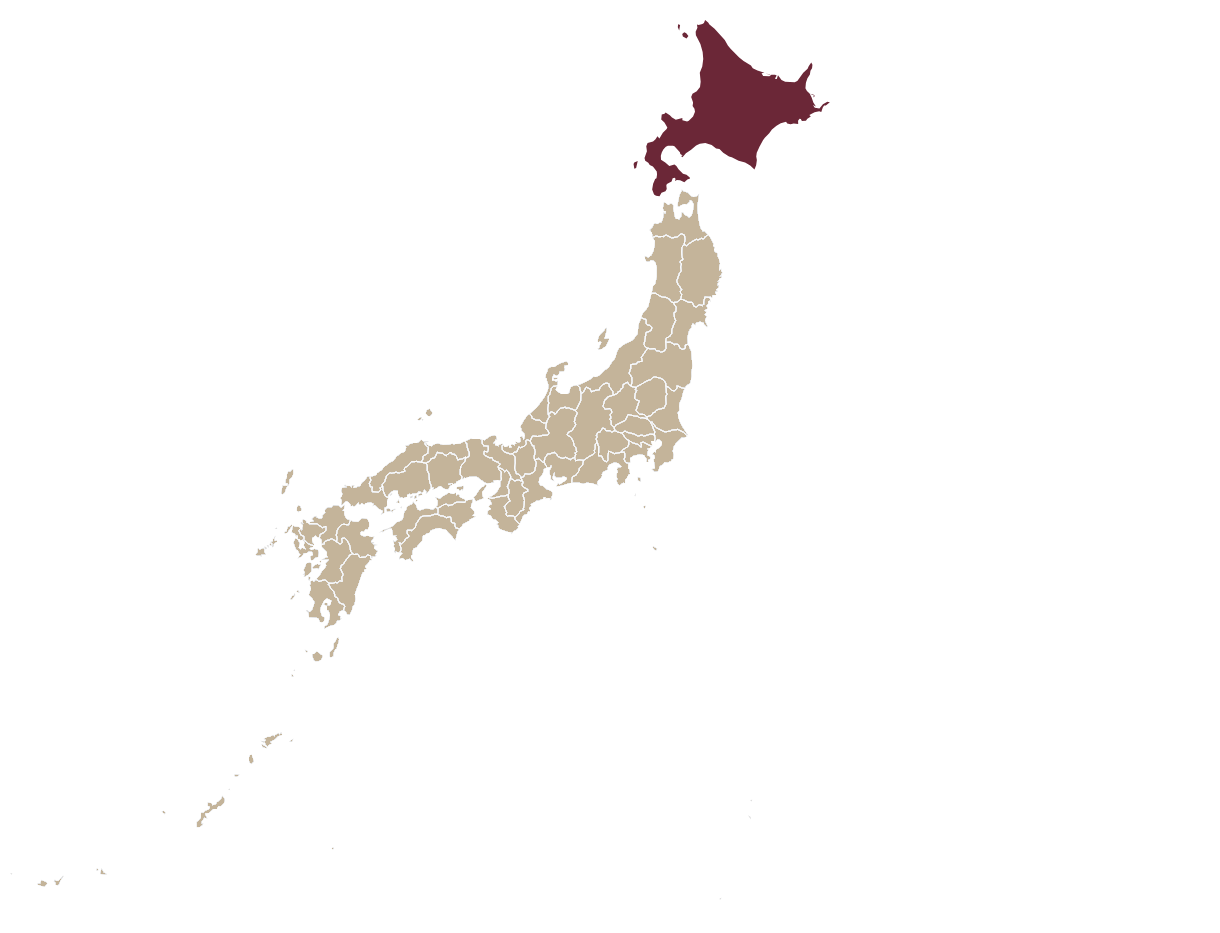
Hokkaido
Japan’s northernmost wine frontier, where subarctic summers and volcanic soils are producing Pinot Noir that has already drawn Burgundy’s own Domaine de Montille to its shores
~800 ha
·
43+
·
Cool Maritime
·
2018
VARIETIES
Pinot Noir · Chardonnay · Kerner · Zweigeltrebe
Hokkaido’s wine story begins not with a château or a viticultural tradition but with a town council’s act of desperation. In 1963, Ikeda—a rural municipality in the island’s southeastern Tokachi region—planted vines as a rural recovery strategy, cultivating cold-hardy hybrid varieties capable of surviving winters that routinely fall to negative 20 degrees Celsius. What they produced was rough by any standard, but it established a proof of concept: grapes could grow on Japan’s northernmost main island. The wines were not elegant. They were not meant to be. They were meant to save a town from economic extinction, and in that specific aim, they succeeded. A half-century later, that modest experiment has given way to one of the most dynamic wine regions in Asia, attracting investment from Burgundy, critical attention from international publications, and a new generation of vignerons convinced that Hokkaido’s dry summers, low humidity, and cool, unhurried autumns represent among the most promising conditions in the country. The climatic logic is simple: Hokkaido sits at 43 degrees north latitude, sharing conditions with Alsace and parts of cool-climate Germany, a geography that offers an escape from the monsoon humidity that plagues the rest of Japan.
The prestige has settled in Yoichi, a coastal district on the island’s southwestern tip where the Sea of Japan moderates temperatures and basalt-rich soils drain cleanly after autumn rains. Domaine Takahiko—founded by Takahiko Soga after a decade at Burgundy’s Domaine Dujac—released its first Yoichi Pinot Noir in 2011 and established a benchmark that remains the reference for the island. The wines are transparent rather than extracted, built on restraint and site-specific precision, and routinely allocated before release. They demonstrate that the cool climate is not a constraint to be overcome but a characteristic to be honored. Alongside Soga’s work, a cluster of small producers—Domaine Mont, Niki Hills, and Takizawa Winery among them—have established Yoichi as a district worth watching with the attention ordinarily reserved for Burgundy’s lesser-known villages. These are not emerging producers making interesting experiments. They are established producers making serious wine.
From Desperation to Destiny
The 2018 Geographical Indication designation, which created Japan’s first legally defined regional wine identity, gave Hokkaido producers a tool to signal origin and differentiate genuine island wine from the blended imports that had long dominated domestic shelves. For Hokkaido the timing was well-placed: that same year, Domaine de Montille of Nuits-Saint-Georges announced its intention to plant 25 hectares at Hakodate on the island’s southern tip. This was not an investment in a emerging market opportunity. It was a statement of terroir conviction—the first time a serious Burgundy producer had committed to Japan as a viticultural region rather than as a market. The decision signaled that what producers like Takahiko Soga had been saying quietly for years was now being acknowledged internationally: Hokkaido’s conditions are not merely suitable for wine. They are distinctive. Hokkaido now encompasses roughly 800 hectares of vineyard and more than 43 licensed wineries, producing approximately 15 percent of Japan’s domestic wine.
The Northern Light
The volumes from Hokkaido remain modest by global standards, but the direction—measured in critical scores, planted acreage, and the address of those doing the planting—points decisively upward. The island accounts for roughly 15 percent of Japan’s domestic wine production, a figure that has more than doubled in the past decade. Furano, a high-altitude district 150 kilometers inland, generates extreme diurnal temperature swings that push vines toward concentration and has become known for structured reds. Ikeda, the birthplace of Hokkaido wine, maintains its unique cold-hardy varieties—Kerner, Zweigeltrebe, Müller-Thurgau—as a living archive of the island’s origins. And Hakodate, where Domaine de Montille is now establishing its Japanese presence, represents the future: international investment, long-term commitment, and the confident assertion that Hokkaido’s terroir deserves serious attention. The journey from 1963’s rural desperation to 2024’s international recognition is remarkable, but it is not accidental. It is the result of decades of patient work by producers like Takahiko Soga, who believed that precision and restraint could transform cold-climate viticulture into something worth fighting for. Hokkaido’s northern light is no longer an impediment. It is an asset.
“In Yoichi, you begin to understand that Japan’s future in wine does not lie in imitation. The terroir here is genuinely its own.”
— Jancis Robinson MW, jancisrobinson.com
The Districts
Four growing areas define Hokkaido’s wine geography — from the cool coastal slopes of Yoichi to the pioneer town of Ikeda, where the island’s viticultural tradition was born.
Premier
Yoichi
Hokkaido’s prestige coastal district, where the Sea of Japan moderates temperatures and basalt-rich soils have produced Pinot Noir that draws sustained comparisons to Burgundy’s villages. Home to Domaine Takahiko and a growing cluster of artisan producers.
Pinot Noir · Chardonnay · Gewürztraminer
Major
Furano
A continental high-plateau district 150 kilometres inland, where extreme diurnal swings and well-drained volcanic soils push vines to concentration. Internationally known for lavender; increasingly recognised for structured reds.
Pinot Noir · Merlot · Cabernet Franc · Chardonnay
Major
Ikeda
The birthplace of Hokkaido wine — in 1963 the town planted cold-hardy vines as a rural recovery initiative. Ikeda’s unique varieties, developed specifically for subarctic winters, remain a living archive of the island’s viticultural origins.
Kerner · Zweigeltrebe · Müller-Thurgau · Seibel
Emerging
Hakodate
Hokkaido’s southernmost maritime district, where Domaine de Montille of Burgundy has planted 25 hectares overlooking the Tsugaru Strait. The warmest microclimate on the island is attracting international investment and a longer-season approach to Pinot Noir.
Pinot Noir · Chardonnay · Zweigelt
Last updated: April 2026
Related Stories
The latest from our coverage of Hokkaido wine.
The next one arrives Thursday.
Vintage intelligence, producer profiles, and curated cellar picks — before the critics weigh in. Weekly dispatch.