

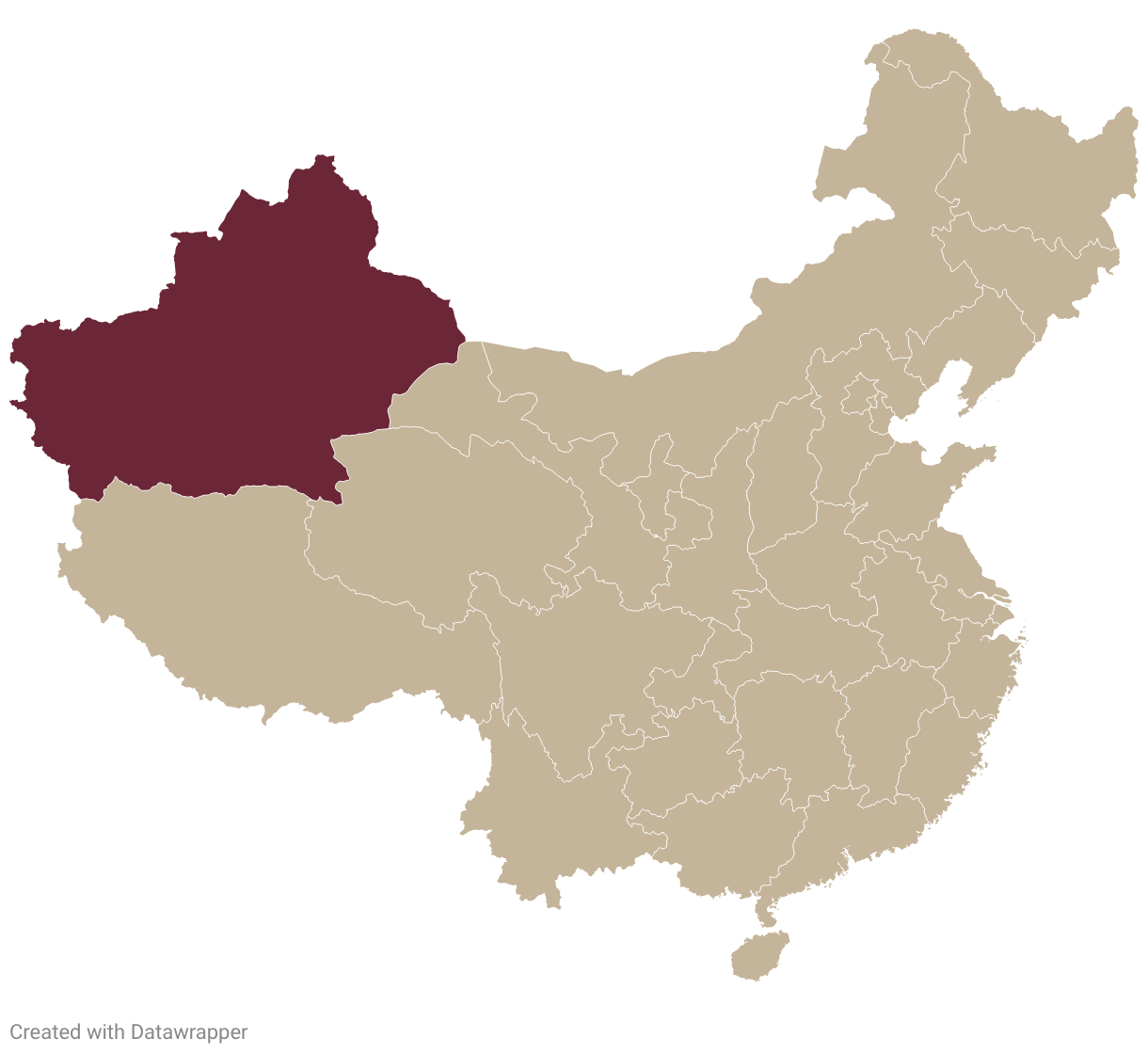
Xinjiang
China’s frontier wine region, where extreme continental conditions and Silk Road heritage create wines of bold character and unique identity.
3
·
Extreme Continental
·
Cab. Sauvignon · Riesling
·
Sand · Gravel · Loess
VARIETIES
Cabernet Sauvignon · Merlot · Riesling · Marselan
Grape cultivation in Xinjiang predates the Common Era. In 138 BC, the Han Dynasty diplomat Zhang Qian departed Xi’an on an embassy westward through Central Asia, crossing what is now Xinjiang. He encountered prosperous grape-growing regions in the Fergana Valley and returned with knowledge of viticulture—though whether he brought actual vine cuttings remains historically debated. What matters for this narrative is not the botanical specimen but the continuity it established: from that era to this one, Xinjiang’s position at the crossroads of the ancient Silk Road meant that wine was a traded commodity, a cultural practice, and an agricultural reality for two millennia before Europe or the Americas had planted their first commercial vines. The region’s vineyards, however modern their equipment, rest on the deepest temporal foundation of any wine region in the world.
That ancient heritage meets a landscape of unflinching severity. The Turpan Basin, sunk 154 metres below sea level, records summer temperatures as high as 49.6°C and winter lows reaching −30°C. Annual rainfall measures below 16 millimetres, a precipitation so scarce that it barely registers as climate. Yet this scarcity is also precision: the region’s ancient water infrastructure, the karez system, survives as a marvel of engineering. These underground channels, dug over centuries and now totalling more than 5,000 kilometres across Xinjiang, carry snowmelt from the Tian Shan mountains down into the basins below, collected from elevations exceeding 5,400 metres and delivered to orchards and vineyards through invisible aqueducts that have functioned uninterrupted for two thousand years. Water here is not weather; it is infrastructure. Heat is not climate; it is the foundational condition.
The Weight of Water
The tension that shapes Xinjiang’s wine industry is not romantic. Suntime International Wine, now part of the CITIC Guoan Group, operates the largest wine production facility in Asia: over 5 million bottles annually, backed by 10,000 hectares of vineyard, 150,000 tonnes of storage capacity, and a supply-chain engineered for China’s domestic market. This is industrial viticulture at scale. Simultaneously, a smaller cohort of quality-focused producers has emerged over the past fifteen years, drawn by terroir distinctiveness that cannot be manufactured and by the historical weight of the Silk Road narrative, a continuity claim no other Chinese wine region can match with equivalent authority. The gap between these two industries is not merely one of volume and ambition; it is a gap that measures the distance between commodity production and place-based identity.
The Yanqi Basin, positioned on the south slope of the Tian Shan at elevations between 1,700 and 1,045 metres, has emerged as the quality centre. Here, wide diurnal temperature swings, sandy-calcareous soils, and a frost-free season extending nearly 210 days create conditions that concentrate both sugars and phenolics to levels rarely achieved in temperate wine regions. Tiansai Vineyards, founded in 2010 by Beijing investor Chen Lizhong across 187 hectares, has attracted international recognition: Gold medals at the Decanter World Wine Awards for its Marselan and Syrah releases, awards that signal not novelty but arrival. Other producers, including the northern Manas region at 43 to 45 degrees North (the latitude of Bordeaux), continue to refine their expression. Yet for all this quality work, Xinjiang’s international wine reputation remains negligible. The region is harder to visit than Ningxia, harder to export from, harder to contextualise. Brand recognition, in wine, is built over decades through distribution, critical attention, and storytelling. Xinjiang has begun that work very recently.
Sugar Concentrated to Extremity
The Turpan Basin’s desert conditions eliminate an entire category of viticultural problem. Fungal diseases (powdery mildew, downy mildew, botrytis) cannot establish themselves in an environment where summer rainfall approaches zero and humidity remains permanently low. The vines are thus unburdened from the chemical interventions required in humid climates. More significantly, the extreme heat sustained in July and August at above 38°C, with sand-surface temperatures reaching 82°C at midday, drives a concentration of sugars that would not be possible in more temperate zones. The diurnal temperature swings of 20°C between day and night, a consequence of the basin’s elevation and the nearby mountains’ thermal mass, add complexity to this ripeness. The region’s ancient Muscat varieties respond to these conditions with an intensity of flavor that older winemaking cultures had optimized over centuries: aromatic intensity, honey-forward sweetness, and a mineral underscore characteristic of desert-grown fruit.
Xinjiang’s raw material argument, rooted in two millennia of continuous viticulture and refined by two decades of modern investment, is not easily dismissed. The region’s wine identity is neither constructed nor borrowed; it emerges from geology, from water management systems engineered in antiquity, and from a climate so extreme that it concentrates what lesser terroirs struggle to achieve. The challenge now is not to prove that exceptional wine can grow here. It is to build the institutions of reputation: distribution networks, critical engagement, international visibility. That work has begun, but it has only begun. For now, Xinjiang remains one of the world’s best-kept wine secrets, not because its grapes are hidden, but because its story is still being told.
“Xinjiang is the region that reminds us China’s wine story is not one story but many — each shaped by conditions too extreme for Europe to have produced, too ancient for the New World to claim.”
— Li Demei, Decanter China
The Sub-Appellations
Three sub-appellations define Xinjiang’s wine geography — each shaped by the Tian Shan mountain range and distinguished by elevation, rainfall, and distance from the desert floor.
Sub-Region
Turpan
Sunk 154 metres below sea level, the Turpan Basin receives less than 16mm of annual rain and endures summer heat exceeding 45°C. Ancient karez irrigation channels carry Tian Shan snowmelt to these vines, producing intensely concentrated reds and some of Asia’s most compelling Muscat dessert wines.
Cabernet Sauvignon · Merlot · Muscat · Riesling
Sub-Region
Yanqi Basin
Nestled on the south slope of the Tian Shan at elevations up to 1,000 metres, the Yanqi Basin benefits from cooler temperatures and greater diurnal swing than Turpan. Tiansai Vineyards, founded here in 2010 across 187 hectares, has drawn international attention with award-winning Marselan, Syrah, and Chardonnay.
Marselan · Syrah · Chardonnay · Riesling
Sub-Region
Manas
On the north slope of the Tian Shan at 450 to 1,000 metres elevation, Manas occupies China’s most northerly wine latitude at 44°N. Higher elevation and annual rainfall of 110 to 200mm create conditions suited to dry table wines — a distinct character from the intense heat and desert concentration of Turpan to the south.
Cabernet Sauvignon · Merlot · Chardonnay · Riesling
Last updated: April 2026
Related Stories
TERROIR’s coverage of Xinjiang wine.
The next one arrives Thursday.
Vintage intelligence, producer profiles, and curated cellar picks — before the critics weigh in. Weekly dispatch.