

The Atlas › Southern Hemisphere › New Zealand › Central Otago
Central Otago
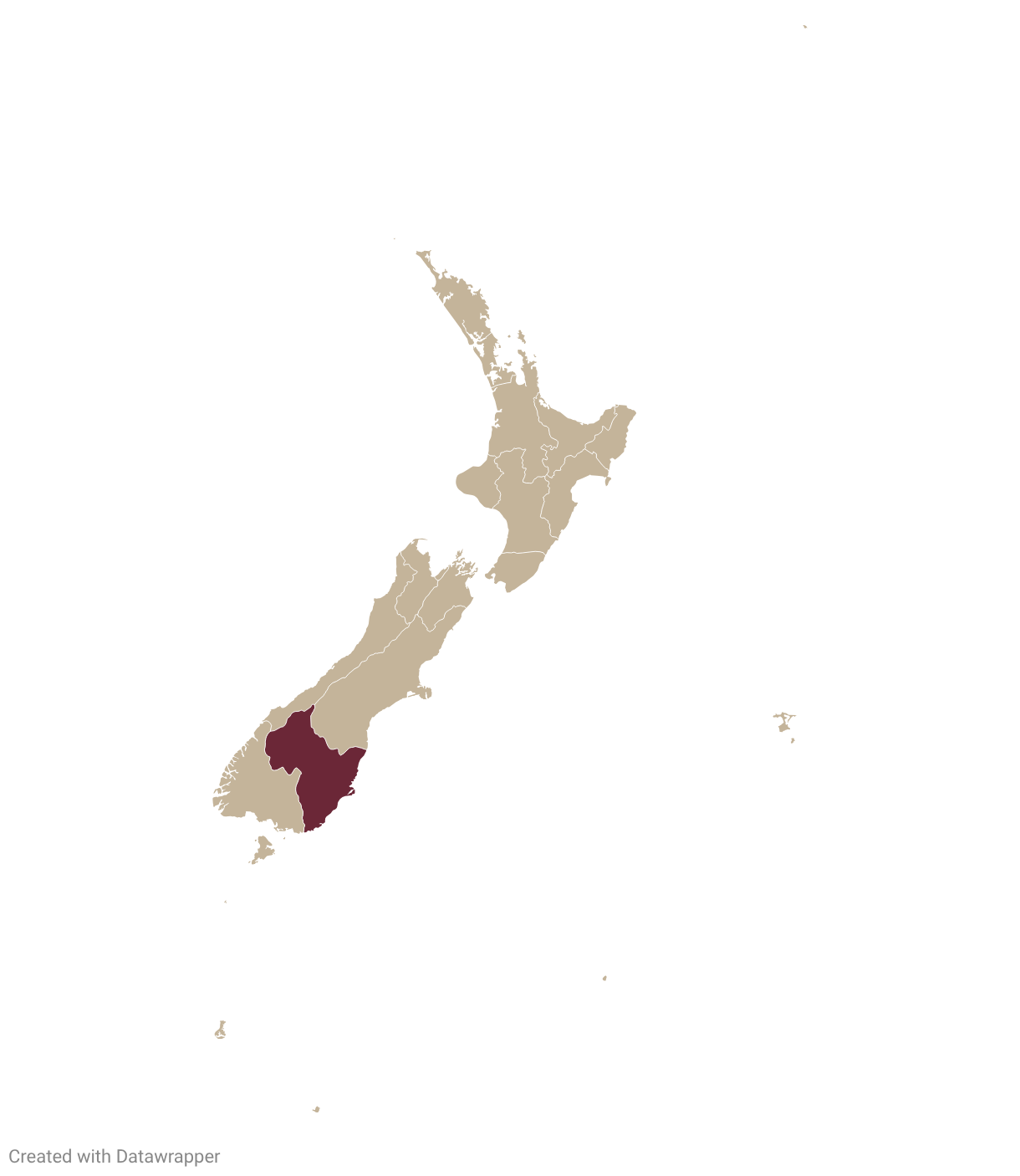
The world’s southernmost major wine region — where alpine schist and extreme continentality forge Pinot Noir of uncommon tension and mineral depth.
4
·
2,100+
·
45°S
·
1981
VARIETIES
Pinot Noir · Pinot Gris · Chardonnay · Riesling
In 1981, Alan Brady planted an experimental vineyard in the Gibbston Valley with the simple conviction that this impossible landscape, 45 degrees south, landlocked, continental, alpine, could grow Pinot Noir worth drinking. By 1987, when he released Central Otago’s first commercial Pinot Noir, Brady had proven something that older wine regions took centuries to articulate: that geology under pressure produces wine of uncommon singularity. This was not a continuation of New Zealand wine history. It was a reversal, a gesture back toward an earlier moment. Jean Desire Feraud had planted the region’s first vines during the 1860s gold rush, only to watch phylloxera and economics bury that chapter entirely. Brady and his peers—Verdun Burgess and Sue Edwards at Black Ridge, the founders of Chard Farm and Rippon—arrived not as inheritors but as pioneers, betting their capital and careers on land that conventional viticulture said was unworkable. Within four decades, they had built an argument for terroir so complete that the world recognized it.
What these first planters understood was that the world’s southernmost major wine region was not a compromise location but a destination, a place where altitude (200 to 450 metres), latitude, and continentality could be read as advantage rather than liability. The mica schist that dominates Central Otago’s hillsides demanded a particular kind of viticulture: humble, precise, patient. The continental climate, searing summer days paired with nights cold enough to shock the vineyards into dormancy, was not a hazard to engineer around but a signature to preserve. Central Otago today is a region that chose difficulty as its identity.
The Cost of Making Wine at the Margin
The region’s diurnal temperature swings of up to 20°C preserve acidity and aromatic intensity that few other growing conditions on Earth can replicate. But this same extremity exacts a price. Frost can strike from March through November. Yields are deliberately kept low, 30 to 45 hectolitres per hectare, through relentless shoot thinning and crop thinning that demand the labour of human hands across entire growing seasons. The schist soils, with their mineral richness and low fertility, force vines to struggle for every nutrient, producing grapes of uncommon intensity but at a production cost that excludes casual approaches to viticulture. A Central Otago vintage is not grown. It is won, each year, against the arithmetic of weather and geology that argues for cheaper wines made easier elsewhere.
Yet producers choose to remain. Rudi Bauer, speaking about his philosophy at Quartz Reef, described his role not as that of a winemaker but as “a vine shepherd and barrel caretaker, because it is not me who makes the wine, but the grape, the yeast, the land, the variety, and so on.” This is the language of people for whom difficulty is not a barrier but the very condition that makes the work meaningful. Climate change, paradoxically, has begun to ease some of Central Otago’s challenges: warmer growing seasons reduce frost risk, accelerate ripening. Yet it simultaneously raises the stakes for maintaining the region’s hard-won identity. The wines depend on tension. Remove the tension and you remove the reason to make them at all.
Schist, Altitude, and the Grammar of Place
The four sub-regions of Central Otago register like movements in a single geological argument. Bannockburn, on the banks of the Kawarau River, is the critical centre-ground: schist hillsides, balanced temperatures, and the most structurally assertive Pinot Noirs from producers like Felton Road, whose Block 3 and Block 5 bottlings have become reference points for the region. Cromwell Basin and Bendigo, warmer and more expansive, produce wines of darker fruit and earlier approachability. Gibbston, coolest and most elevated within its narrow gorge, yields wines of fine-grained minerality and textural delicacy that Jancis Robinson has compared favourably to Burgundy’s lighter communes. Wanaka, remote above its glacial lake, makes the region’s most austere expression: small yields, intense mineral signature, a wine that tastes less like any other Central Otago and more like a direct expression of schist itself.
Central Otago Pinot Noir speaks in a dialect distinct from nearly everywhere else on Earth. The wines carry darker fruit than most Burgundy: black cherry, wild thyme, iron, paired with structural tension and mineral persistence that no other soil type in New Zealand reproduces. When Blair Walter, the winemaker at Felton Road since its first vintage in 1997, described his approach, he returned always to a single principle: “let the fruit speak for itself, gentle handling, as little intervention as possible.” This is the philosophy of someone who understands that the land has already made all the major decisions. The schist has spoken. The frost has shaped the vintage. The winemaker’s role is to listen, not to insist.
At 45 degrees south, on soils that have spent epochs being pushed upward by tectonic forces and sculpted by glacial action, Central Otago has built in four decades an argument for singularity that will require only time to complete. The wines are already capable of developing for a decade or more. The producers are building for a century.
“I see myself as a vine shepherd and barrel caretaker—because it is not me who makes the wine, but the grape, the yeast, the land, the variety, and so on.”
— Rudi Bauer, Quartz Reef
The Sub-Appellations
Four valleys of alpine intensity — each shaped by altitude, schist terroir, and Continental extremes into a distinct register of Central Otago Pinot Noir, from the mineral precision of Bannockburn to the austerity of Gibbston.
Prestige
Bannockburn
The critically acclaimed centre of Central Otago — hillside schist vineyards and balanced temperatures produce the region’s most complex Pinot Noir, with mineral tension and aging potential. Felton Road and Mt Difficulty define the benchmark.
Pinot Noir · Pinot Gris · Chardonnay
Major
Cromwell Basin & Bendigo
The warmest and most expansive sub-zone — a wide basin floor at moderate elevation produces densely fruited Pinot Noir of dark cherry and spice character, with broader texture and earlier approachability than the other sub-zones.
Pinot Noir · Pinot Gris · Riesling
Regional
Gibbston
The coolest and most elevated sub-zone — narrow gorge vineyards produce Central Otago’s lightest, most structured Pinot Noir, with the highest natural acidity and the clearest parallel to Burgundian fruit weight and finesse.
Pinot Noir · Riesling · Pinot Gris
Emerging
Wanaka
Remote western sub-zone above glacial Lake Wānaka — small-scale production yields austere, mineral Pinot Noir of singular identity, among the most terroir-expressive expressions in the region and largely undiscovered internationally.
Pinot Noir · Pinot Gris · Riesling
Last updated: April 2026
Related Stories
The next one arrives Thursday.
Vintage intelligence, producer profiles, and curated cellar picks — before the critics weigh in. Weekly dispatch.