

The Atlas › The Americas › Argentina › Salta & Cafayate
Salta & Cafayate
Where missionary zeal planted the seed, and altitude—literal and philosophical—shaped the inheritance.
1,700m+
·
300
·
9°C
·
1887
VARIETIES
Torrontés · Malbec · Cabernet Sauvignon · Tannat
In the 1550s, Jesuit missionaries arrived in what is now Salta with seeds from Peru and conviction that the Andean valleys could hold vines. They were wrong about almost everything except that single instinct. By the mid-17th century, the Calchaqí Valleys held vineyards. For centuries, those vines produced wines for local consumption, trade, and sacrament—a quiet apotheosis of missionary faith that left no monuments, no critical acclaim, only the proof of continued harvest. The region’s real transformation came in the late 1990s, when modern investment and winemaking ambition rediscovered what had been sleeping for generations. In 1998, Donald Hess, the Swiss art collector and businessman, arrived in Salta with a singular obsession: to plant vines higher than anyone had dared. Bodega Colomé, founded in 1831 as a colonial trading post turned winery, became the laboratory for a thesis: that altitude is not a liability but a language.
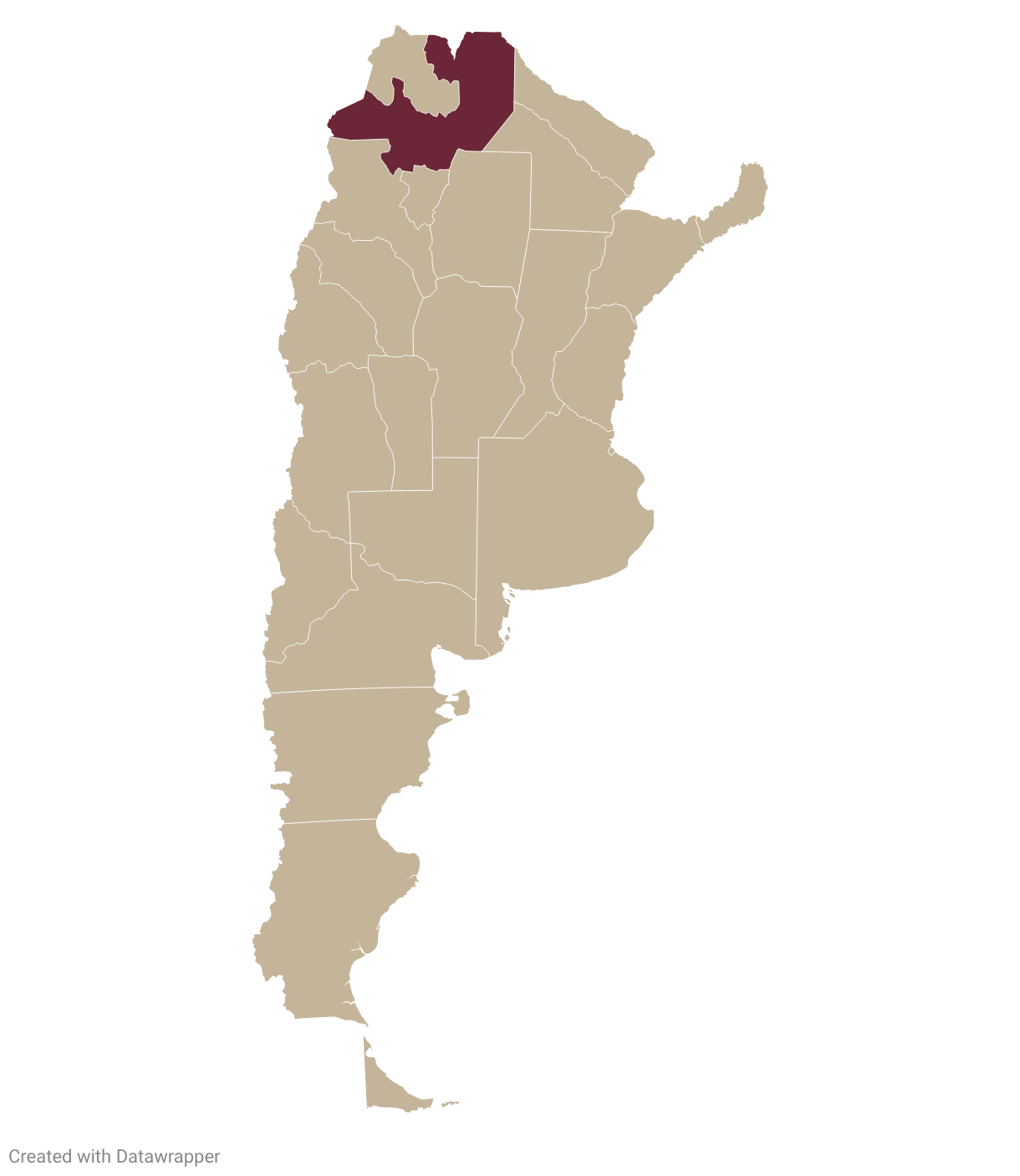
Salta’s terroir is defined by a contradiction. The region occupies the northern frontier of serious Argentine viticulture, where latitude (roughly 24° South) places it closer to the Tropic of Capricorn than to Buenos Aires. Summer daytime temperatures routinely exceed 38°C, a heat that would obliterate ripening fruit across lower elevations. Yet the Calchaqí Valleys funnel cool air at night; altitude compounds the effect. Vineyards at 1,800 metres experience temperature swings of 25 degrees Celsius between day and night, a diurnal amplitude that few regions north or south can match. This swing preserves acidity while allowing phenolic ripeness to develop fully. The soils are ancient, carved by millennia of water and wind—gravelly, mineral-rich, poor in organic matter, demanding that vines exhaust themselves reaching for nourishment. Malbec has claimed roughly 60 percent of plantings across Salta because the variety thrives under these conditions, developing deep colour, intense black fruit, and a mineral spine that speaks less of fruit than of stone and altitude.
The Gravity of Thin Air
At 3,111 metres, the air carries roughly 30 percent less oxygen than at sea level. The sun’s ultraviolet radiation, less filtered by atmosphere, strikes exposed grape skins with a force that lower-altitude viticulture cannot comprehend. The plant responds by thickening its skin, accumulating anthocyanins and polyphenols—the pigments and tannin precursors that yield colour, aroma, and structural depth. Grapes grown at Bodega Colomé’s Altura Máxima vineyard develop thicker skins than their counterparts in Mendoza or anywhere else in Argentina. The consequence is wines of visceral intensity: deeper colour, more complex aromatics, and tannin structures built for decades. Etchart, established in 1850 as one of Salta’s pioneering wineries, has operated at 1,800 metres for over 170 years and still draws on vines planted in the nineteenth century. The altitude does the work. The winemaker learns to listen.
The elevation gradient within the Calchaqí Valleys creates a natural hierarchy of styles. Cafayate town itself sits at roughly 1,700 metres, where Malbec develops fresh acidity and transparent fruit character. Move upslope to the San Pedro de Yacochuya project at 2,000 metres, and the same variety becomes structurally dense, its acidity more pronounced, its mineral edge more insistent. Reach Colomé’s highest terraces, and Malbec transforms into something that resembles not New World fruit-driven wine but rather a structural argument about geology and stellar radiation. The productive tension here is not between tradition and modernity, but between accessibility and extremity. Lower-altitude Salta wines communicate immediately; they charm and perform well young. The high-altitude expressions demand patience and philosophical openness—wines that ask the drinker to accept that intensity can coexist with restraint.
What the Missionaries Left Behind
Salta holds some of Argentina’s oldest continuously productive vineyards—vines with over 150 years of unbroken harvest, still yielding Torrontés, still tended across multiple generations. This is not nostalgia. It is proof of concept. The region’s capacity to hold vines for over a century and a half, without replanting, without collapse, suggests a terroir of profound stability and balance. The missionary vines that arrived in the 1550s were not preserved intact; they were absorbed into the regional agricultural fabric and transformed by local climate and selection into something distinctly Salta. Modern winemaking has inherited this patient, adaptive tradition. When Hess arrived with his vision of 3,111-metre viticulture, he was not proposing a rupture with history but an acceleration of it—taking the region’s fundamental proposition that altitude is an asset and pushing it to its logical extreme.
The region’s terroir—its extreme elevation, its diurnal thermal swings, its intense solar radiation, its ancient alluvial soils—creates Malbec and Torrontés of uncommon mineral intensity and freshness. TERROIR finds in Salta not an anomaly or a frontier experiment, but the culmination of a centuries-long conversation between vine and terrain. The Jesuits planted with faith. Donald Hess planted with audacity. The inheritance these movements have created is a wine region where altitude is not a limitation to overcome but a language to speak fluently. In thin air, surrounded by the Andes, producing wines that taste of stone and sunlight, Salta has become not a footnote to Argentine viticulture but one of its most compelling chapters: a frontier that became tradition without ever ceasing to be frontier.
“I returned to Salta and Cafayate and also tasted wines from Jujuy. I was pleased to see how the wines are evolving toward greater finesse and elegance—something that is not easy at that latitude.”
— Tim Atkin MW, La Nación, 2026
The Sub-Appellations
Extreme altitude viticulture where Torrontés achieves its most aromatic and compelling expression.
AVA
Cafayate Valley
Established high-altitude heartland producing elegant, mineral whites and structured reds from 1,700+ meter vineyards. Diurnal extremes and sandy soils create wines of surprising finesse.
Torrontés · Malbec · Cabernet Sauvignon · Tannat
AVA
Molinos
Extreme elevation frontier (2,500m+) pushing cool-climate boundaries in South America. Thin-skinned grapes and mountain terroir unlock pale reds of uncommon delicacy.
Torrontés · Malbec · Cabernet Sauvignon · Cabernet Franc
Last updated: April 2026
From the Archive
TERROIR’s coverage of Salta & Cafayate — appellations, producers, and vintages worth knowing.
The next one arrives Thursday.
Vintage intelligence, producer profiles, and curated cellar picks — before the critics weigh in. Weekly dispatch.