

The Atlas › The Americas › Chile › Maipo Valley
Maipo Valley
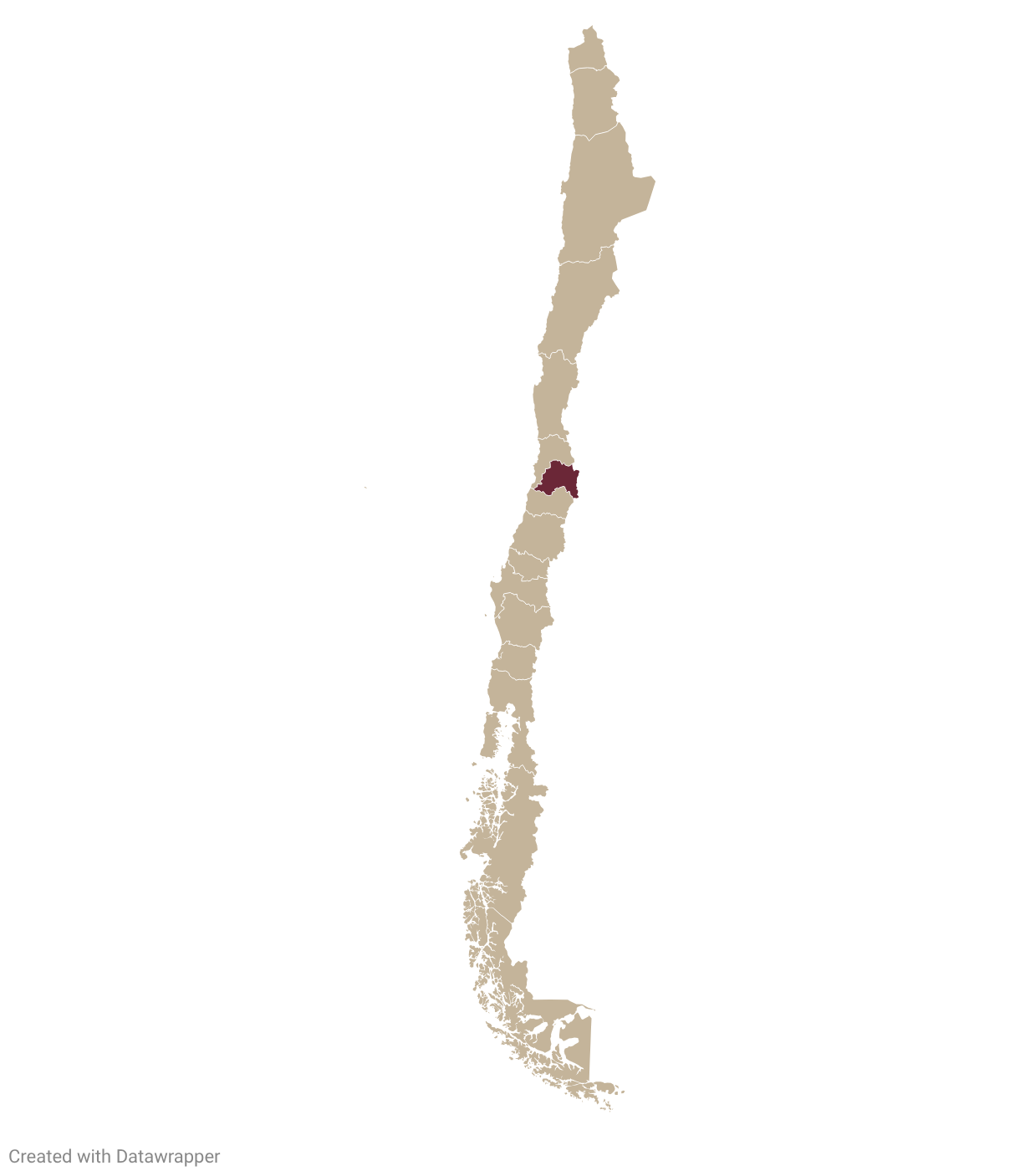
Maipo Valley is Chile’s Cabernet heartland—where colluvial soils and Andean snowmelt produce wines of mineral precision that no longer need to prove themselves.
3
·
650 m
·
300+
·
1883
VARIETIES
Cabernet Sauvignon · Carménère · Merlot
The Maipo Valley, which stretches south of Santiago between the Andes and the Pacific, was not Chile’s first wine region, but it became its most serious one. When the Spanish colonial authorities established vineyards in the sixteenth century, they planted widely across the Central Valley, seeking quantity and consistency. But Maipo’s particular advantage emerged over centuries—a geography that compressed extremes. The river that gives the valley its name originates high in the Andes, its snowmelt cooling the terroir even as northern exposure and lower elevation in Alto Maipo allow ripe fruit phenolics to develop. This paradox—cool nights and ripe days, mountain water and coastal distance—created conditions ideally suited to one variety. Cabernet Sauvignon, the Bordeaux grape that arrived in Chile before phylloxera destroyed European vineyards, found in Maipo a second home where it could express an identity entirely its own.
The valley’s modern prestige originates not from size but from a single decision: the choice by visionary producers in the 1980s and 1990s to focus on quality rather than volume. Concha y Toro, founded in 1883 and still the region’s largest producer, began reserving fruit from its Puente Alto vineyard in Alto Maipo for a single wine: Don Melchor, first produced in 1987. The winery understood that Maipo’s colluvial soils—rocky, free-draining, mineral-rich—could yield Cabernet Sauvignons of remarkable structure and longevity. Other producers followed. Viña Santa Rita, established in 1880, created Casa Real in Alto Maipo. Cousiño Macul, one of the nation’s oldest family wineries, focused its premium effort here with Finis Terrae. A partnership between Concha y Toro and the Rothschild family produced Almaviva, a wine designed to compete directly with the first-growth Bordeaux that had previously dominated collectors’ cellars. Maipo was no longer a volume region—it was becoming a declaration.
The Architecture of a Cabernet Valley
Maipo Valley divides into three distinct zones, each with its own character. Alto Maipo, encompassing the sub-regions of Puente Alto and Pirque, represents the region’s pinnacle—higher elevation, rocky soils, cooler nights, and the accumulation of mineral tension that separates premium Cabernet from competent bulk production. Central Maipo, which surrounds the towns of Buin and Paine, sits on lower ground with warmer conditions and more clay-based, fertile soils; these wines carry riper fruit and slightly less refinement than their Alto Maipo neighbors. Maipo Bajo, the warmest zone, produces fruit-driven wines suited to earlier drinking. The hierarchy is not arbitrary. Alto Maipo’s rocky colluvial soils—composed of gravel and weathered stones deposited by ancient Andes runoff—demand higher vine stress, which concentrates flavor and extends tannin structure.
Cabernet Sauvignon dominates Maipo’s output, and the grape thrives here in ways that surprise those familiar only with Napa Valley or Bordeaux. Master of Wine Tim Atkin notes that “Maipo reds tend to be full-bodied and blessed with substantial, but ripe tannins,” distinguished particularly by “pronounced minty flavours, especially when the grapes come from the higher altitude vineyards.” This minty character—a cool-climate signature derived from the Andes’ persistent influence—separates Maipo Cabernet from warmer New World competitors. The wines age with grace: Don Melchor, Casa Real, and Cousiño Macul’s Antiguas Reservas regularly improve for a decade or more after vintage, their tannins resolving into silky textures while secondary flavors—mint, cedar, dark earth—emerge. This is not the blockbuster Cabernet of Paso Robles or Margaret River, where alcohol dominance often announces itself. Maipo’s style is architectural: layered, mineral-edged, with acidity and tannin in precise calibration.
The Valley That Answered Berlin
The Berlin Tasting of January 2004—when Viñedo Chadwick 2000 and Seña 2001, both from Alto Maipo, topped a blind tasting of first-growth Bordeaux and Super Tuscans—was not Maipo’s origin story. It was its confirmation. Eduardo Chadwick, who organized the tasting with the late Steven Spurrier, understood that a single event could not create quality; it could only reveal what the vineyard had already proven. Puente Alto’s colluvial terroir had been producing structured, age-worthy Cabernet for decades before the world noticed. What the Berlin Tasting accomplished was translating that quality into market credibility—proof, witnessed by 36 European critics, that Chile’s finest wines belonged in the same conversation as Lafite and Margaux.
Maipo today stands at a crossroads between historical prestige and future ambition. The region’s greatest bottles—Don Melchor, Almaviva, Seña, Casa Real, Viñedo Chadwick—command prices and critical attention that would have seemed impossible three decades ago. Yet Maipo’s identity remains fundamentally tied to Cabernet Sauvignon, and to the specific expression that comes from Andean runoff, mineral soils, and cool nights tempering ripe fruit. This is not a limitation but a gift. The world does not need another voluptuous Cabernet; it needs more wines of mineral precision, structured elegance, and the patience to improve over decades. The work ahead is to deepen terroir expression, to understand how the valley’s sub-regions might each articulate distinct identities within Cabernet’s broad language, and to prove that Chile’s greatest wines are not historical accidents but architectural achievements.
“Maipo reds tend to be full-bodied and blessed with substantial, but ripe tannins. They are often distinguished by pronounced minty flavours, especially when the grapes come from the higher altitude vineyards.”
— Tim Atkin, Master of Wine
The Sub-Appellations
Chile’s Cabernet heartland, from the Alto Maipo foothills to the warm central valley floor.
DO
Alto Maipo
DO
Pirque
DO
Buin
Last updated: April 2026
Related Stories
The next one arrives Thursday.
Vintage intelligence, producer profiles, and curated cellar picks — before the critics weigh in. Weekly dispatch.