

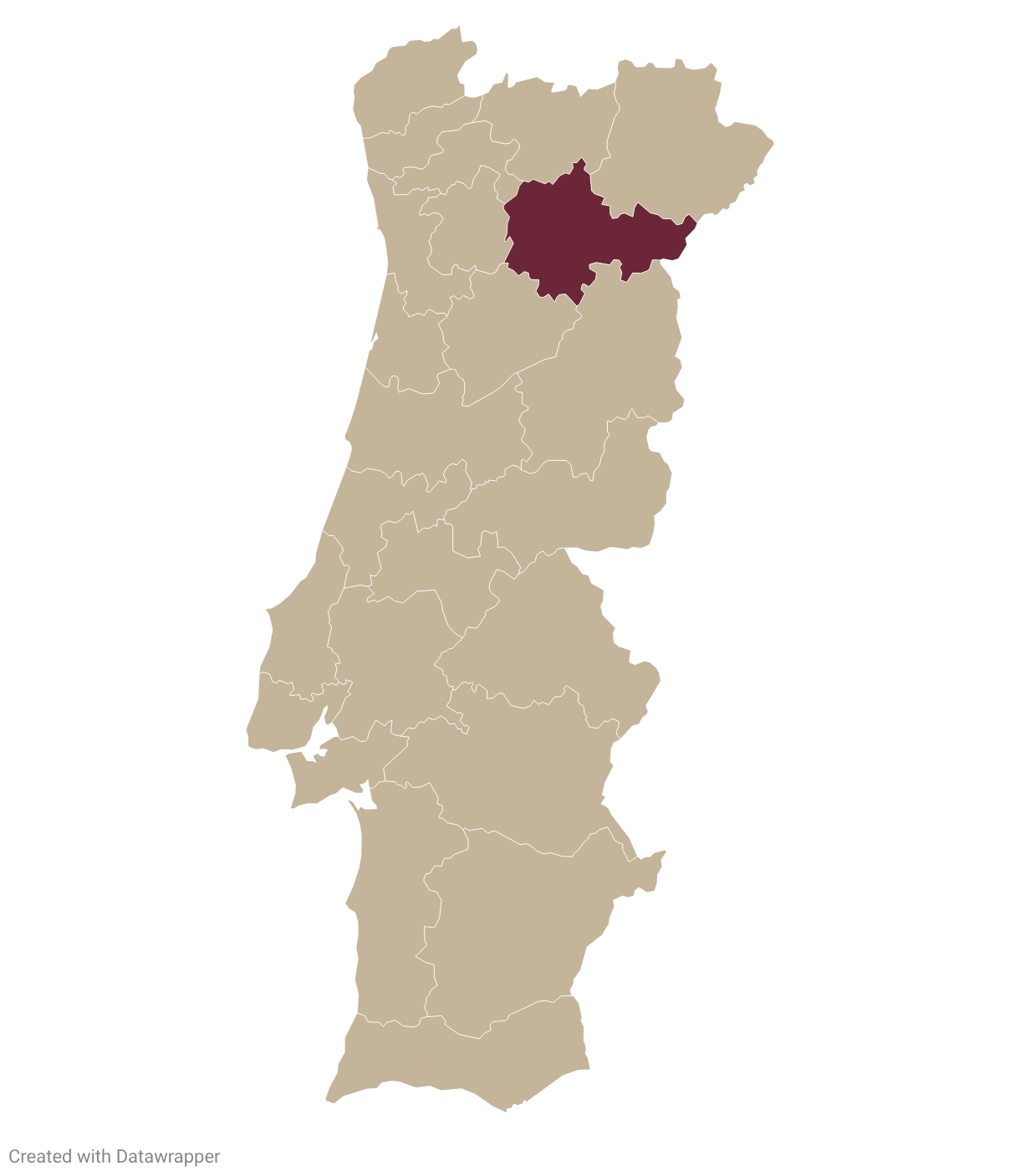
Douro Valley
The cradle of Port — and one of the world’s great red wine landscapes.
45,000 ha
·
3
·
1756
·
Touriga Nacional
VARIETIES
Touriga Nacional · Touriga Franca · Tinta Roriz · Tinta Barroca
In 1756, the Marquis de Pombal established something that would make the Douro Valley one of the most regulated wine regions in human history. While the designation came three decades after the formal demarcation of Tokaj and a generation after Chianti received its boundaries, what set Pombal’s intervention apart was its permanence. The Douro Wine Company was created not merely to protect a reputation but to stabilize an entire economy—to balance producers against traders, guarantee quality by eliminating systematic adulteration, and ensure a product with defined characteristics suitable for export to England. The demarcation was marked by 335 granite pillars driven into the valley floor, a gesture both pragmatic and ceremonial. Nearly three centuries later, the Douro remains the only major wine region still functioning under its original regulatory framework, its foundational logic intact even as everything around it transformed.
What Pombal created was a system designed to export wealth. Port wine became the mechanism: sweet, fortified, durable, and perfectly suited to long Atlantic voyages. For nearly two centuries, the Douro’s identity was Port’s identity. The region gave the wine its terroir; Port gave the region its economy. Yet this partnership, which seemed permanent by the 19th century, contained within it the seeds of its own reconfiguration. The vineyards existed before the Port classification system. The schist terraces, the river’s influence, the altitude gradients from west to east—these geological facts preceded the commercial logic by millions of years. By the late 20th century, a handful of producers began asking what those original terroirs might yield if left unfortified, unoxidized, allowed to speak in their primary language.
The Identity Reclaimed
The shift began quietly, almost as an act of curiosity. In 1991, Dirk Niepoort decided that his family’s centuries-old Port shipper business should make unfortified wines from the old vineyards they already controlled. The first bottle was Redoma, followed by Batuta in 1999. These were not experimental releases or marginal products. They were acts of conviction. By the early 2000s, a loose coalition of producers—Dirk Niepoort, Cristiano van Zeller, and others including Quinta do Crasto and Quinta do Vallado—began to reshape how the world understood the Douro, and in doing so, they recovered what had always been true: that the region was capable of producing outstanding unfortified wine. The movement came to be called the Douro Boys, a term that disguised its radical significance behind a casual nickname.
The economic stakes of this shift were substantial. Between 2000 and 2020, Port sales declined by roughly 30 percent by volume, while simultaneously dry table wine production in the Douro grew to represent over 45 percent of the region’s output. Today, what appears as a straightforward competition between fortified and unfortified wines is better understood as a recovery of the Douro’s pre-Port identity. For roughly 90 percent of the valley’s winemaking history, before the 18th-century English alliance, dry wines were what the Douro produced. The timing of this modern reassertion is not accidental. Portugal’s accession to the European Union in 1986 dissolved the Port producers’ monopoly on bottling rights. Suddenly, independent producers could sell their own wines under their own names. The structural barrier had been removed. What followed was an explosion of discovery, as producers like Jorge Serôdio Borges and his wife Sandra Tavares at Wine and Soul began mapping old vineyards with scientific precision—at Quinta do Crasto, individual vines were given GPS coordinates, confirming 49 distinct grape varieties where producers had previously assumed monoculture. The region, when finally allowed to speak, revealed far greater complexity than its fortified reputation had ever suggested.
The Language Beneath the Terraces
The Douro’s terroir is not subtle, nor does it require elaborate interpretation. The schist dominates. The soil consists of finely weathered particles mixed with fragments of the foliated rock that rises in tiers up the steep valley walls—ancient, foliated, fractured into pieces small enough to hold water in summer but large enough to warm rapidly in Mediterranean heat. The landscape has been physically sculpted to accommodate this geology. Terraces, often no more than a few meters wide, climb the slopes like staircases, each constructed by hand over centuries, now recognized by UNESCO as a world heritage landscape. The terraces are more than aesthetic achievement; they are a document of how producers have learned to work with the schist rather than against it.
Altitude and rainfall create the valley’s internal geography. The westernmost sub-zone, Baixo Corgo, sits between 100 and 600 meters above sea level, cooled by Atlantic influence, receiving 1,200 millimeters of rain annually. Wines from this zone tend toward freshness and pronounced minerality. Cima Corgo, the middle zone, represents the classical heart of Port production: more balanced, moderate in its extremes, home to many of the region’s most celebrated names. Douro Superior, the eastern boundary, rises to 750 meters in places and receives only 380 millimeters of rain annually. Heat accumulates here. The wines are darker, more concentrated, structured for aging. The schist beneath all three is constant, but its expression shifts with these environmental variables. At higher altitudes and in cooler microclimates, the schist contributes precision and savory minerality. In the hotter zones, it becomes a reservoir that steadies the vines through summer stress, allowing them to ripen slowly even in extreme conditions.
It is in this specificity—the fact that the terroir does not offer generic excellence but rather carefully differentiated character—that the modern Douro claims its stature. The region is not the most extraordinary thing in wine, nor should it pretend to be. What it offers instead is a measurable, describable form of distinction: schist that works, altitudes that matter, a commercial history that had to be abandoned before its terroir could be understood. This is how regions mature. The Douro’s present identity represents not an invention but a recovery, and recovery, because it restores what was always true beneath the surface, carries a particular kind of authority.
“The Douro Valley is one of the most spectacular wine landscapes in the world, and home to one of its oldest protected appellations — a region where the vine and the mountain have reached an ancient agreement.”
— Jancis Robinson, Oxford Companion to Wine
The Appellations
The Douro is divided into three distinct sub-zones that follow the river eastward — each warmer and drier than the last, each producing wines of a distinct character. Together they span one of the most geologically varied and climatically extreme wine regions in Europe.
DOC Sub-Region
Cima Corgo
The valley’s storied heartland, centred on the town of Pinhão, where the greatest quintas concentrate. Extraordinary old-vine schist terraces yield both world-class Vintage Port and DOC Douro reds that rank among the most serious unfortified wines on the Iberian Peninsula. The Cima Corgo is the address that built the Douro’s international reputation.
Touriga Nacional · Touriga Franca · Tinta Roriz
DOC Sub-Region
Baixo Corgo
The westernmost sub-zone, where Atlantic influence moderates the Douro’s characteristic intensity. Cooler temperatures and higher rainfall yield wines of more accessible character, including the bulk of entry-level Ruby and Tawny Port. Increasingly a source of honest DOC Douro reds at approachable prices — lighter in weight, but unmistakably Douro in spirit.
Touriga Franca · Tinta Roriz · Tinta Barroca
DOC Sub-Region
Douro Superior
The most remote corner of the Douro, stretching east toward the Spanish border under a near-continental climate. Long overlooked for extreme heat and challenging terrain, it is now drawing ambitious estates who find that ancient schist soils and wide diurnal variation produce wines of notable concentration and longevity. Climate change is directing increasing attention to this sub-zone.
Touriga Nacional · Tinta Roriz · Sousão
Last updated: April 2026
Related Stories
The latest from our coverage of the Douro Valley and Portuguese wine.
The next one arrives Thursday.
Vintage intelligence, producer profiles, and curated cellar picks — before the critics weigh in. Weekly dispatch.