

Rías Baixas
Atlantic Spain’s white wine revelation—where Albariño on granite above the rías produces wines of saline mineral precision that no inland region can match.
5
·
Atlantic
·
~4,000 ha
·
1988
VARIETIES
Albariño · Treixadura · Loureiro · Caiño Blanco · Godello
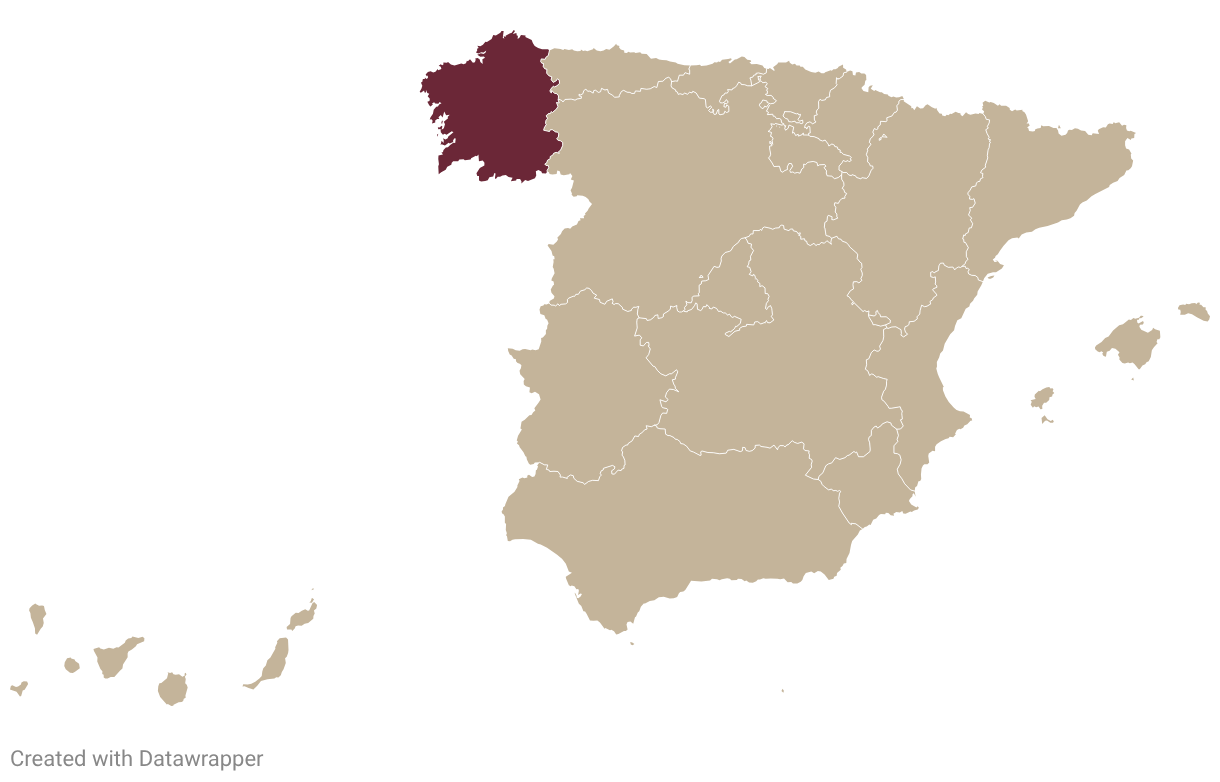
Rías Baixas is the part of Spain that doesn’t behave like Spain. In a country defined by arid plateaus, punishing summers, and Tempranillo’s deep reds, this sliver of Atlantic Galicia produces something entirely different: Albariño—floral, citrus-bright, saline, and built for seafood with a precision that warmer Spanish whites cannot replicate. The name itself is a geography lesson. The rías are drowned river valleys that indent Galicia’s coastline, pulling maritime influence far inland and creating the cool, humid microclimate that Albariño requires. On granite and sandy soils above these estuaries, with annual rainfall that can exceed 1,200 mm—double what Rioja receives—the grape develops the aromatic intensity and bracing acidity that made it Spain’s white wine discovery of the past three decades.
The Rías Baixas DO, granted in 1988, is organized into five sub-zones stretching from the Atlantic coast to the hills above the Miño river. Val do Salnés, the closest to the ocean, is the historic heart of Albariño production and the source of the region’s most celebrated bottlings—wines that carry a saline mineral finish the locals attribute to granite and sea air in equal measure. O Rosal, where the Miño meets the Atlantic on the Portuguese border, produces a slightly fuller style, often blending Albariño with Loureiro and Treixadura. Condado do Tea, the most inland sub-zone, experiences warmer temperatures and yields wines of riper fruit and softer acidity. Together these zones account for some 4,000 hectares of vineyard, with Albariño comprising roughly 96% of all plantings—a degree of varietal dominance unusual in Spanish viticulture.
The grape’s history in Galicia stretches back centuries—traditional accounts credit Cluniac monks with its introduction along the Camino de Santiago, though modern ampelographic research by José Vouillamoz and others points to Albariño as indigenous to the Galicia–Minho corridor rather than a monastic import. What is not debated is the result: on pergola-trained vines (the traditional parras that lift fruit above Galicia’s damp soils), Albariño produces a combination of peach, lemon zest, jasmine, and granite-driven minerality that remains one of Spain’s most reliable white wine values.
The productive tension in Rías Baixas today is between fresh, early-drinking Albariño—the style that built the region’s international reputation—and a growing movement toward complexity. Producers like Zárate, Forjas del Salnés, and Nanclares y Prieto now vinify single-vineyard bottlings, ferment with indigenous yeasts, and age on lees for months or years, producing wines that challenge the assumption that Albariño is only for drinking young. Soutomaior and Ribeira do Ulla, the smallest and newest of the five sub-zones, add further nuance, with altitude and microclimate variations that are only beginning to be mapped. For the quality-focused buyer, Rías Baixas offers something increasingly rare in wine: a region still in the early stages of discovering what its terroir can do.
“Albariño is one of the most fashionable and best-adapted white wine grapes in the Iberian Peninsula, producing aromatic, relatively light-bodied wines with notably high acidity.”
— Jancis Robinson, Julia Harding & José Vouillamoz, Wine Grapes
The Sub-Zones
Five official sub-zones stretching from the Atlantic coast to the inland hills above the Miño, each shaped by proximity to the ocean, altitude, and the granite that defines Albariño’s mineral character.
Prestige
Val do Salnés
The historic heart of Rías Baixas and the sub-zone closest to the Atlantic. Granite soils and direct ocean influence produce Albariño of pronounced salinity, citrus precision, and floral lift—the benchmark for the entire denomination. Home to some of Galicia’s most respected producers.
Albariño · Caiño Blanco · Loureiro
Premier
O Rosal
Where the Miño river meets the Atlantic on the Portuguese border. Warmer and more sheltered than Val do Salnés, O Rosal produces a slightly fuller, rounder Albariño, often blended with Loureiro and Treixadura for added texture and aromatic complexity.
Albariño · Loureiro · Treixadura · Caiño Blanco
Regional
Condado do Tea
The most inland sub-zone, along the Miño valley near the Portuguese border. Greater continental influence brings warmer temperatures and riper fruit, producing Albariño of softer acidity and more tropical character. Treixadura plays a larger blending role here than in any other sub-zone.
Albariño · Treixadura · Loureiro · Torrontés
Last updated: April 2026
Related Stories
The latest from TERROIR on Rías Baixas, Albariño, and Atlantic Spain.
The next one arrives Thursday.
Vintage intelligence, producer profiles, and curated cellar picks — before the critics weigh in. Weekly dispatch.