

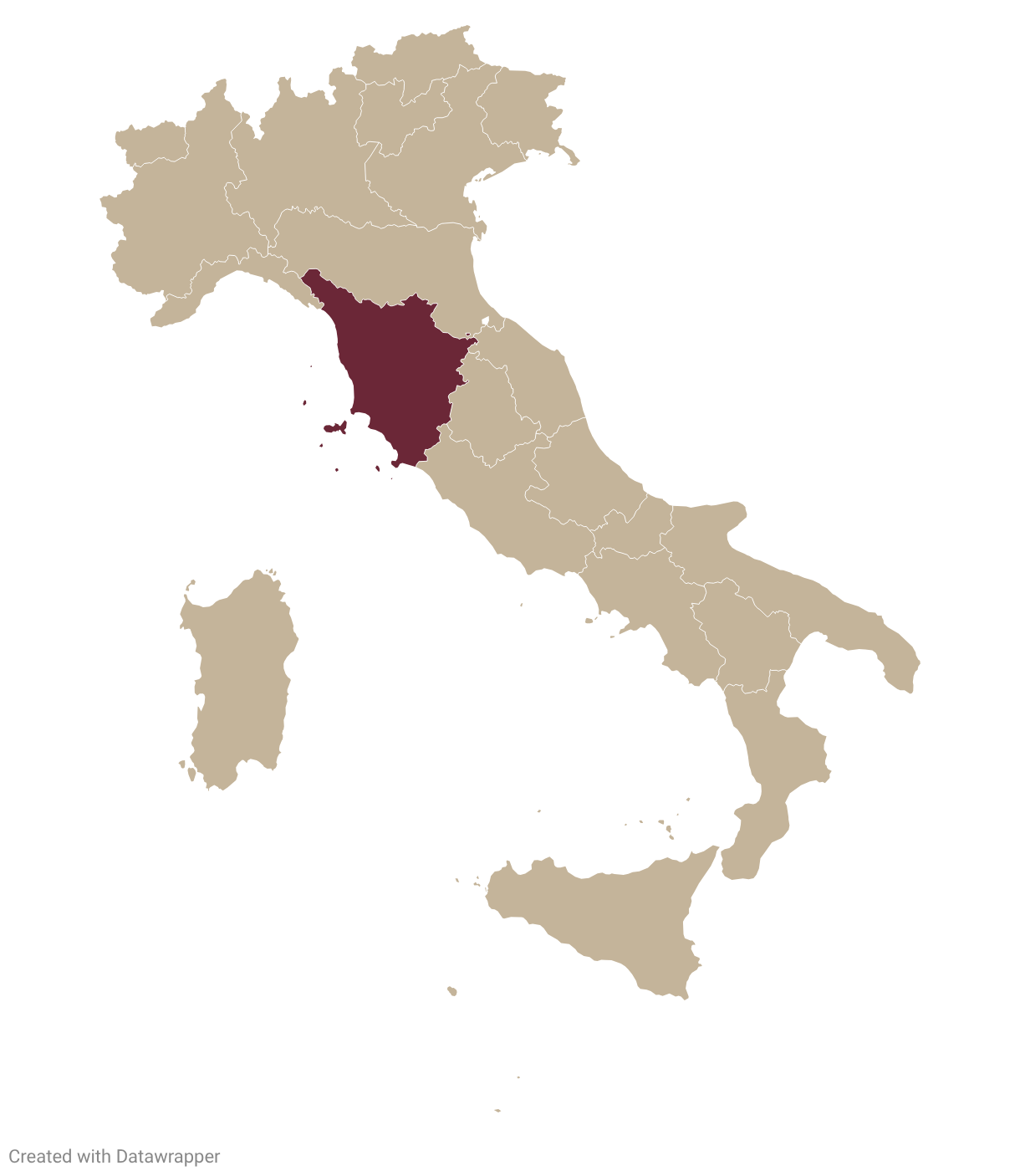
Tuscany
Sangiovese’s home territory — from the rolling Chianti hills to the coastal blends that rewrote Italy’s quality hierarchy.
14
·
~60,000 ha
·
1968
·
20+
VARIETIES
Sangiovese · Cabernet Sauvignon · Merlot · Vernaccia · Vermentino · Trebbiano
Tuscany is the wine region Italy presents to the world when it wants to be taken seriously. The landscape—cypress-lined roads, hilltop villages, ochre farmhouses, olive groves woven between vines—has become the visual grammar of Italian romance. But the region’s true identity lies not in postcards. It lies in what its ancient soils have taught fourteen DOCG regions to produce. Sangiovese, the local backbone, performs differently at every altitude and in every microclimate: on the high plateau around Montalcino, it becomes Brunello, a wine that demands years of aging before its structure reveals itself. In the Chianti Classico zone between Florence and Siena, it flows as a wine of bright cherry and herb, built to dance with food from the first pour. One region, one grape, infinite expressions—this is Tuscany’s grammar.
The story of modern Tuscany begins in the late 19th century, when Clemente Santi and later his grandson Ferruccio Biondi-Santi developed the aggressive aging protocol that defined Brunello. This commitment to extraction and time—decades, not years—required complete faith in both the fruit and the wine’s future. When the Biondi Santi family commercialized this style with the 1888 vintage, they established a template: Tuscan wines could age with the best of Europe, and they could demand international respect. The 20th century brought the DOC system (1966) and later DOCG designations (1980s), which formalized this diversity into law. Fourteen separate appellations now govern Tuscany’s 60,000 hectares, each claiming its own character. The same grape produces wines of radically different philosophies—a reminder that place, not grapes alone, writes a region’s story.
When Rules Were Made to Be Broken
In 1968, Marchese Mario Incisa della Rocchetta released a wine that should not have existed. Sassicaia was Cabernet Sauvignon grown on the Bolgheri coast, aged in French oak, and labeled Vino da Tavola—literally, table wine—because the DOC system had no category for what it was. It was an act of productive disobedience. When international critics placed it alongside premier cru Bordeaux in blind tastings, Incisa della Rocchetta forced a question into Italian winemaking: Did the future lie inside the regulations or outside them? Antinori’s Tignanello followed in 1971, blending Cabernet with Sangiovese in what became a template for the modern “Super Tuscan”—a wine made by choice, not accident, with ambition that exceeded the DOC system’s capacity to recognize it.
The rebellion became the rule. Today, Sassicaia, Ornellaia, and Masseto carry their own designations (Bolgheri DOC and Toscana IGT), and they rank among the wines that command waiting lists and collector premiums. But the real victory was philosophical: the DOC system learned to expand. It now makes room for wines that refuse to fit the template, and Tuscany grew not by abandoning its rules, but by proving that rules could be generous enough to contain ambition. This is why Tuscany remains one of Europe’s only regions where the smallest family producer and the largest international négociant both work within the same regulatory framework—each with radically different goals, and both producing wines that matter.
The Grammar of Soil
Burgundy has its limestone and clay; Bordeaux has its gravels and its maritime influence. Tuscany’s argument is written in three distinct soils, each producing an entirely different expression of the same region. Galestro—a crumbly marl-limestone—defines the hilltop sites of Chianti Classico. This soil is light, mineral, and alive with drainage; it gives Sangiovese its characteristic lift, the kind of electric acidity that makes a 30-year-old Chianti sing as if it were five years old. The heavier alberese clay of Montalcino works the opposite way. It holds water, builds weight, and contributes to Brunello’s austere power—the structural tannins and dark mineral core that require a decade or more of cellaring before they soften into something approaching approachability.
On the Bolgheri coast, the soils shift again to gravel and iron-rich sand—Mediterranean terroir that seems, on paper, too warm for Cabernet Sauvignon and Merlot. Yet those gravelly, well-drained sites are precisely what allows these Bordeaux varieties to thrive without overripening. The heat moves through the soil too quickly; the vines are forced to work harder; the result is concentration without jammy excess. This is not an abstraction. The relationship between vine and soil in Tuscany is the organizing principle of the entire region, and it explains why a Brunello from Montalcino will never taste like a Chianti Classico, and why the coastal Super Tuscans occupy a world entirely their own.
Beyond its headline appellations, Tuscany rewards curiosity. Vino Nobile di Montepulciano produces Sangiovese (called Prugnolo Gentile here) with genuine depth at prices that don’t yet reflect the wine’s quality. Vernaccia di San Gimignano offers the region’s only white wine at DOCG level—a crisp, mineral counterpoint to Tuscany’s red-dominated reputation. Across the Maremma coast, a younger generation of producers is proving that the region’s potential extends well beyond what maps and guidebooks have already claimed. The best way to understand Tuscany is not to study its categories, but to taste across them—to move from soil to soil, vintage to vintage, and discover what fourteen different patches of earth have learned to say.
“No region in Italy has argued more fiercely with its own traditions—or emerged stronger for doing so. Tuscany’s genius is that it never chose between heritage and ambition; it insisted on both.”
— Hugh Johnson & Jancis Robinson, The World Atlas of Wine
The Appellations
From Brunello’s austere grandeur to Bolgheri’s coastal ambition, Tuscany’s major appellations each express Sangiovese—and its international counterparts—through distinct soils, altitudes, and winemaking philosophies.
Prestige
Chianti Classico
The historic heartland between Florence and Siena: Sangiovese on galestro and alberese soils delivering cherry, herb, and leather with the firm acidity that has made Chianti among the most food-compatible reds produced anywhere. The Gran Selezione tier, introduced in 2014, represents estate-grown ambition at its highest.
Sangiovese · Canaiolo · Colorino · Merlot · Cabernet Sauvignon
Grand Cru
Brunello di Montalcino
Italy’s most age-worthy red: pure Sangiovese Grosso from the Montalcino plateau, released no earlier than January of the fifth year after harvest. Dark cherry, iron, dried rose, and mineral complexity that evolves over decades. The Riserva tier demands an additional year of aging—and rewards the patience.
Sangiovese Grosso (Brunello)
Prestige
Bolgheri & Super Tuscans
Tuscany’s coastal revolution: Sassicaia, Ornellaia, Masseto—Cabernet Sauvignon and Merlot on Mediterranean coastal soils producing wines that compete with classified Bordeaux. The Bolgheri DOC formalised what began as a deliberate break from Italian convention. Among the most internationally celebrated wines Italy has produced.
Cabernet Sauvignon · Merlot · Cabernet Franc · Petit Verdot · Sangiovese
Premier
Vino Nobile di Montepulciano
Sangiovese as Prugnolo Gentile on the slopes around Montepulciano, occupying a compelling middle ground between Brunello’s austerity and Chianti’s generosity. Two years minimum aging, with Riserva requiring three. Consistently among Tuscany’s strongest value propositions at the DOCG level.
Sangiovese (Prugnolo Gentile) · Canaiolo · Mammolo
Last updated: April 2026
Related Stories
TERROIR’s Tuscany coverage—regional reporting, vintage dispatches, and the stories
shaping what ends up in your glass.
The next one arrives Thursday.
Vintage intelligence, producer profiles, and curated cellar picks — before the critics weigh in. Weekly dispatch.