

Loire Valley
Cool-climate diversity across 800 kilometres, where freshness and minerality define France’s most versatile wine landscape.
~70,000 ha
·
~70%
·
~800 km
·
~4,000
VARIETIES
Sauvignon Blanc · Chenin Blanc · Cabernet Franc · Melon de Bourgogne · Gamay
The Loire Valley’s wine identity crystallized not from geology alone, but from geography and power. When the French royal court relocated to the Loire during the Renaissance — drawn by the river’s navigability, its mild climate, and the strategic defensibility of its châteaux — local viticulture transformed from subsistence farming into a prestige enterprise. The river itself became a trade artery: Vouvray and Chinon wines floated downstream to Nantes and the Atlantic, then to England, the Low Countries, and beyond. By the 16th century, contemporary records documented Sancerre and Pouilly as wines worth cellaring, their names spoken with the reverence reserved for bottled time. This wasn’t a region that discovered wine; it was a region that learned to market it, to age it, to write it into the architectural record of châteaux whose defensive walls soon gave way to ornamental gardens and wine cellars.
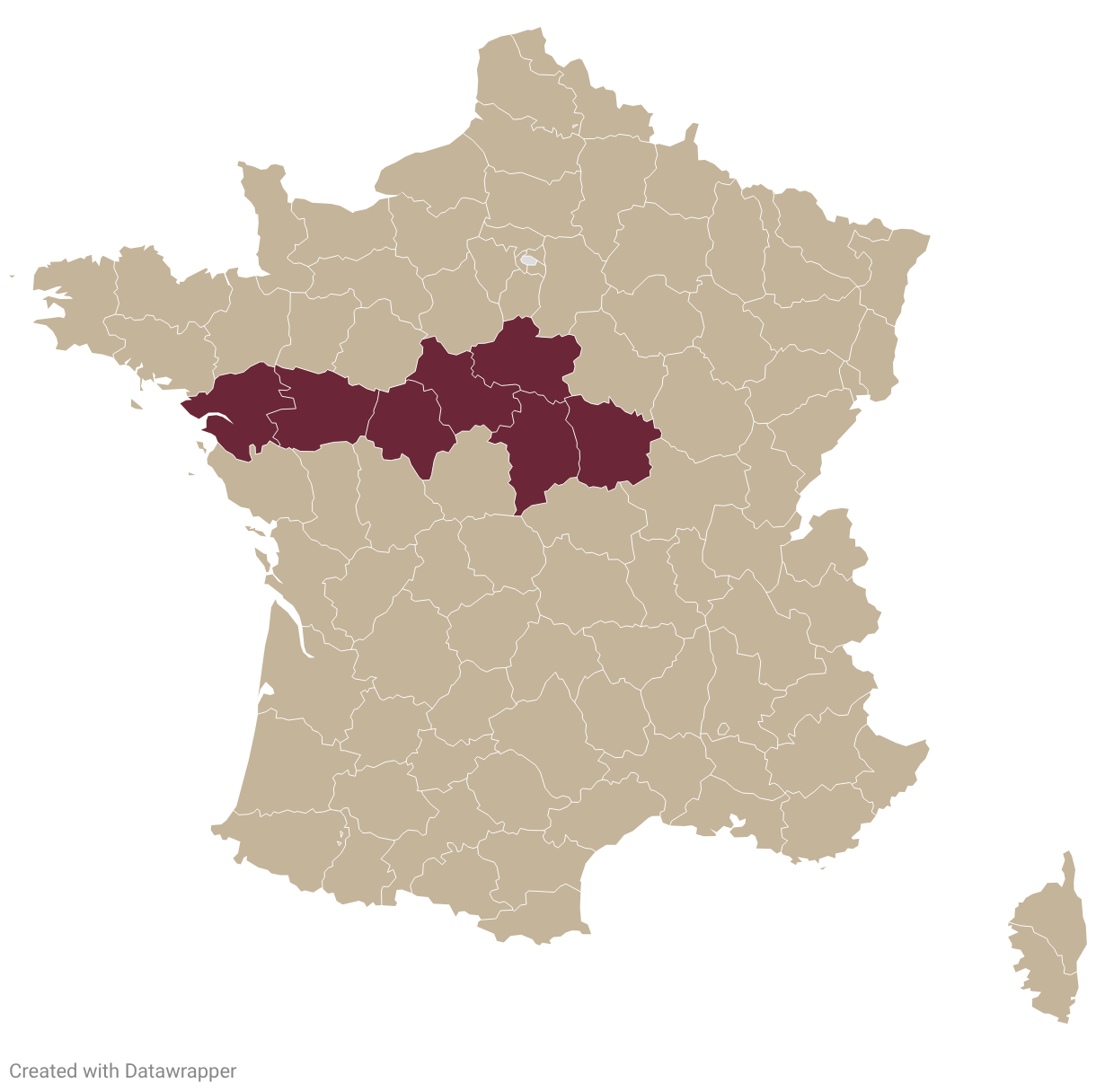
That dispersed patronage left the Loire fractured: structurally, commercially, and in its collective identity. Stretching roughly 800 kilometres from the Atlantic-influenced Muscadet zone near Nantes to the continental conditions of Sancerre and Pouilly-Fumé in the east, the region spans almost every expression white wine can take: bone-dry Sauvignon Blancs shaped by flint and limestone; Chenin Blancs ranging from prickling, herbaceous dry versions to off-dry sparkling wines to richly sweet moelleux capable of aging 30 years; lighter, peppery Cabernet Francs built for elegance rather than extraction. This stylistic range is the Loire’s greatest asset and its persistent commercial liability. Bordeaux sells you a hierarchy; Burgundy sells you a classification; the Loire sells you something closer to a treasure hunt. Quality and value exist in abundance, but they require exploration. The fragmentation that defined the Renaissance — multiple courts, competing interests — persists in the modern appellation system: four thousand small producers, no grande maison, no classified growth to anchor the conversation. To understand the Loire is to embrace a region that resists easy categorization, that refuses a single story.
The Diversity Paradox
Chenin Blanc exemplifies the Loire’s commercial enigma. A single grape variety, grown in the same soils for centuries, produces wines so stylistically diverse that blind tasting reveals no obvious kinship. A bone-dry Vouvray tastes nothing like a sweet Vouvray Moelleux; a sparkling Vouvray Crémant occupies yet another register entirely. For the consumer accustomed to the reassuring consistency of Chardonnay or Riesling — where the same grape reliably signals a particular flavor profile — Chenin presents a puzzle. Producers and marketers have struggled with how to present it: as a dry table wine? A dessert wine? An aperitif sparkler? The lack of a singular identity has historically disadvantaged Chenin on global markets, where brand clarity sells premiums. Yet that very versatility — the ability of a single vineyard to express dryness, sweetness, and effervescence across different vintages and techniques — represents a kind of mastery that few appellations can match. The Loire does not simplify; it complicates. And in a homogenized wine market, that complexity is increasingly valuable.
The Loire Valley has become the global epicenter of natural wine production — not by accident, but by consequence of its structure. When you have four thousand small family producers with limited access to large distribution networks, when you have cooler-climate grapes that require technical precision to ripen, when you have generations of winemakers experimenting with minimal intervention out of necessity rather than ideology, you create fertile ground for radical approaches. Producers like Didier Dagueneau in Pouilly-Fumé and François Chidaine in Vouvray pioneered techniques of extreme precision — harvesting by ripeness, fermenting with ambient yeasts, bottling without sulfur additions — not because natural wine was fashionable (it wasn’t), but because they believed it expressed their terroir with greater clarity. The natural wine movement grew from Loire’s margins because the region’s fragmentation allowed individual producers to operate without the institutional resistance that constrained innovation in more hierarchical regions. Today, a significant portion of Loire’s most acclaimed wines are produced with minimal intervention, a fact that reflects both the region’s commitment to freshness and its cultural willingness to embrace stylistic risk.
The Language of Soil
The Loire’s stylistic diversity is not arbitrary; it flows directly from the river’s geological inheritance. The valley follows a fault line where the ancient Armorican Massif to the south meets younger sedimentary deposits to the north. In Vouvray and Chinon, white tuffeau limestone — a soft, chalky rock formed from marine fossils — dominates. This stone stores heat and reflects it back into the vineyard during cool nights, allowing grapes to ripen fully while retaining acidity. Vouvray’s limestone caves, carved into the tuffeau over centuries, provide natural cellaring at constant temperature and humidity: these are not tourist attractions but functional extensions of the vineyard. Further west, around Muscadet, the soils become lighter, more granitic, yielding leaner, crisper expressions. In Sancerre and Pouilly-Fumé to the east, the limestone gives way to three distinct soil types that have generated generations of debate among producers: the chalky Kimmeridgian limestone (which some argue favors herbaceous, linear Sauvignon); the flint-rich silex (associated with smokiness and minerality); and clay (which tends toward rounder, riper fruit). This geological specificity is not poetic flourish — it is measurable, mappable, and it matters. A producer in Sancerre who owns parcels on all three soil types will produce three distinct wines, each expressing the fundamental character of its parent stone.
The Loire River itself acts as a thermostat. Its 800-kilometre length moves from Atlantic influence in the west — where maritime air moderates temperature and extends the growing season — to continental conditions in the east, where temperature swings are sharper and ripening more precarious. This gradient explains why Chenin Blanc in Vouvray consistently ripens to higher alcohol and richer fruit than Chenin in Jasnières, despite identical grape and similar soils. It explains why Sauvignon Blanc in Pouilly-Fumé, though farther east than Sancerre, often shows marginally rounder fruit — a function of slightly warmer exposures and earlier ripening. What ties these wines together across 800 kilometres is not a signature flavor but a structural signature: freshness, precision, minerality, the taste of restraint. In an era of global climate warming and alcohol creep, the Loire’s coolness has become an unexpected advantage. Where regions farther south scramble to maintain acidity in 15%-alcohol wines, the Loire’s structural challenge — ripening grapes in a cool climate — now reads as an expression of intentionality. The region’s wines taste like the environment that shaped them: the reflection of both soil and sky.
The Loire Valley teaches that wine regions are not born from marketing but from geology, history, and the accumulated decisions of thousands of small hands. It is a region for collectors willing to do the work of exploration, for drinkers who value character over consistency, for those who understand that the greatest wines often resist easy description. The Loire’s four thousand producers are not chasing a singular vision; they are interpreting an inheritance. That inheritance — written in limestone and schist, shaped by royal patronage and trade routes, expressed through grapes that have grown here for centuries — deserves more than casual attention. It deserves the slow, patient work of understanding.
“The Loire is France’s longest river and its most diverse wine region — a truth that is also its greatest marketing challenge.”
— Jacqueline Friedrich, A Wine and Food Guide to the Loire
The Appellations
Atlantic to continental, Sauvignon to Chenin—five appellations across 800 kilometres of cool-climate diversity.
Prestige
Sancerre
The Loire’s benchmark Sauvignon Blanc appellation: crisp, mineral, and herbaceous on chalky slopes. Three distinct soil types—silex, Kimmeridgian limestone, and clay—create a geological complexity that separates Sancerre from simpler Sauvignon expressions.
Sauvignon Blanc · Pinot Noir
Prestige
Pouilly-Fumé
Sancerre’s neighbor across the Loire, named for the “smoky” mineral character its silex soils lend to Sauvignon Blanc. Slightly warmer exposures yield rounder, riper fruit while preserving the mineral backbone that defines the Upper Loire.
Sauvignon Blanc
Prestige
Vouvray
Chenin Blanc’s fullest expression: bone-dry to lusciously sweet, sparkling to still, capable of aging 30 years or more. The tuffeau limestone caves that line the valley provide natural cellaring conditions, producing wines whose complexity belies their modest prices.
Chenin Blanc
Premier
Chinon
Cabernet Franc’s spiritual home in the Loire: peppery, herbaceous, red-fruited, with fine-grained tannins shaped by south-facing tuffeau and gravel soils. The best cuvées from producers like Charles Joguet and Bernard Baudry age 10–15 years with increasing depth.
Cabernet Franc
Premier
Bourgueil
Chinon’s fuller-bodied counterpart: clay-dominant soils yield rounder, fruitier Cabernet Franc built for approachability. Bright cherry fruit and supple tannins with aging potential of 8–12 years—a consistent source of well-priced Cabernet Franc in a market dominated by Bordeaux blends.
Cabernet Franc
Last updated: April 2026
Related Stories
TERROIR’s coverage of the Loire Valley — appellations, producers, and vintages worth knowing.
The next one arrives Thursday.
Vintage intelligence, producer profiles, and curated cellar picks — before the critics weigh in. Weekly dispatch.