

Alsace
France’s most aromatic whites, shaped by Germanic tradition and a rain shadow that creates one of the country’s sunniest vineyard climates.
15,500
·
51
·
170 km
·
1962
VARIETIES
Riesling · Gewurztraminer · Pinot Gris · Muscat · Pinot Blanc · Sylvaner
Alsace has traded sovereignty between France and Germany four times since 1870 — 1871, 1918, 1940, 1944 — and those political convulsions left permanent marks on its wine identity. Unlike most European wine regions, which crystallized their character within a single national tradition, Alsace was forced to absorb contradictory influences at the speed of military occupation. The result is a region without a comfortable category in either country. The wines carry German names on the label — Riesling, Gewürztraminer, Pinot Gris — and the cellar families who make them bear German surnames: Trimbach, Hugel, Zind-Humbrecht, Kreydenweis. The viticultural philosophy, however, the patient ripening strategy, and the structural ambition belong unambiguously to France. Alsace occupies a space it was forced to invent for itself, between two wine traditions that have never fully resolved their claim to it.
That doubled inheritance shaped Alsace’s most distinctive feature: its labeling convention. In France, wines are labeled by place — Bordeaux, Burgundy, Champagne — a system that traces to the French medieval notion that terroir (the soil and place) matters more than the grape. In Germany, wines are labeled by variety — Riesling, Müller-Thurgau — reflecting a philosophy that the grape’s expression is paramount. Alsace did something remarkable: it adopted the German naming logic but within a French quality framework. You will find a bottle labeled simply “Riesling” from Alsace, yet that wine will be dry, structured for food and aging, with the mineral tension of a French approach. This hybrid identity — German grapes and terminology, French winemaking philosophy — is unique among the world’s fine wine regions. The result is a category that belongs to neither country and to both.
The Grand Cru Question
In 1983, Alsace formalized a Grand Cru classification: 51 named parcels, each tied to a specific geographic site and soil type, allowed to produce wines under stricter yield limits and single-variety regulations. The intention was to codify seven centuries of accumulated knowledge about which hillsides produced wines worth the extra patience. In theory, the Grand Cru designation signals the finest sites, the parcels where geology and microclimate align to create concentration and longevity. In practice, the 51 sites vary wildly in reputation, quality consistency, and global recognition. Some — Kitterle, Schoenenbourg, Brand — command the respect of top Burgundy producers and international collectors. Others are barely known outside their immediate villages. The Grand Cru system created a useful quality tier, but it also exposed a fundamental challenge: Alsace’s geology is so diverse, and its producers so numerous, that no single classification can fairly represent the region’s complexity.
This inconsistency reflects a deeper truth about Alsace. The best village-level producers from the Alsace AOC — the regional appellation — often produce wines of equal or greater quality than wines from lesser Grand Cru sites. A Riesling from a young vigneron in Eguisheim working a steep slate slope may outage and outlast a second-tier Grand Cru offering from a more celebrated name. This reality has forced serious collectors and merchants to move beyond classification hierarchy and toward producer knowledge — a shift that suits Alsace’s character but complicates its market positioning. The fifty-one sites remain useful markers of place, but they are not guarantees of superiority, and savvy drinkers know that the most reliable measure of Alsace quality is the reputation and philosophy of the maker.
The Vosges Rain Shadow
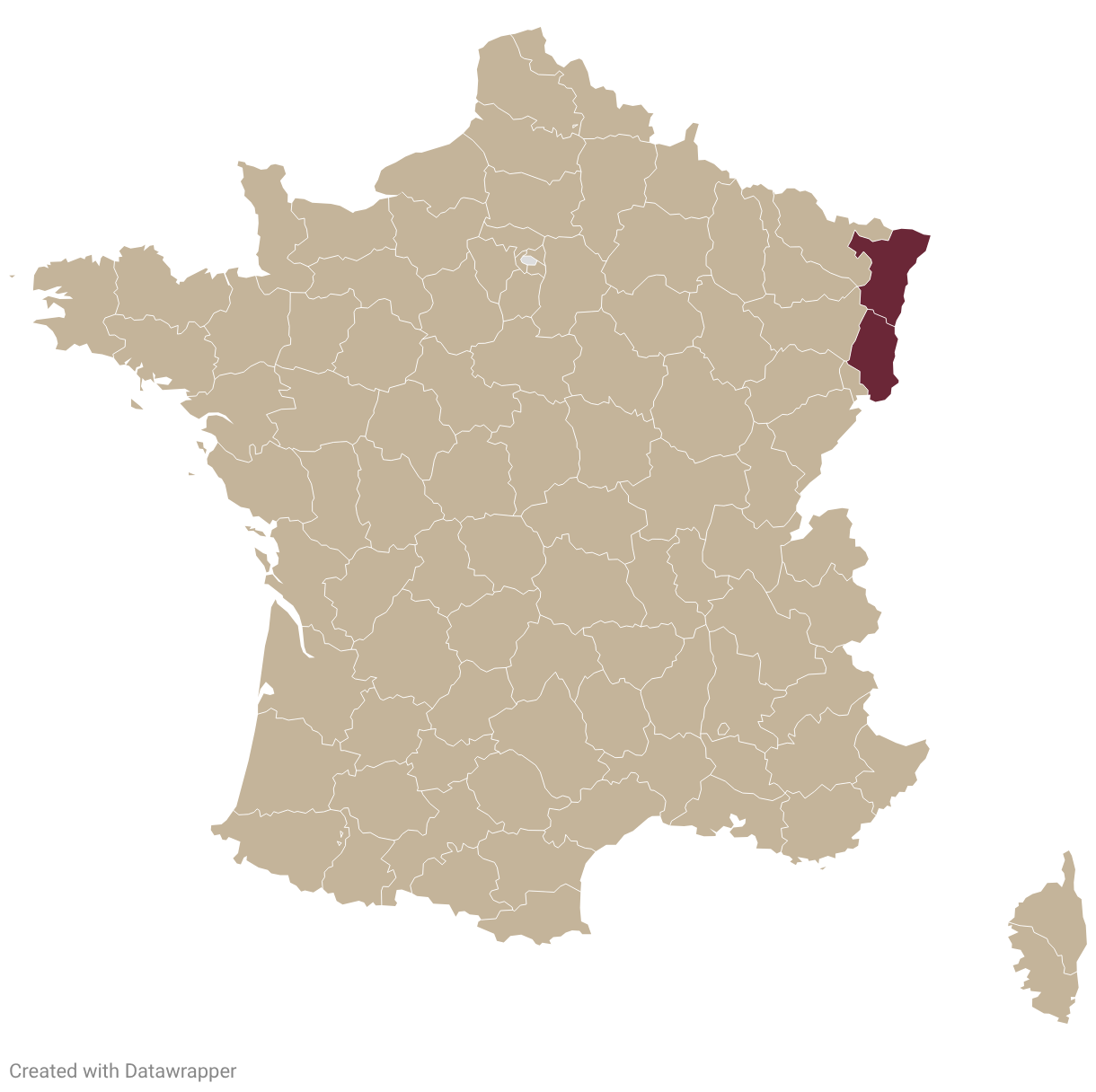
The Vosges Mountains, running north to south along Alsace’s western border, are the region’s defining geographic fact. They block the Atlantic moisture that drenches the rest of France, creating a rain shadow so pronounced that Colmar, in the heart of Alsace, receives just 607 mm of annual rainfall — drier than many Mediterranean wine regions. This continental semi-aridity, combined with warm summers and lingering autumns, allows Riesling, Gewürztraminer, and Pinot Gris to ripen fully while retaining the acidity that makes them age-worthy. The climate alone distinguishes Alsace from other northern European wine regions; the geology refines that distinction into something singular. The 51 Grand Cru parcels sit on radically different soils: granite and sandy marl in Brand (Turckheim), limestone and calcareous clay in Hengst (Wintzenheim), volcanic basalt in Rangen de Thann, schist in Kastelberg. A geologist moving between Alsace Grand Cru sites would recognize a catalog of mineral identities as varied as any wine region in France. That geological diversity — compressed into a strip barely 170 kilometres long — is the engine of Alsace’s expressive power.
This is Alsace’s deeper definition: a region where two neighboring vineyards, separated by 200 metres of elevation or a change in underlying rock type, will produce wines that taste of entirely different geologies. A Riesling from granite-based Brand carries mineral weight and a slight salinity that reflects its bedrock. A Riesling from limestone-based Hengst carries rounder textures and higher-toned minerality. Neither is “better” — they are precise expressions of place, structured by soil and subsoil in ways that go beyond fashion or winemaker preference. That fidelity to site, that refusal to blur regional identity into a single house style, is Alsace’s defining contribution to world white wine. The region asks not “What is the most commercial wine we can make?” but “What does this specific parcel of land, in this year, under these conditions, have to say?” That conversation between soil and vine is what gives Alsace its authority and its longevity.
“Alsace is one of the great white wine regions of the world, yet it remains curiously underappreciated.”
— Hugh Johnson, The World Atlas of Wine
The Appellations
Three tiers from generic to Grand Cru—each expressing the geology of a different slope along the Vosges foothills.
Prestige
Alsace Grand Cru
Fifty-one named parcels, each tied to a specific soil type. The Grand Cru designation demands lower yields and single-variety planting, producing wines of concentration and site specificity.
Riesling · Gewurztraminer · Pinot Gris · Muscat
Regional
Alsace AOC
The broadest appellation, covering the full range of Alsace varietals across the foothills and plains. The best village-level producers here rival Grand Cru estates at a fraction of the price, making Alsace AOC one of France’s strongest value tiers.
Riesling · Gewurztraminer · Pinot Gris · Pinot Blanc · Muscat · Sylvaner
Sparkling
Crémant d'Alsace
France’s second-largest sparkling appellation after Champagne. Made by the traditional method from Pinot Blanc, Auxerrois, and Pinot Gris, offering Champagne-comparable structure at a third of the price.
Pinot Blanc · Auxerrois · Pinot Gris · Riesling · Pinot Noir
Last updated: April 2026
Related Stories
Explore TERROIR’s coverage of Alsace — appellations, producers, and vintages worth knowing.
The next one arrives Thursday.
Vintage intelligence, producer profiles, and curated cellar picks — before the critics weigh in. Weekly dispatch.