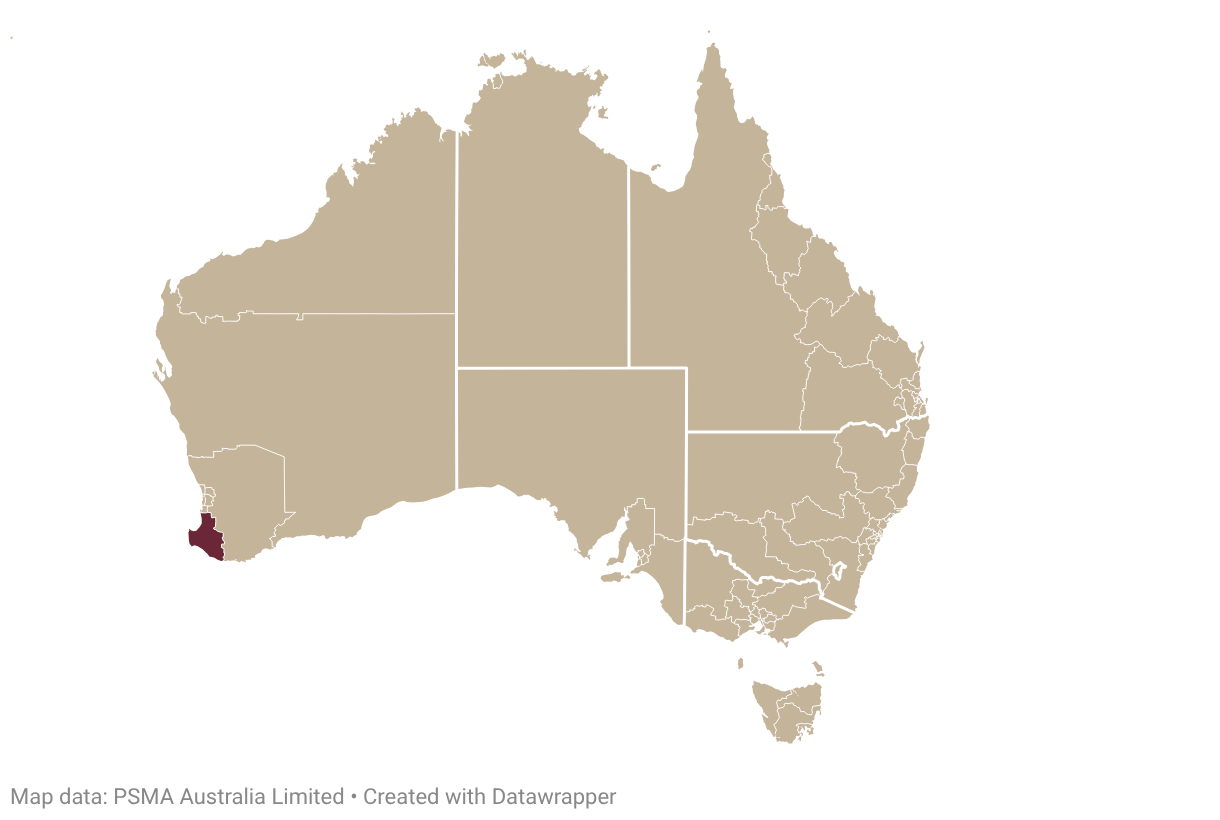
Margaret River
Western Australia’s crown jewel, where Cabernet Sauvignon achieves a graceful balance between New World richness and Old World restraint.
2
·
Cool Maritime
·
5,200+
·
1967
VARIETIES
Cabernet Sauvignon · Chardonnay · Sauvignon Blanc · Merlot · Shiraz
One name launched Margaret River into the world’s wine consciousness: Dr. John Gladstones, an agronomist at the University of Western Australia, whose 1966 research paper identified the region’s extraordinary potential. Gladstones had mapped the climate with precision, comparing Margaret River’s maritime influence, mild winters, and reliable dry summers directly to Bordeaux. His analysis was not idle scholarship. Tom Cullity, a Perth cardiologist, read the paper and acted. In 1967, he planted the first commercial vineyard at Vasse Felix on the Leeuwin-Naturaliste Ridge. Others followed swiftly: Moss Wood in 1969, Cape Mentelle in 1970, Cullen in 1971. These were not speculative ventures but calculated responses to scientific evidence. Within four years, a founding generation had assembled that would define premium Australian wine for the next fifty years.
That founding generation transformed a remote peninsula into an international standard. They chose to make wines that age, that demand cellaring, that announce themselves not through aggressive fruit but through mineral tension and structural integrity. This was a deliberate counter-movement against the trajectory of Australian winemaking elsewhere. While South Australia pursued volume and accessibility, Margaret River’s pioneers built an identity rooted in restraint and longevity. Today, fifty-eight years on, that choice still reverberates. The region produces less than three percent of Australia’s wine but accounts for over twenty percent of its premium volume, a ratio that speaks less to luck than to a collective refusal to chase trends. Vasse Felix’s Heritage Release, Cullen’s biodynamic Cabernet-Merlot, Moss Wood’s benchmark Cabernet, and Leeuwin Estate’s Art Series Chardonnay remain the wines by which Australian ambition is measured.
Isolation as Inheritance
Margaret River sits 270 kilometres south of Perth, accessible only by roads winding through forest and farmland. The geographic isolation that once seemed a liability has proven its inverse: a quality moat. Remote from the commercial pressures of eastern Australia’s bulk wine industry, producers here built a culture around craft over commerce. The isolation reinforced restraint. These wines don’t announce themselves with the voluminous fruit of warmer regions; instead, they earn attention through structure, mineral precision, and an expectation of patience. For over five decades, that remoteness has functioned not as a constraint but as a protection, a buffer against the cycle of fashion and quantity that has reshaped Australian wine elsewhere.
Yet isolation contains its own productive tension. Margaret River produces tiny volumes relative to its reputation. The region’s 5,200 hectares and modest annual output stand in striking asymmetry to its standing in the world’s premium wine markets. This disparity, between geographic remoteness, limited scale, and outsized influence, has become the region’s defining paradox. It cannot expand to meet demand without compromising the identity that created the demand in the first place. Cabernet Sauvignon remains the lens through which the world views Margaret River, though the region’s Chardonnay increasingly challenges that hierarchy. The Bordeaux comparison still defines regional conversation, yet Margaret River’s maritime character produces wines that are precisely neither Bordeaux nor Australian in the conventional sense. They occupy a singular space, neither wholly European nor wholly colonial. That ambiguity is the region’s greatest asset.
The Language of Ancient Granite
Beneath every Margaret River vineyard lies bedrock of gneiss and granite, among the oldest geological formations on earth. The Precambrian basement erupts in weathered gneiss and decomposed granite, creating low-fertility soils that frustrate conventional agriculture. For the vines, this poverty is precisely the point. Nutrient scarcity forces root systems deep, driving concentration into small berries. The result is a mineral precision that richer soils cannot achieve. Around these ancient stones, lateritic gravels and ironstone accumulate, materials that drain with exceptional speed, allowing the maritime influence to moderate rather than overwhelm. The Wilyabrup subregion, in the warmer north, produces structured, age-worthy Cabernets from these red gravels over granite; the Wallcliffe subregion, cooler and closer to the Southern Ocean, yields more restrained Chardonnays and mineral-driven whites with citrus freshness.
The Indian Ocean moderates daily, and the Southern Ocean moderates seasonally, a dual maritime influence found nowhere else at this latitude in Australia. The sea breeze arrives each afternoon during the growing season, cooling the canopy and extending ripeness into autumn without pushing sugars beyond balance. Frost is virtually non-existent; excessive heat is buffered. It is a climate of equilibrium, not exuberance. The region’s Cabernet Sauvignon develops a signature profile of cassis and cedar with a distinctive saline mineral lift, a maritime imprint that no other Australian region reliably reproduces. Chardonnay achieves Burgundian tension: weight balanced against cutting acidity, richness tempered by precision. Sauvignon Blanc and Sémillon, often blended in the tradition of Pessac-Léognan, gain a textured complexity and age-worthiness rare in Australian white wine.
Margaret River’s terroir speaks a language of constraint and balance, the opposite of the generous, exuberant expression that dominates much contemporary Australian wine. For TERROIR, this restraint is precisely the point. A region’s character emerges not from what it proclaims but from what it refuses to do. Margaret River refuses easy fruit, refuses quantity, refuses to compete on any terms but its own. In that refusal lies its identity, and in that identity lies its future. The oldest soils on earth produce wines built for decades, not seasons.
“If Cabernet Sauvignon is the king of grapes, Margaret River is its castle in the Southern Hemisphere.”
— James Halliday, Wine Companion
The Sub-Regions
From the warm red gravels of Willyabrup in the north to the cooler, ocean-influenced soils of Yallingup — Margaret River’s two informal districts each offer a distinct expression of the region’s Bordeaux-influenced character.
Prestige
Willyabrup
Margaret River’s northern prestige zone, celebrated for powerful, structured Cabernet Sauvignon and Bordeaux blends. Warmer inland soils over red gravel and granite bedrock produce wines of natural ripeness, mineral grip, and remarkable longevity — home to Cullen, Moss Wood, and Vasse Felix.
Cabernet Sauvignon · Merlot · Chardonnay · Shiraz
Premier
Yallingup
The cooler northern district shaped by direct ocean exposure and clay-loam soils over limestone. Produces some of Margaret River’s most refined Chardonnay and Sauvignon Blanc–Sémillon blends, balancing the region’s characteristic richness with crisp maritime freshness and precise acidity.
Chardonnay · Sauvignon Blanc · Cabernet Sauvignon · Shiraz
Last updated: April 2026
Related Stories
The latest from our Margaret River coverage.